AI isn't just a thing of the future anymore; it's changing how businesses work right now. From handling customer service to writing code on the fly, AI is becoming a key part of the workplace.
There's a downside, though. The majority of AI runs on cloud servers, leading to delays, monthly fees, and worries about security.
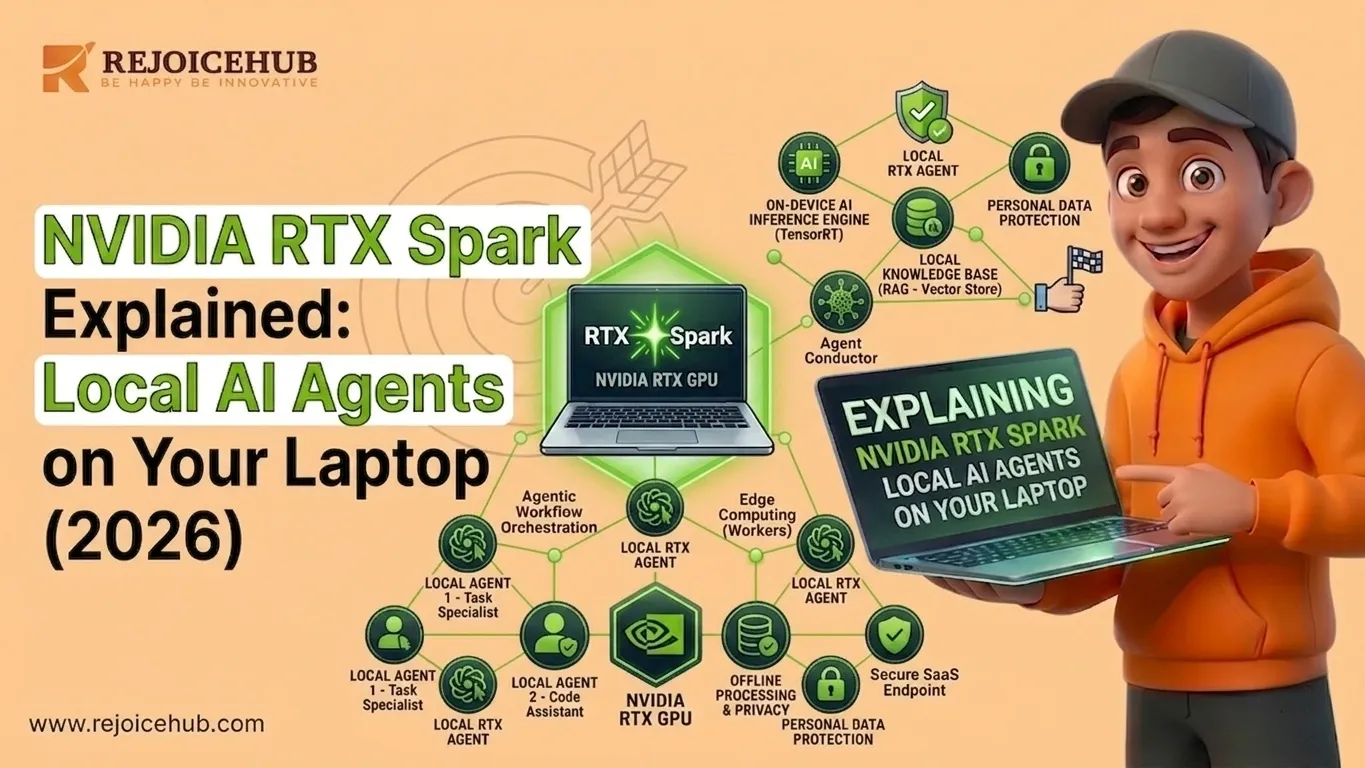
That's where NVIDIA RTX Spark comes in. Unveiled at Computex 2026, this superchip will bring top-notch, local AI processing right to your computer, cutting out those pesky cloud problems entirely. If you're exploring how this fits into a broader strategy, it helps to first understand what agentic AI really means for modern businesses.
What Is NVIDIA RTX Spark?
NVIDIA RTX Spark, a new superchip or platform, redefines Windows PCs for an age filled with personal AI helpers. Introduced officially by NVIDIA alongside Microsoft on May 31, 2026, it pairs an Arm-based CPU with a next-gen Blackwell GPU in one efficient package.
At Computex 2026, Jensen Huang, NVIDIA's CEO, hailed RTX Spark as "the new PC." This really shows how much NVIDIA believes in local AI taking over personal computing.
Its main idea is straightforward yet robust. Rather than sending AI tasks to the cloud, RTX Spark processes them right on your laptop. This tech offers impressive specs 1 petaflop AI power, up to 128GB of unified memory, and access to the whole NVIDIA CUDA and RTX system.
Essentially, it turns your laptop into a powerhouse, boasting data center-level smarts but with long-lasting battery life in a thin frame.
Key specs at a glance:
- 1 petaflop of AI compute power on-device
- Up to 128GB unified memory (competitive with Apple's highest-end silicon)
- Arm-based CPU + NVIDIA Blackwell GPU in one superchip
- Full CUDA, RTX, DLSS, TensorRT, and OptiX support
- Designed for slim laptops and compact desktop PCs
- Devices shipping fall 2026 from ASUS, Dell, HP, Lenovo, Microsoft Surface, MSI, Acer, and GIGABYTE
NVIDIA RTX Spark isn't just a faster chip; it's an entirely new AI-first computing platform built around the idea that your PC should work with you as an intelligent teammate, not just as a passive tool.
How Does NVIDIA RTX Spark Work?
AI Processing on Device
RTX Spark's magic is local inference running AI models right on your device, no remote server needed. At its heart, the RTX Spark Superchip uses GPU acceleration with NVIDIA's Blackwell architecture.
This setup is perfect for the matrix multiplications AI needs. It also supports FP4 precision, slashing memory use and boosting speed without losing crucial accuracy.
This matters for business users because it means:
- Your AI agent responds in milliseconds, not seconds
- Your data never leaves your device
- You don't pay per-query API costs to a cloud provider
Hardware and Software Integration
RTX Spark is more than just about hardware; its full software stack makes it practical for real-world AI tasks. The NVIDIA CUDA, which drives most of today's AI, runs natively on RTX Spark. This means all those AI tools and models, already optimized for CUDA, work perfectly right out of the box.
On top of that, RTX Spark integrates:
- NVIDIA TensorRT for high-performance AI model inference
- NVIDIA DLSS for AI-powered upscaling and rendering
- NVIDIA OptiX for ray-traced graphics
- Deep integration with Windows on Arm, co-developed with Microsoft
- Support for popular AI frameworks, including PyTorch, vLLM, and Llama.cpp
Microsoft and NVIDIA are also collaborating to build Windows-native agentic AI capabilities, meaning your operating system itself will be capable of orchestrating agentic AI workflows locally making RTX Spark systems purpose-built AI computers, not just fast laptops with AI tacked on.
How NVIDIA RTX Spark Enables Agentic AI
-
Understanding Agentic AI
Agentic AI isn't about responding to prompts; it's about acting on its own to meet certain goals. Unlike a chatbot that tackles one question after another, an AI agent sets its own smaller goals to reach a bigger objective. It can also call on outside tools, check how good its output is, and keep tweaking until it gets the job done.
This type of multi-step reasoning makes AI agents super useful for business purposes. For instance, a sales automation agent won't just draft an email. It does way more it researches the prospect, makes the message personal, arranges follow-up calls, and tracks the activities in your CRM. All of this happens without you having to intervene at each step.
-
Why Local AI Agents on Your Laptop Matter
Running agentic AI locally rather than in the cloud gives businesses three key benefits:
First, it offers faster response times. When using cloud AI, there's an extra delay each time the AI processes info. Yet, with RTX Spark, the AI thinks super quickly right on the device in milliseconds. That speed really matters for real-time stuff like coding helpers, front-line chat support, or live writing apps.
Second, it enhances privacy. Sending data to cloud services can raise issues, especially for fields like health care, law, and finance. Having local AI means sensitive info stays inside your own device. This way, you keep control over your info and dodge those pesky compliance worries.
Startups and small businesses can get all that zippy speed, private handling of info, and always-working dependability without pricey cloud fees. It's a big edge for them in the market especially when you consider the real benefits of AI for business at scale.
Real-World Use Cases of NVIDIA RTX Spark
1. AI Coding Assistants
Today, developers using AI coding tools commonly face lag because the model accesses a remote server. RTX Spark changes that by running the AI coding assistant right on the developer's machine.
This leads to real-time autocomplete, instant code generation, and local debugging support. It even lets you run big models like Llama 3 (70B+ parameters) locally, no cloud subscription required. So, software teams can expect quicker shipping cycles.
2. Business Automation Agents
Business process automation is one of the highest-ROI applications for agentic AI. An RTX Spark-powered system could run a local automation agent that:
- Monitors your inbox and drafts replies
- Summarizes meeting transcripts and updates your task manager
- Pulls reports from your CRM and generates weekly summaries
Because it runs locally, it can integrate with on-premise tools and databases that cloud AI agents can't access a major advantage for enterprise environments. Teams looking to get started can explore how to deploy AI agents without an ML team as a practical first step.
3. Customer Support Agents
More customer support teams are turning to AI for handling initial inquiries. Rather than sending data to the cloud, using local AI like an RTX Spark desktop in an ops center helps with privacy and cuts costs by avoiding API fees.
The local system handles basic questions without lag, and there are no monthly charges that rise with usage. For a deeper look at this space, the AI customer support automation guide covers practical deployment approaches worth reviewing.
4. Personal Productivity Agents
Founders and knowledge workers can use local AI agents for business automation on RTX Spark to boost productivity. Picture an agent that checks your calendar, researches meeting attendees before calls, and sums up docs as you open them. Plus, it crafts follow-ups the second your call ends without hogging cloud resources.
This aligns with NVIDIA's view of PCs evolving "from tool to teammate." And that's more than just marketing fluff; it's really a big shift in computing architecture.
NVIDIA RTX Spark vs. Cloud-Based AI
A common question: Is local AI actually better than just using a cloud service?
The honest answer is: it depends on your use case. But for most business applications where latency, privacy, and cost predictability matter, RTX Spark has clear advantages.
| Feature | RTX Spark (Local) | Cloud AI |
|---|---|---|
| Speed | Near-instant (on-device) | Dependent on internet connection |
| Privacy | High data stays on the device | Variable data sent to third-party servers |
| Cost Model | One-time hardware purchase | Ongoing subscription / per-token billing |
| Offline Use | Yes, fully functional offline | No requires an internet connection |
| Customization | Full control over models | Limited to provider's available models |
| Scalability | Fixed to device capacity | Easily scales up via the provider |
Is RTX Spark better than cloud AI?
RTX Spark has real advantages for latency-sensitive, privacy-critical, or high-frequency tasks compared to cloud AI. But for jobs needing tons of computing power or allowing multiple users to share AI resources, cloud AI is still better. So, the best setup for many companies probably involves both local agents for daily tasks and cloud AI for the heavier workload. Understanding how AI agents can automate your workflows will help you figure out where that line falls for your team.
Best Laptops for AI Agents in 2026
RTX Spark devices are expected to ship in fall 2026, and the lineup of hardware partners is honestly pretty impressive. Here's what you can kind of expect across different user types:
-
For Creators and Developers
ASUS and MSI are both confirmed RTX Spark partners, and both have a track record of building laptops for creators. So expect thin, premium machines with high-refresh displays, great build quality, and that RTX Spark Superchip sitting in there. These will likely be the everyday picks for developers who want to build and run AI agents locally basically "agent workstations" in a portable form.
-
For Enterprise and Business Users
Dell, HP, and Lenovo the usual enterprise laptop trio are all bringing RTX Spark devices to market. You should see the usual business goodies: security certifications, support contracts, plus management tooling that IT teams typically ask for. If a company is planning to build an AI agent stack for business and deploy it across a group of people, these are the machines to keep an eye on.
-
For the Microsoft Ecosystem
Microsoft Surface devices powered by RTX Spark should deliver the most deeply integrated Windows-native AI experience, mostly because Microsoft and NVIDIA are co-developing. If you're already pretty locked into Microsoft 365 and you want local AI agents that play nicely with Windows, Surface RTX Spark models are worth serious consideration right away.
-
For Budget-Conscious Buyers
Acer and GIGABYTE are also making RTX Spark devices, and they tend to land at more accessible price points than the premium crowd. This makes them a decent fit for startups and SMBs that want local AI capability without paying the "Dell XPS or ASUS ProArt tax."
One of the most important things to check on any RTX Spark laptop is the unified memory capacity.
Conclusion
NVIDIA RTX Spark feels like a real turning point for how companies will end up using AI not just "in theory" but day-to-day.
By shifting AI inference off the cloud and onto the actual device, RTX Spark helps deliver quicker response times, better data privacy, and more predictable expenses, all while still keeping the muscle you need for serious agentic AI workloads.
For startup founders, SaaS crews, and ops teams that are looking at AI agents, the question doesn't really stay "should we adopt agentic AI?" anymore. It's more like, how do we roll it out in a way that is fast, secure, and budget-friendly? When RTX Spark devices show up in fall 2026, putting local AI agents into production should feel way more practical than it has been.
Frequently Asked Questions
1. What is NVIDIA RTX Spark?
NVIDIA RTX Spark is a superchip announced at Computex 2026 that combines an Arm-based CPU and a Blackwell GPU in one package. It lets your laptop run powerful AI models locally no cloud, no internet needed. Jensen Huang called it "the new PC," and that really says it all.
2. What is NVIDIA RTX Spark used for?
NVIDIA RTX Spark is mainly used for running AI agents directly on your device. That includes coding assistants, email automation, customer support bots, and personal productivity tools. Because it works offline and keeps your data on-device, it's especially useful for businesses that care about privacy and response speed.
3. How does NVIDIA RTX Spark work?
RTX Spark processes AI tasks right on your laptop using NVIDIA's Blackwell GPU architecture. It supports FP4 precision to handle large AI models efficiently. It also works with tools like PyTorch, TensorRT, and llama.cpp, so your existing AI software runs smoothly without any cloud connection involved.
4. How does NVIDIA RTX Spark enable agentic AI?
RTX Spark gives your laptop enough power to run multi-step AI agents locally. These agents don't just answer questions; they set goals, use tools, and finish tasks on their own. Think of an agent that researches a client, writes an email, and logs it in your CRM, all without your help.
5. What are the best laptops for AI agents in 2026?
RTX Spark laptops from ASUS, Dell, HP, Lenovo, Microsoft Surface, MSI, Acer, and GIGABYTE are expected in fall 2026. For developers, ASUS and MSI are strong picks. Enterprise users should look at Dell, HP, or Lenovo. Budget-conscious buyers may prefer Acer or GIGABYTE for solid local AI capability at a lower price.
6. Is running local AI agents on a laptop better than using cloud AI?
It depends on what you need. Local AI agents on a laptop like RTX Spark are faster, more private, and cost less over time since there's no per-use billing. Cloud AI still wins for heavy workloads or team-wide scaling. For most day-to-day business tasks, though, local AI makes more practical sense.
7. When will NVIDIA RTX Spark devices be available?
NVIDIA RTX Spark devices are expected to ship in fall 2026. Multiple brands, including Dell, ASUS, HP, Lenovo, Microsoft Surface, MSI, Acer, and GIGABYTE, are confirmed hardware partners. If you're planning to build a local AI setup for your team or personal use, fall 2026 is the window to watch.