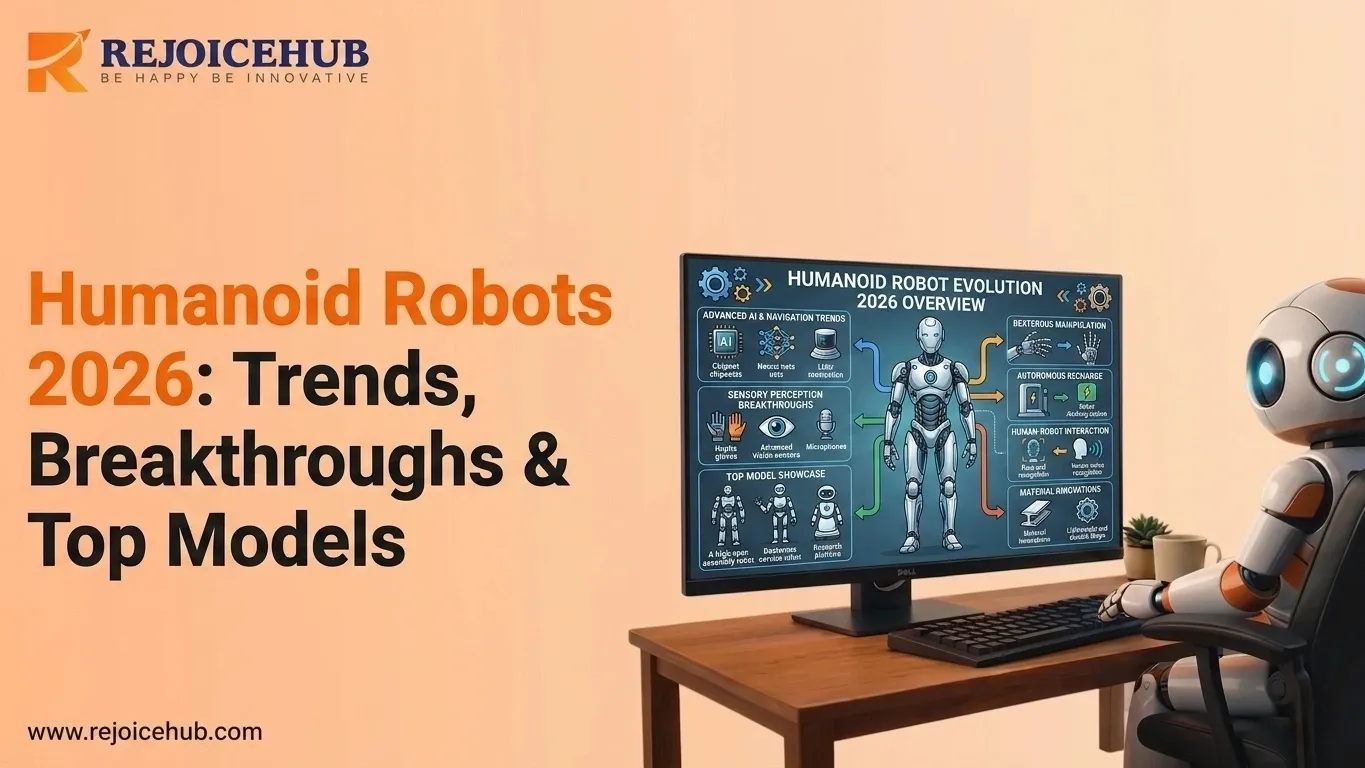
 A robot just completed a half-marathon race. Another one defeated a professional table tennis player. Currently, thousands of humanoid robots work without breaks to stack shelves, assemble parts, and assist patients.
Humanoid robots 2026 isn't a science fiction headline. The actual events are progressing faster than business leaders planned.
The global humanoid robotics market is projected to exceed $3.7 billion in 2026, and enterprise adoption is accelerating at a pace that's making decision-makers sit up and pay attention. The reason? The combination of AI with existing hardware has reached sufficient development to meet current demands. If you're trying to understand where this fits in the bigger picture, our breakdown of differences between robotics and AI is a great starting point. The combination of advanced machine learning systems with flexible physical equipment produces robots that can function together with humans in authentic work settings.
This guide provides essential information about humanoid robots, which includes their definition and operation, current industry leadership, and the advantages they bring to your company.
What Are Humanoid Robots?
Humanoid robots function as self-operating machines that replicate human physical characteristics, human body movements, and human decision-making abilities. Their human-like design includes two arms and two legs, a torso, and a head, which allows them to function in spaces that people have created.
A humanoid robot is a robotic system with a human-like physical form and AI-powered intelligence that enables it to work in unpredictable settings without requiring continuous human oversight.
How Are They Different from Industrial Robots?
People imagine factory robots as large permanent machinery that uses welding arms to assemble automotive frames. The machines described as industrial robots exist to perform a single specific task which they execute in a controlled setting.
AI humanoid robots are fundamentally different:
- Mobile: they move through spaces, navigate stairs, and open doors
- Adaptive: they adjust to new tasks without reprogramming
- Interactive: they collaborate with humans in shared workspaces
- General-purpose: one robot can do dozens of different jobs
The Role of AI in Modern Robotics
The functioning of the humanoid robot depends on sophisticated machine learning because it only acts as a costly dummy without this technology. The current artificial intelligence system enables robots to perceive their surroundings while using their reasoning abilities to make decisions and execute tasks within unpredictable real-world conditions.
The year 2026 stands apart from other years because of its unique characteristics. The artificial intelligence technology has reached a level of development that enables humanoid robots to function effectively as practical tools across various applications.
How Humanoid Robots Work
Your decision-making might just be made better through a better grasp of the technology.
1. Sensors and Computer Vision
Humanoid robots "see" the world through a combination of sensors:
- Cameras: RGB and depth cameras capture visual data, identify objects, and read environments
- LiDAR: laser-based distance sensors map 3D space with millimeter precision
- IMUs (Inertial Measurement Units): track balance, orientation, and movement speed
- Tactile sensors: fingertip pressure sensors allow delicate manipulation of objects
These systems enable robots to assess their entire environment — identifying obstacles, understanding human presence, and conducting safe interactions with their surrounding space.
2. AI Decision-Making
This is where humanoid robot technology gets genuinely impressive. Modern robots use:
- Machine learning: trained on millions of examples to recognize objects, predict outcomes, and adapt behavior
- Real-time reasoning: onboard AI chips process data in milliseconds, enabling fluid responses to unexpected situations
- AI agents: autonomous software systems that plan multi-step tasks, prioritize goals, and self-correct when something goes wrong
- Multimodal AI: combining vision, language, and motion understanding in a single model
To understand how AI agents work and what they're capable of, it helps to see how they power the decision layer inside these robots. The system enables the robot to understand instructions instead of simply following them.
3. Motion and Robotics Systems
Movement is the hardest part of robotics. Humans take balance for granted; robots have to calculate it continuously.
- Dynamic balance: AI constantly adjusts motor outputs to keep the robot upright on uneven surfaces
- Whole-body motion planning: coordinating dozens of joints simultaneously for natural, efficient movement
- Dexterous manipulation: multi-fingered hands capable of picking up a grape without crushing it or threading a bolt without dropping it
The best humanoid robots in 2026 move with a fluidity that would have seemed impossible just three years ago.
Biggest Robotics Breakthroughs in 2026
This year has delivered some genuinely jaw-dropping milestones.
-
Robot Half-Marathons
In early 2026, Unitree's H1 robot completed a half-marathon in Beijing 21 kilometers on two legs, navigating varied terrain without falling. The performance demonstrated three capabilities through its endurance test, which also showed real-time balance control and autonomous navigation at an unprecedented scale.
It proved that humanoid locomotion has crossed a critical threshold.
-
AI Table Tennis Robots
Google DeepMind developed a robotic table tennis system that achieved media coverage by defeating amateur human players. The robot used three technologies computer vision, physics simulation, and reinforcement learning to track, predict, and return shots during actual match play.
The main lesson businesses need to learn from this does not involve ping pong. It shows that AI-powered robots now possess the ability to perform fast, dynamic precision tasks that require instant decision-making.
-
Multimodal Robotics
The year 2026 introduced robots that possess both linguistic comprehension and functional capabilities. The robot can execute the command "bring me the red box from the third shelf" because it understands the instructions, determines which item to find, moves through the area, and finishes the work without needing any programmed instructions.
Humanoid robots become operational for commercial use through their ability to merge visual processing with language understanding and physical movement.
-
Autonomous Navigation
Indoor navigation systems currently exist at their commercial development peak. Robots from Boston Dynamics, Figure AI, and Tesla can now navigate complex, human-shared environments warehouses, hospitals, retail floors without pre-mapped routes.
Companies Leading the Charge
| Company | Key Robot | Notable Achievement in 2026 |
|---|---|---|
| Tesla | Optimus Gen 2 | Manufacturing deployment at Gigafactories |
| Boston Dynamics | Atlas | Advanced parkour + warehouse trials |
| Figure AI | Figure 02 | BMW factory partnership, expanded tasks |
| Unitree Robotics | G1 / H1 | Half-marathon completion, low-cost scaling |
Best Humanoid Robots in 2026
Here's a quick comparison of the top candidates companies are evaluating right now:
| Robot | Manufacturer | Mobility | AI Capability | Best For |
|---|---|---|---|---|
| Optimus Gen 2 | Tesla | High | Advanced (Tesla AI stack) | Manufacturing, assembly |
| Figure 02 | Figure AI | High | Strong (OpenAI integration) | Logistics, warehouse |
| Atlas | Boston Dynamics | Elite | Strong | R&D, heavy industrial |
| Unitree G1 | Unitree Robotics | Good | Solid | Research, cost-sensitive deployments |
What to Look for When Evaluating Robots
- Enterprise readiness: Does it integrate with your existing systems?
- Task flexibility: Can it handle your specific workflows out of the box?
- AI capabilities: How well does it adapt to new instructions?
- Total cost of ownership: Hardware + software + integration + maintenance
How Businesses Will Use Humanoid Robots
The practical application of work starts at this point. The current deployment of humanoid robots across different industries shows their existing use cases and upcoming market potential.
1. Healthcare
- Patient transport and room preparation
- Medication delivery in hospital corridors
- Assisted living support for elderly patients
- Lab sample handling and sterilization tasks
Labor shortages in healthcare are severe. Robots don't replace nurses they handle the time-consuming physical tasks that pull staff away from patient care. For a broader look at this shift, see how AI is already transforming healthcare operations.
2. Logistics and Warehousing
- Picking, packing, and sorting orders
- Loading and unloading trucks
- Inventory auditing and stock replenishment
- Last-mile handoff support
The sector experiences its fastest growth rate. Companies like Amazon, DHL, and FedEx conduct active tests of humanoid robots. The ROI calculations validate their results because robots decrease error rates while delivering continuous work without needing extra payment.
3. Manufacturing
- Assembly line tasks previously too delicate for traditional robots
- Quality inspection
- Tool handling and component placement
- Flexible production line switching
To see just how deeply this shift is playing out across the industry, it's worth reading about how AI is transforming the manufacturing sector beyond just robotics. Tesla's Optimus has already started executing production tasks in its Gigafactories, with a clear goal of having robots work alongside human colleagues on the floor within five years.
4. Retail and Hospitality
- Shelf stocking and inventory checks
- Cleaning and sanitation
- Customer-facing assistance and wayfinding
- Food preparation support
Retail is another space seeing rapid adoption. The way AI is already being used inside retail stores gives a good sense of where humanoid robots will fit next.
The Bigger Picture: AI-Driven Workflows
The most advanced companies now build their AI systems through the development of operational frameworks, which include humanoid robots as one element of their complete intelligent systems.
The network incorporates AI agents that handle all planning, scheduling, monitoring, and optimization tasks while robots serve as the physical system control component.
If your business is thinking about AI automation and intelligent systems, RejoiceHub specializes in AI agent development and enterprise automation. We help companies build the software infrastructure that makes AI including robotics actually work at scale.
Challenges and the Future of AI Humanoid Robots
Many challenges lie ahead for humanoid robots. Any sincere evaluation must account for these gaps.
-
Cost
The biggest barrier right now is price. The cost of enterprise-grade humanoid robots starts at $30,000 and reaches prices above $250,000. Most SMBs face a major financial challenge because of this, although prices continue to decrease. Unitree's G1 launched at under $20,000, which shows the direction future pricing is heading.
-
Ethics and Workforce Concerns
Workforce displacement is a real concern that businesses need to address honestly. The goal isn't to replace people it's to handle repetitive, physically demanding, or hazardous tasks so human workers can focus on higher-value work. Transparent communication and workforce transition planning will matter as adoption grows.
-
Regulations
The existing regulatory frameworks have not yet completed their development process. The EU AI Act and US OSHA guidelines and sector-specific regulations for healthcare create rules that determine where and how humanoid robots can be used. Companies require legal and compliance guidance to proceed with full system deployment.
-
Safety
Robots need to achieve maximum operational reliability when they work in proximity to humans. The system cannot accept software errors that lead to sudden, unpredictable movements. Complete implementation of thorough testing, dual safety mechanisms, and emergency response systems is non-negotiable.
What Comes Next: 2027 and Beyond
The trajectory is clear:
- 2027: Humanoid robots enter mass production below $15,000 per unit. Consumer applications emerge home assistance, elder care.
- 2028–2030: Enterprise adoption becomes mainstream across logistics, healthcare, and manufacturing. AI-robot collaboration becomes a standard business model.
- Beyond 2030: General-purpose household robots become commercially viable. The line between AI software agents and physical robots blurs into unified autonomous systems.
The businesses that start building their AI automation infrastructure now will be best positioned to integrate robotics seamlessly when the price and capability thresholds cross.
Conclusion
Humanoid robots have moved from research labs to factory floors, hospital corridors, and retail warehouses and 2026 is the year the industry crossed the threshold from "impressive demo" to "real business tool."
The breakthroughs speak for themselves: half-marathons, table tennis, multimodal understanding, and autonomous navigation. The leading platforms Tesla Optimus, Figure 02, Atlas, and Unitree G1 are commercially available and actively deployed. The first industries to adopt will see immediate improvements in operational efficiency, workplace safety, and financial performance.
The robot is not the complete system. The AI behind it is what delivers the real value.
Success in the humanoid robot era depends on more than just purchasing the hardware. Intelligent AI systems including agents, automation workflows, and data infrastructure are what make the machines actually work. Companies that get that right, early, will have a serious edge.
Frequently Asked Questions
1. What are humanoid robots, and how do they work?
Humanoid robots are machines built to look and move like humans, with two arms, two legs, and a head. They use cameras, sensors, and AI to understand their surroundings and make decisions on their own. In 2026, they can follow voice instructions, pick up objects, and work alongside people without constant supervision.
2. What are the biggest humanoid robot breakthroughs in 2026?
Three major things happened this year. Unitree's H1 robot finished a half-marathon in Beijing. Google DeepMind's robot beat amateur table tennis players. And robots from Tesla, Figure AI, and Boston Dynamics started handling real tasks in factories and warehouses, not just controlled test environments.
3. Which are the best humanoid robots available in 2026?
The top models right now are Tesla Optimus Gen 2, Figure 02, Boston Dynamics Atlas, and Unitree G1. Each one suits different needs. Tesla is strong for manufacturing, Figure 02 fits logistics, Atlas handles heavy industrial work, and Unitree G1 is the most affordable option for research or smaller budgets.
4. How much does a humanoid robot cost in 2026?
Prices range from around $20,000 for budget models like the Unitree G1 to over $250,000 for enterprise-grade robots. Costs are dropping faster than expected. By 2027, mass production could push prices below $15,000, making humanoid robots realistic for more small and mid-sized businesses.
5. How are humanoid robots different from regular industrial robots?
Old industrial robots are fixed machines built for one specific job in a controlled space. Humanoid robots are mobile, adaptable, and general-purpose. They can walk through a building, respond to new instructions, and switch between tasks all without being reprogrammed every time something changes.
6. What industries are using AI humanoid robots right now?
Healthcare, logistics, and manufacturing are leading early adopters. Hospitals use robots for patient transport and medication delivery. Warehouses use them for picking and packing orders. Factories like Tesla's Gigafactories have already started using humanoid robots on actual production lines alongside human workers.
7. Are humanoid robots safe to work around humans?
Safety is a top priority and still an active challenge. Robots go through extensive testing, use dual safety systems, and have emergency stop mechanisms built in. The goal is zero unpredictable movement near people. As AI humanoid robot technology matures, safety standards and regulations from bodies like OSHA and the EU AI Act are also catching up.