
Let's you understand from basics, when I initially began collaborating on AI projects three years back, I was a complete beginner and made the very best mistakes. I observed how companies were using millions to get the best AI tools, and those tools were not even used for six months to a year. There was excitement, but there were no actual returns. Not that much, anyway.
The plain truth is that the competition for AI adoption among companies is a reality, but a lot of them are having a hard time proving its worth. Recent research suggests that despite 77% of firms either using or looking into AI, a staggering 42% of AI initiatives fail to reach their anticipated outcomes. That is nearly a 50% failure rate across the board.
What is AI ROI? Understanding the Fundamentals
Before we examine, let us first make sure that we are on the same wavelength in terms of the subject matter.
The concept of traditional ROI is very straightforward. You put in $100, and you are given $150 in return, and that is it, you have made a 50% profit. The calculation is very simple: take your net profit, subtract the total amount invested, divide by the investment, and multiply by 100. No hassle with numbers.
The reason is, when you purchase a traditional tool, it operates the same as it did initially after 100 days. AI is not like that, though. AI models do not remain static-they learn, they change, and at times they even lose their power to an extent after a period of time.
Hard ROI vs. Soft ROI: Two Sides of the Same Coin
When it comes to picking the winners of an AI investment, it is kind of like two birds with one stone.
Hard ROI is really the most recognizable part of the whole story. These benefits are so direct and certain that they regularly appear in your financial records.
The calculation of soft ROI is even more difficult but just as crucial as hard ROI. After all, these are the invisible gains that eventually become visible through the passage of time.
What I have drawn from this is that hard ROI alone is not enough to view the whole picture. Always measure the dollars saved, but also consider how AI is transforming your firm, which cannot be quantified right away.
Key Drivers of AI ROI: Where the Real Value Comes From
I would like to tell you something that really surprised me. To the majority of people, the first thought when they consider the ROI of AI is "cost-cutting" right away. Really, the automated systems are money savers. However, the highest benefits usually come from hidden places.
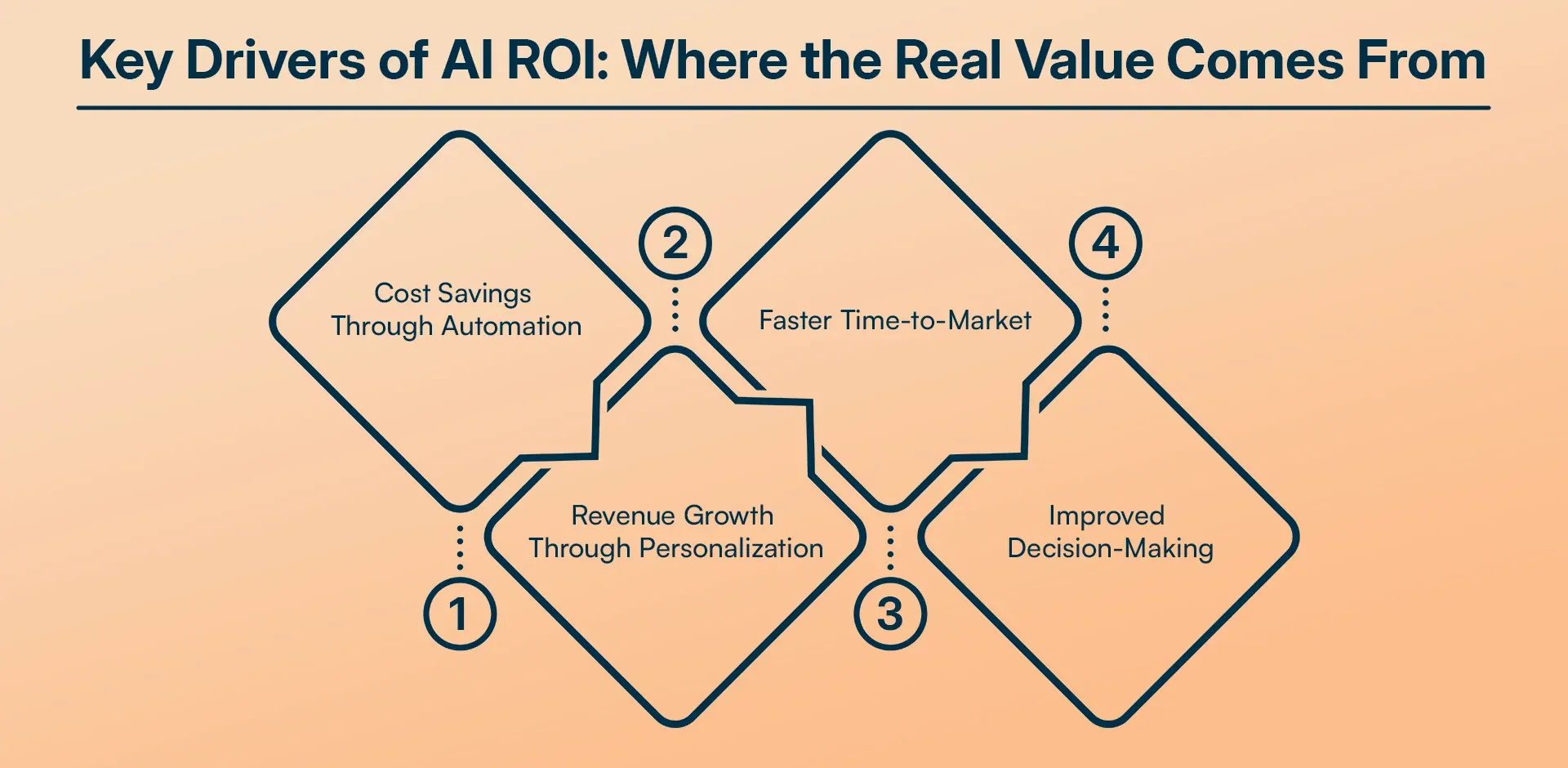
1. Cost Savings Through Automation
That is the main point, and it is still significant. AI is very good at removing repetitive and time-consuming tasks from the team's workload. Invoicing, data entry, or routine customer service inquiries, when processed automatically, you save not only the labor cost but also the creativity and judgment-based work of your human resources.
2. Revenue Growth Through Personalization
This is the point at which the fun starts. AI-driven personalization can upsell by 10-30% in the case of retail and e-commerce. If Netflix shows you love to watch or Amazon recommends things you never thought you needed, you are having an AI ROI experience.
One of the main attractions of such a method is that it builds up. A happy customer is a customer who will make more purchases, and, in turn, more data will be generated that will help your AI to make even better recommendations; that is an ethical cycle.
3. Faster Time-to-Market
Here's a driver that frequently gets disregarded. AI is capable of compressing the product development cycles from several months to just a few weeks. In the area of pharmaceuticals, AI is speeding up the process of drug candidate selection for researchers. In the case of software, AI is assisting in generating and testing code. In manufacturing, AI is optimizing design iterations.
4. Improved Decision-Making
Perhaps, this is the most unnoticed factor that drives AI for ROI. When predictive analytics can inform you about the customers who are likely to leave, the products with the highest turnover rate, or the marketing strategies that would be most successful, you end up making better decisions. Making better decisions results in reduced waste, increased revenue, and improved strategic positioning.
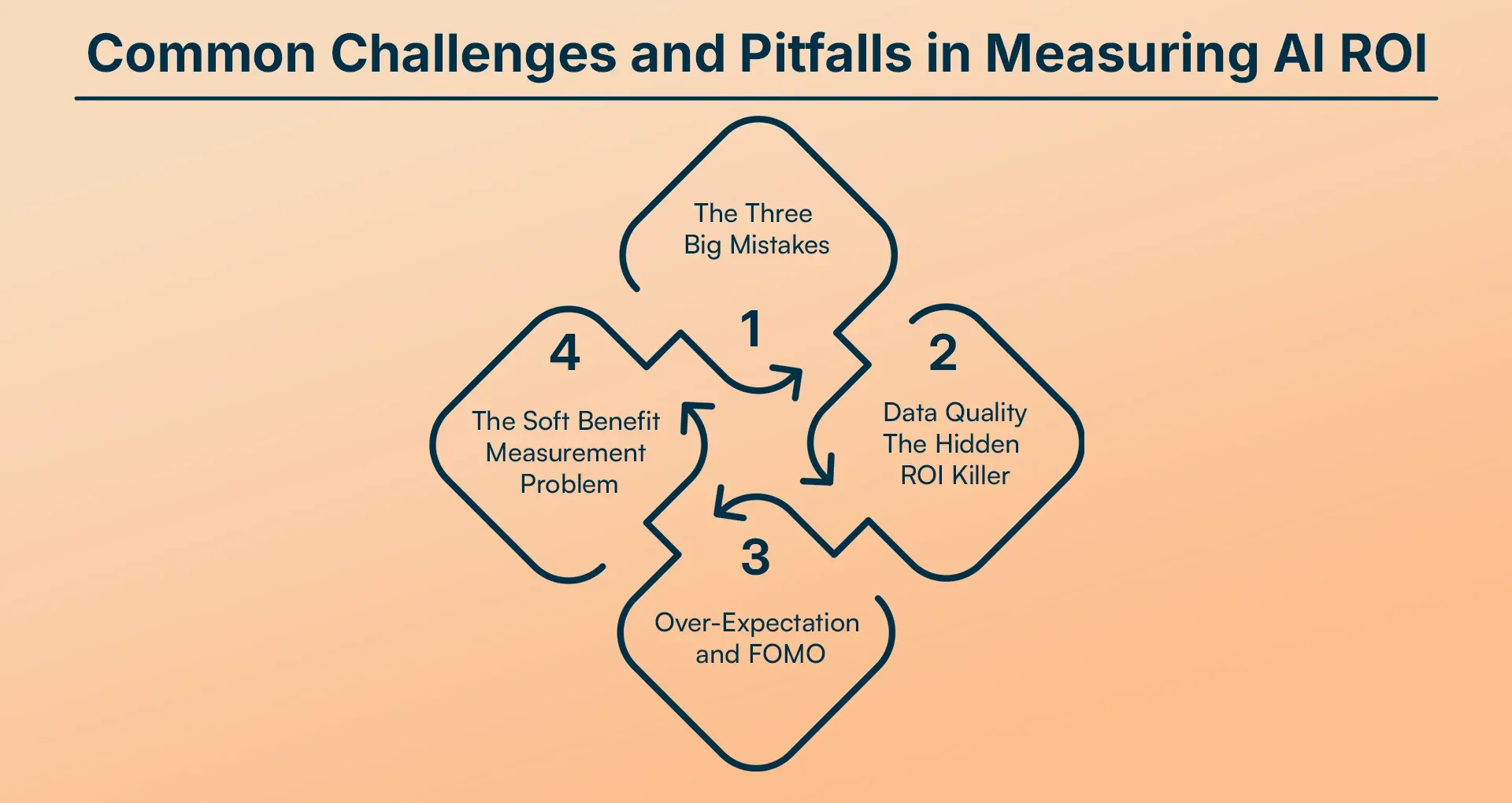
Common Challenges and Pitfalls in Measuring AI ROI
Some of the common challenges and causes of measuring ROI in AI that help you avoid making mistakes which has been described as follows:
-
The Three Big Mistakes
The research by PwC has pointed to three main mistakes that are responsible for the low returns on investments in AI, and I personally have been a witness to all three of them.
Then they go on to treat each project as being separate and isolated from others. They calculate the ROI for every AI project individually, not taking into account how they might interact with each other. There are times when Project A does not appear very promising by itself, but it is the very project that enables B to take off and reap the major returns. Hence, thinking in terms of a portfolio is very important.
-
Data Quality: The Hidden ROI Killer
There is one unpleasant truth that no one wants to listen to: a majority of the companies allocate 60-80% of their total AI project time for data preparation. This is not the phase of developing the fantastic models; it is the phase of cleaning the disorganized spreadsheets, integrating the disconnected systems, and correcting the quality issues with the data.
And what do you know? All that time is money, and that directly affects your ROI AI calculations. If you allocated $100,000 for an AI project but $80,000 only on data preparation, your real investment is significantly higher than what you had planned.
-
Over-Expectation and FOMO
I have seen businesses hurrying into AI because that is what everybody is doing. They bypass the basic principles, overlook the fact of whether AI really answers their issue, and use the technology just for the sake of it.
What comes out of it? Inexpensive mistakes that could be avoided by merely asking: "Is AI truly the best solution for this issue, or are we just scared of not being up to date?"
-
The Soft Benefit Measurement Problem
How is better employee satisfaction measured? How is better strategic agility quantified? These so-called "soft" benefits are indeed real and valuable, yet it is not easy to assign a monetary value to them.
Successful companies in this area resort to using proxy measures. Employee retention rate is one of the indicators that is measured as a proxy for employee satisfaction. Another measure taken is decision speed and quality, which are considered as something for strategic agility. Then, a comparison of the market positioning before and after the use of AI is made.
The process is not perfect, but it is surely better than completely overlooking these advantages.
Also Read: AI in Banking Explained: Benefits, Use Cases & Trends
How to Measure and Track AI ROI: The Practical Guide
Measuring and tracking AI ROI means that how much value your AI projects will also save time, reducing costs or increasing revenue.
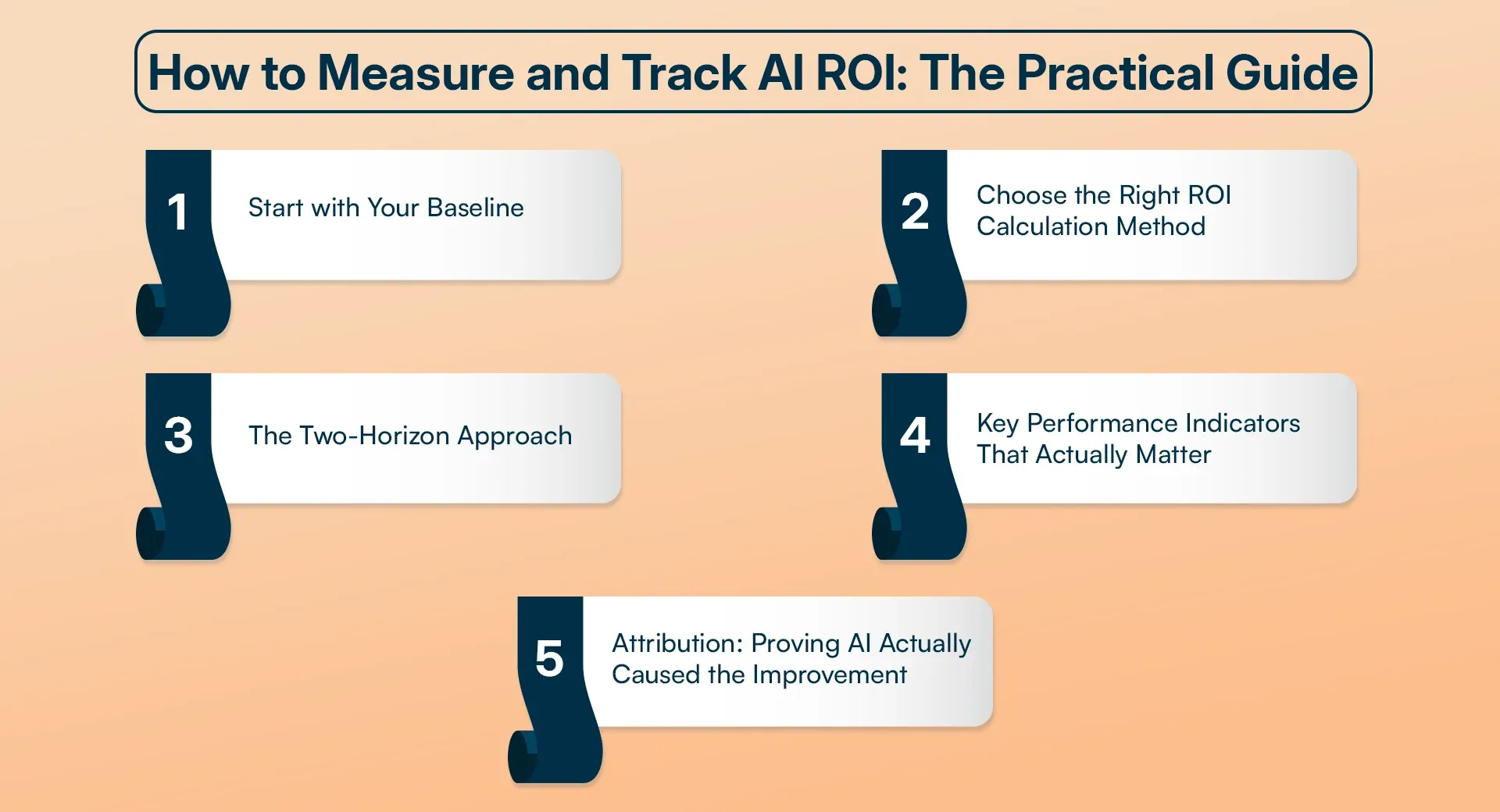
1. Start with Your Baseline
Before applying any AI solution, it is essential first to know the situation. What are the costs incurred at the moment? How satisfied are your customers currently? What is the time taken for the current process?
I cannot emphasize enough this point: not having baseline metrics established will result in your inability to demonstrate that AI has given value. You will be in the position of saying "things feel better" rather than "we cut down processing time by 47%."
2. Choose the Right ROI Calculation Method
The straightforward ROI calculation method is suitable only for straightforward projects, but one has to rely on complex methodologies for thorough AI investment evaluation.
The Net Present Value (NPV) accounting method should be applied to projects with a duration of more than one year, as it considers the time value of money. The worth of a dollar saved in three years is less than the worth of a dollar saved now, and NPV shows that.
3. The Two-Horizon Approach
This is a model that has saved me many troubles: measure both leading and lagging indicators.
Leading indicators appear early, in the first six months. Usage metrics (are people actually using the AI tool?), adoption rates, process efficiency improvements, and user satisfaction scores consist of the aforementioned. These indications give you a sneak preview of whether you are on the right track before major costs are incurred.
4. Key Performance Indicators That Actually Matter
Some of the key performance indicators that help to improve ROI Indicator which help to sustain financial parameters whas as mentioned here :
In assessing AI's influence, I monitor several metrics, including financial metrics such as cost per transaction, revenue per user, and profit margins, operational metrics such as processing time, throughput, and errors, and customer metrics such as satisfaction, retention, and lifetime value.
5. Attribution: Proving AI Actually Caused the Improvement
This is the most challenging and complicated aspect of measuring AI ROI. What methods can be used to convince that the improvement was due to AI and not to other factors?
A/B testing is perceived as the gold standard. Utilize AI on a select group of customers while employing the traditional process on the other half, and then assess the outcomes. This method is very effective in separating the influence of AI.
Keep a record of those outside elements that might have an impact on the results. For instance, if you experienced an increase in ROI during a period of economic growth, that should be taken into consideration. Likewise, if AI were introduced together with an extensive marketing campaign, it needs to be factored in.
Industry-Specific AI ROI Examples
In the healthcare sector, AI-powered diagnosis tools are not only increasing precision but also easing the burden of radiologists. One hospital system revealed that the diagnosis time was reduced by 30% and the finding that was missed was lowered by 15%, which in turn resulted in an increase in patient outcomes and a decrease in the risk of malpractice.
In the retail and e-commerce sectors, AI-based personalization systems are providing a boost of 15-25% in conversion rates. The AI used for inventory management is cutting the amount of overstock by 20-30%, thereby directly enhancing cash flow and minimizing waste.
In the field of advertising, AI is the one deciding which customers to target in the campaign, thereby cutting down customer acquisition costs by 20-40% and at the same time engaging more customers.
Best Practices to Maximize AI ROI
Based on years of watching things work and fall short, here is what really works.
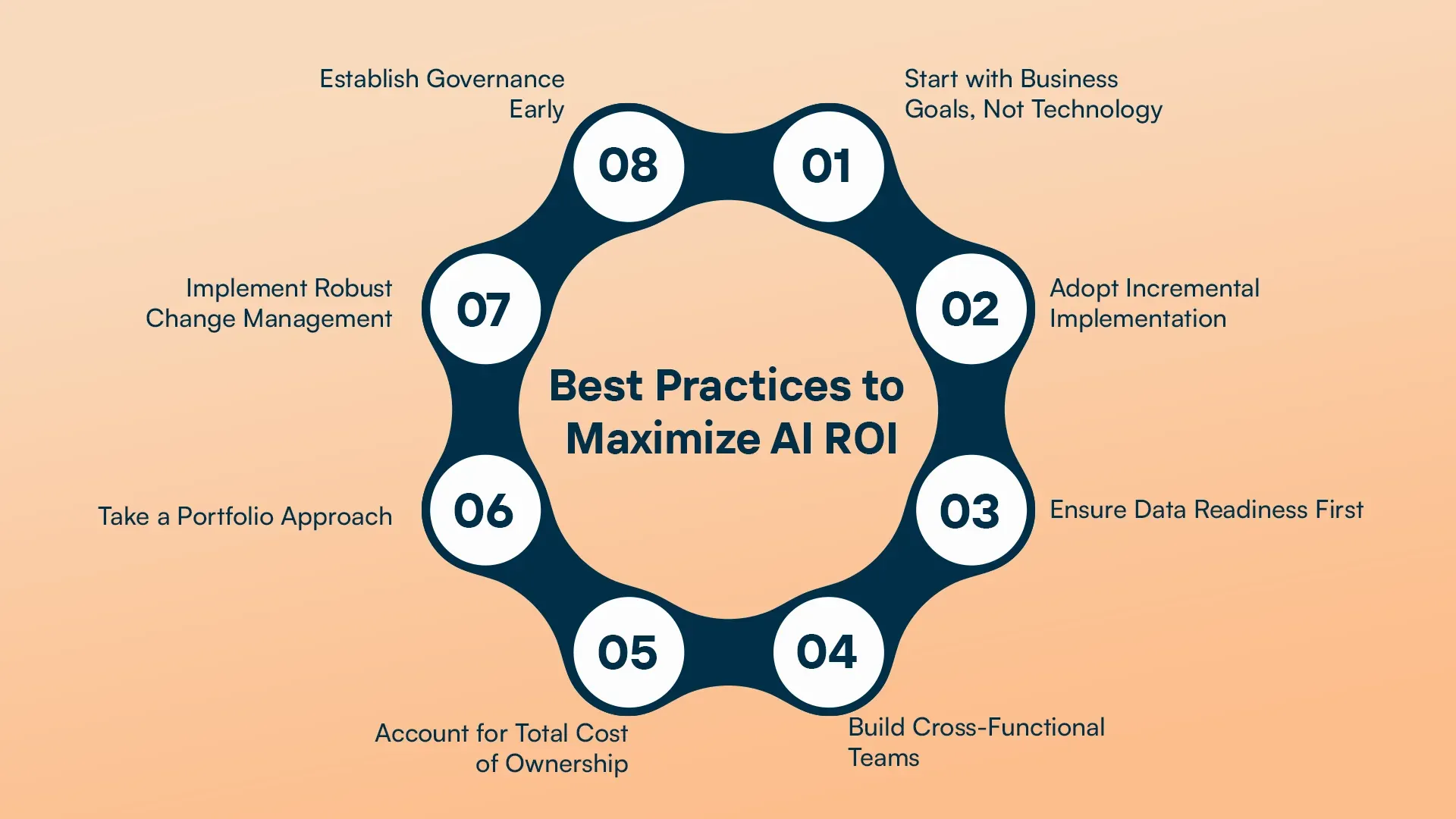
1. Start with Business Goals, Not Technology
The most significant blunder is to get enamored with the AI tech without knowing what problem you are solving. First, detect the most excruciating challenges in your business, and subsequently inquire if AI is a suitable answer.
2. Adopt Incremental Implementation
You are not supposed to make the whole world of technology your oyster. Rather, select a small pilot project that is easy to keep track of, yet important enough to show value. Get to know the pilot, adjust your method, and then enlarge the area where what is done correctly is produced.
3. Ensure Data Readiness First
Before deploying AI, ensure that your data is ready. This means accessibility, cleanliness, correct labeling, and appropriate governance.
4. Build Cross-Functional Teams
AI projects fail when they're siloed in IT or data science teams. The best AI for ROI results comes from teams that include business stakeholders, technical experts, and end users working together from day one.
5. Account for Total Cost of Ownership
Plan a budget for the entire lifecycle and not only for the initial development. Consider data preparation, integration costs, training expenses, maintenance, model retraining, and eventually, the replacement costs.
6. Take a Portfolio Approach
Align quick wins that provide value rapidly with strategic bets that could take more time but give bigger returns. Spread your risk out. Do not invest all your resources in one big AI project that has the risk of failing.
7. Implement Robust Change Management
Technology is simple. Humans are difficult. The most brilliant AI system in the whole world provides no return on investment if the workers do not utilize it.
8. Establish Governance Early
Before deploying, establish explicit protocols for AI ethics, data privacy, security, and compliance. Retrofitting governance is a much more difficult task than integrating it at the outset.
Not only will this help you stay out of trouble. Proper governance will even speed up AI deployment because the whole group is aware of the rules and thus can work quickly.
The Future: Agentic AI and Evolving ROI Models
Let's discuss briefly what the next thing is going to be.
Agentic AI-types of AI that act on their own rather than just advise-are the ones that will be the fastest to arrive. These systems can take appointment scheduling, purchasing, negotiating, and managing complicated procedures with very little human intervention.
The more we head towards the AIs being more autonomous, the more the companies will have to adapt their measurement systems. The old metrics like "time saved" lose significance when an AI takes care of the whole process. The new metrics concerning quality, reliability, and strategic value will be the ones that will matter more.
Conclusion
Maximizing AI ROI in 2026 consists strategic approach, continuous optimization, and the right implementation partner. AI focuses on high-impact use cases, invests in quality data infrastructure, and measures outcomes strictly. Remember that AI transformation is a journey, not a destination. Start small, scale what works and performs constantly.
Whether you're operating automation or improving customer experience, some of the platforms, like as RejoiceHub, which help to accelerate your AI adoption journey with some of the proven frameworks and expert guidance, helpino you to achieve measurable results faster while minimizing implementation risks.
Frequently Asked Questions
1. What is AI ROI, and why does it matter?
AI ROI measures the return you get from investing in artificial intelligence. It helps you understand if your AI spending actually brings value through cost savings or revenue growth.
2. How do you calculate ROI for AI projects?
Calculate AI ROI by subtracting total costs from benefits gained, then dividing by the investment and multiplying by 100. Include setup, maintenance, and training expenses in calculations.
3. What is the difference between hard ROI and soft ROI in AI?
Hard ROI includes direct financial gains like cost savings and revenue increases. Soft ROI covers indirect benefits like better decision-making, improved employee satisfaction, and enhanced customer experience.
4. Why do so many AI projects fail to deliver expected returns?
Most AI projects fail because companies treat them separately, struggle with poor data quality, rush implementation without clear goals, or set unrealistic expectations about immediate results.
5. How long does it take to see ROI from AI investments?
Simple automation projects may show returns in 3-6 months. More complex AI systems typically need 12-18 months before delivering measurable ROI and consistent business value.
6. What are the biggest cost savings from using AI?
AI delivers major savings through automation of repetitive tasks, reduced labor costs, fewer errors, faster processing times, and optimized resource allocation across business operations.
7. Can AI actually increase revenue for my business?
Yes, AI increases revenue through personalized customer experiences, better targeting, improved product recommendations, faster time-to-market, and data-driven decision-making that boosts sales conversions.
8. What metrics should I track to measure AI ROI?
Track financial metrics like cost per transaction and profit margins, operational metrics like processing time and error rates, plus customer metrics including satisfaction and retention.
9. How much should companies budget for AI implementation?
Budget should cover data preparation (60-80% of initial costs), system integration, training, ongoing maintenance, model retraining, and eventual upgrades—not just initial development expenses.
10. What is the best way to start with AI for maximum ROI?
Start with one small pilot project targeting a specific business problem. Measure results carefully, learn from the experience, then scale successful approaches to other areas.
11. How important is data quality for AI ROI?
Data quality is critical poor data can waste 60-80% of your AI project budget on cleaning and preparation instead of building solutions that deliver actual value.
12. Should small businesses invest in AI or wait?
Small businesses should invest now if they have clear problems AI can solve. Start small with affordable tools, focus on quick wins, and scale gradually based on results.
13. What industries see the highest ROI from AI?
Healthcare sees 30% faster diagnosis times, retail gets 15-25% conversion boosts, and marketing cuts customer acquisition costs by 20-40% through AI-powered targeting and personalization.