The current state of enterprise AI adoption has reached its implementation phase. The present moment shows enterprises across the world adopting this technology at major levels. US companies with more than 1000 employees use AI technology to test their core business operations in more than 65 percent of cases. The present requirements for organizations to operate at high speeds need special attention because they must protect their compliance and security, and operational functions.
The company Anthropic makes its entrance.
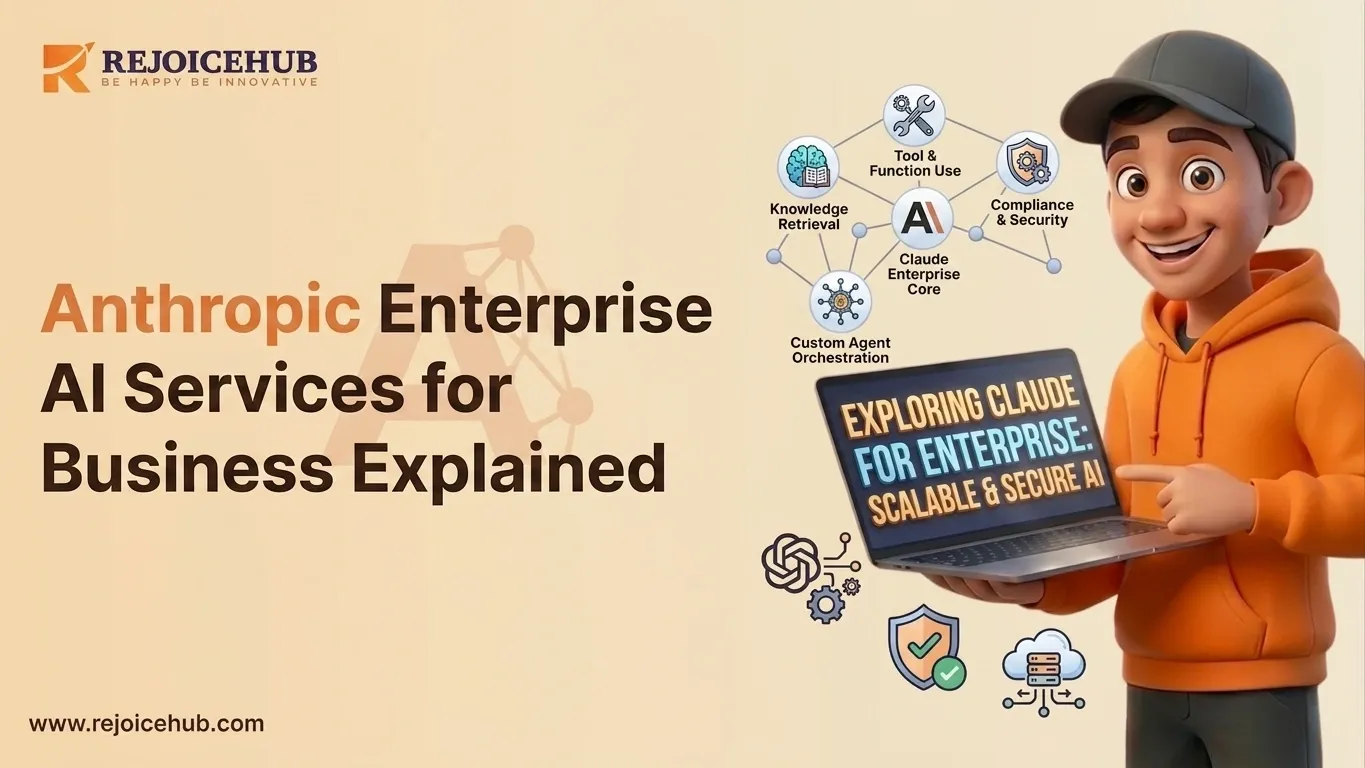
The AI safety company Anthropic provides Claude as its main product while it develops its business operations from research-based activities into establishing its enterprise AI service model. The company uses its Claude model family to develop enterprise infrastructure, which enables businesses to handle their AI production needs. If you want to understand how this fits into the broader landscape, it helps to first explore what are agentic AI workflows and how they are reshaping business operations today.
The actual question that decision-makers need to solve requires them to answer two parts. The first part explores the meaning of Anthropic's enterprise expansion while its second part investigates whether organizations need AI consulting partners.
Let's analyze the situation.
What Are Anthropic Enterprise AI Services?
Anthropic Enterprise AI Services refers to the complete set of professional AI solutions which includes all features that Anthropic provides for businesses to implement its Claude AI models through their work processes while maintaining secure operations and extended system performance and safety features.
At its core, Anthropic's enterprise offering includes:
- Claude API Access: The primary interface for developers and enterprises to integrate Claude into their applications and workflows.
- Claude.ai for Teams and Enterprise: A managed SaaS platform with shared workspaces, advanced admin controls, audit logs, and SSO.
- Deployment customization: Options for private cloud deployments and enhanced data privacy controls for compliance-heavy industries.
- Safety and alignment focus: Unlike many AI providers, Anthropic's models are built with Constitutional AI methodology, meaning the model is designed to be safer and more controllable by default.
The Claude model family, which includes Claude Opus, Sonnet, and Haiku, provides multiple capability levels with different cost tiers which enable users to perform tasks that range from simple automation to advanced reasoning.
Want to build production-ready AI workflows using Anthropic's Claude? RejoiceHub can help you go from idea to deployment, fast.
How Anthropic Helps Enterprises Deploy AI
1. Flexible Deployment Models
Anthropic offers multiple deployment paths depending on your infrastructure needs:
-
Cloud API (most common): The Claude connection uses REST API to establish direct communication. The system provides fast setup to support scalable operations without requiring any infrastructure maintenance. The system serves as the perfect solution for both SaaS applications and internal business solutions.
-
Private Cloud / VPC Deployments: The isolated deployment configuration from Anthropic enables enterprises to meet their strict data residency requirements by protecting their data from access through shared systems.
-
AWS Bedrock and Google Cloud Integration: The cloud marketplaces provide access to Claude which simplifies adoption for teams using those cloud environments. This is especially relevant for companies already exploring custom vs off-the-shelf AI software as part of their technology decisions.
2. Security and Compliance-First Architecture
One of Anthropic's key differentiators for enterprise buyers is its security posture:
- SOC 2 Type II compliant
- No training on customer data by default
- Configurable data retention policies
- Role-based access controls and audit logging for enterprise plans
- HIPAA-eligible configurations for healthcare use cases
For regulated industries like finance, healthcare, and legal, where most enterprise AI budgets are concentrated, security isn't a checkbox. It's a deal-breaker.
3. Fine-Tuning and Workflow Integration
Beyond raw API access, Anthropic supports:
-
System prompt customization: Tailor Claude's behavior, tone, and output format to match your brand or workflow requirements.
-
Tool use and function calling: Connect Claude to databases, CRMs, internal APIs, or third-party SaaS tools for agentic AI workflows that automate business processes.
-
Long context windows: Claude can handle 100K+ token contexts, making it capable of processing entire documents, contracts, or codebases in a single call.
Key Benefits of Anthropic AI Services for Business
Claude's API provides developer documentation through its user-friendly interface. Skilled teams complete prototype development within days instead of spending several months on the project.
The safety-first model design of Anthropic reduces AI risk through its ability to decrease hallucinations while improving instruction-following capabilities and delivering more reliable output patterns which organizations need for their customer-facing systems.
Anthropic provides enterprise customers with uptime SLAs through its enterprise-grade reliability system which includes priority API access and dedicated support services.
The managed API system enables businesses to access frontier AI capabilities because it eliminates the need for businesses to develop their own models, which results in a substantial decrease in technical requirements. For teams evaluating costs, a detailed Anthropic per-token pricing enterprise AI cost guide can help clarify total expenditure across different usage scenarios.
Enterprises can use flexible pricing tiers which include Haiku for cost-effective high-speed performance and Opus for maximum system capabilities to calculate their cost-per-token expenses based on the complexity of their tasks.
Enterprise AI Use Cases: High-Value Applications
The Claude system developed by Anthropic functions as an advanced reasoning system rather than a typical chatbot. The following list shows the business use cases which provide the greatest return on investment for companies to implement today.
-
Financial Crime Detection (AML and Fraud)
Banks and fintech companies are using Claude to analyze transaction patterns, flag anomalies, and generate Suspicious Activity Reports (SARs) with contextual reasoning, tasks that previously required large analyst teams. To see how this fits into a larger picture, the growing role of artificial intelligence in finance illustrates the transformation underway across the entire sector.
ROI impact: Reduced false positives, faster case resolution, and lower compliance staffing costs.
-
Customer Support Automation
Claude powers next-generation support agents that handle complex, multi-step queries, not just simple FAQs. It can read full conversation history, access knowledge bases, and escalate appropriately. Businesses looking to implement this should review the complete AI customer support automation guide to understand deployment best practices.
ROI impact: 30 to 60% reduction in Tier 1 support ticket volume. Faster resolution times. Higher CSAT scores.
-
Internal Knowledge Copilots
Enterprises are deploying Claude as an internal AI assistant, trained on internal docs, SOPs, HR policies, and product documentation. Employees get instant, accurate answers without digging through wikis.
ROI impact: Reduced onboarding time, fewer internal support tickets, and faster decision-making.
-
Document Processing and Summarization
Legal, real estate, and financial services firms use Claude to extract key data from contracts, NDAs, and filings, reducing manual review time by 70% or more. Organizations exploring this path should also consider the benefits of AI for business more broadly to identify additional areas where automation can drive measurable returns.
ROI impact: Significant time savings on document-heavy workflows. Lower outsourcing costs.
Looking to build one of these solutions? RejoiceHub specializes in custom AI agent development for exactly these use cases. Get a free consultation.
Does Anthropic's Enterprise Push Replace AI Consulting Companies?
This is the question on the minds of every AI services firm and it demands a straightforward answer.
Short answer: No. But it does change the role of consulting firms.
| Category | Anthropic | AI Consulting (e.g. RejoiceHub) |
|---|---|---|
| Core Offering | Foundation models + APIs | Custom AI strategy and implementation |
| Deployment | Cloud API / private cloud | End-to-end project delivery |
| Customization | Fine-tuning, system prompts | Full workflow design and integration |
| Change Management | Not included | Yes, team training and adoption |
| Ongoing Support | Platform uptime and model updates | Iterative improvement and optimization |
| Best For | Developers and large enterprises | SMBs, startups and mid-market teams |
Anthropic demonstrates clear superiority through its foundation models, API infrastructure, model safety systems, and cloud-level reliability. They build the engine.
RejoiceHub demonstrates its strengths through its ability to create strategies, design custom workflows, connect multiple systems, and help teams adapt and sustain their operations. They build what runs on the engine.
Anthropic operates as the AWS equivalent for AI infrastructure. RejoiceHub is the firm that architects your cloud migration and makes sure your team actually uses it. Businesses navigating this decision can also benefit from understanding how to build an AI agent stack for business before committing to either path.
Enterprises that go to Anthropic directly without a strategy partner often end up with expensive API credits and a prototype that never makes it to production.
The model requires simple execution. The development of dependable operational systems, the connection of traditional systems, and the training of personnel to adopt new practices represent the difficult challenges.
That's where consulting firms deliver irreplaceable value.
Build vs. Partner: What Should Enterprises Actually Do?
| Go Direct with Anthropic API When... | Hire an AI Partner Like RejoiceHub When... |
|---|---|
| You have an in-house ML/engineering team | You lack internal AI development resources |
| You need raw API access for custom builds | You need a full solution from strategy to launch |
| You're integrating into an existing product | You're building a new AI-powered workflow |
| You have clear, defined AI use cases | You need help identifying the right use cases |
| You can manage security and compliance in-house | You need compliance guidance for your industry |
The most common mistake we see at RejoiceHub: companies spend 3 to 6 months trying to build AI workflows internally, burn out their developers, and end up with something fragile that breaks the moment requirements change.
The smarter path? Engage an AI partner early to design the right architecture, then own and iterate on it internally once it's stable. Teams that want to move faster should explore how to deploy AI agents without an ML team as a practical starting point for reducing implementation barriers.
Conclusion
The expansion of Anthropic's business operations reaches a level of true importance. Businesses now have access to safer, more capable AI infrastructure than ever before without needing to build their systems from scratch.
Having access to an excellent model does not provide businesses with a functional AI system that can operate at full capacity.
The enterprises that will succeed during the next 3 to 5 years will achieve their goals through their combination of superior AI infrastructure from Anthropic, OpenAI, and Google with their selection of intelligent implementation partners who transform basic capabilities into tangible business results.
That is the actual function of RejoiceHub.
Looking to deploy AI agents in your business? RejoiceHub helps you go from idea to production with strategy, custom development, and end-to-end integration. Book your free AI strategy call today.
Frequently Asked Questions
1. What are Anthropic's enterprise AI services?
Anthropic's enterprise AI services are a set of business-ready tools built around their Claude AI models. This includes API access, team workspaces, private cloud options, admin controls, and security features. It's designed to help companies add AI to their workflows without building models from scratch.
2. How does Anthropic help enterprises deploy AI?
Anthropic gives businesses a few deployment paths — direct API access, private cloud setups, and integrations with AWS Bedrock and Google Cloud. Each option suits different infrastructure needs. Whether you're a startup or a large enterprise, there's a setup that fits your team's size and compliance requirements.
3. Is Claude safe enough for enterprise use?
Yes. Anthropic builds Claude using a method called Constitutional AI, which makes the model safer and easier to control by default. Add to that SOC 2 Type II compliance, no training on customer data, and HIPAA-eligible configs, and it becomes a solid pick for regulated industries like healthcare, finance, and legal.
4. What is the difference between Claude Opus, Sonnet, and Haiku?
These are three versions of Claude built for different use cases. Haiku is fast and affordable, great for simple tasks. Sonnet balances speed and power for mid-level tasks. Opus is the most capable, built for complex reasoning. Businesses can mix these based on task complexity and budget.
5. Can Anthropic's AI services replace a consulting company?
Not really. Anthropic builds the AI models and infrastructure. But a consulting partner handles strategy, custom workflow design, system integration, team training, and ongoing support. Think of Anthropic as the engine and a consulting firm as the team that builds and runs the car around it.
6. What industries benefit most from Anthropic's enterprise AI?
Finance, healthcare, legal, and real estate see the biggest returns. These industries deal with heavy document workloads, compliance requirements, and complex data — all areas where Claude performs well. Customer support, internal knowledge tools, and fraud detection are also strong use cases across industries.
7. What are the top enterprise AI use cases for Claude in 2026?
The highest-value use cases right now include fraud detection and AML reporting, customer support automation, internal knowledge assistants, and contract or document review. Each of these replaces hours of manual work and cuts down on staffing costs while improving accuracy.