
It is highly likely that as a real estate agent in the year 2025, you have already observed the scenario firsthand. The whole playing field has been modified dramatically. Customers are looking for quicker replies, customized suggestions, and 24/7 service. On the other hand, the competition is up to the highest standard ever. The question that arises here is, how do you manage to stay in the game without stressing yourself?
With the technology through the years, I have been watching its impact on different sectors, and real estate is among those that are currently witnessing the biggest changes. The use of Artificial Intelligence in real estate is not limited to the provision of advanced tools. It has now become a matter of existence.
What Is AI in Real Estate?
Artificial Intelligence means computers that can do human-like tasks. In the real estate domain, AI real estate agents are smart software systems that are intended to take over and improve the different phases of property transactions and client management. The next point is where the real topic is. AI assistants and AI autonomous agents are completely different. I have observed that the majority of people treat these concepts as if they were synonymous, while in fact, they are not.
AI assistants, such as chatbots, are simply reactive. They respond to prompts and adhere to fairly basic scripts, being the digital receptionists in a way that they can deal with simple questions concerning property, etc., details, availability, and scheduling. However, the AI autonomous agents are the ones that completely change the game. These systems are futuristic and can even predict the future; they are capable of making decisions and taking actions without the need for human guidance all the time.
Why Real Estate Agents Need AI
To be direct, the current condition of the real estate market is totally different from that of five years ago. Expectations of clients have increased to an unbelievable level, and the competition has gone to the extent of fighting like animals.
Based on my dealings with agents in different states, I have discovered one common struggle that is experienced by everyone. Business expansion is a dream for all, but one has to handle it within the limited hours of a day. Administrative duties, lead follow-ups, client viewings’ scheduling, property descriptions writing, and, at the same time, trying to maintain a close personal relationship with each client are the tasks that you are overwhelmed with.
The first one is that they save a huge amount of time by avoiding routine tasks. Picture an assistant who never sleeps, never takes breaks, and takes care of lead qualification, appointment scheduling, and follow-ups, the whole lot automatically. That is just what AI real estate technology provides.
The second one is that they take much more informed and data-driven decisions. Most people have difficulties with property pricing and market predictions. Is it better to price a house at $425,000 or $450,000? Which neighborhoods are to take off in terms of price? AI for real estate goes through and analyzes thousands of data points virtually in an instant, providing you with insights that would take weeks to manually collect.
Top Benefits of Using AI in Real Estate
Now I want to demonstrate to you the very specific advantages that you will reap from the incorporation of AI for real estate agents in your business. I have witnessed these benefits change the fate of non-performing agents, making them part of the leading group.
-
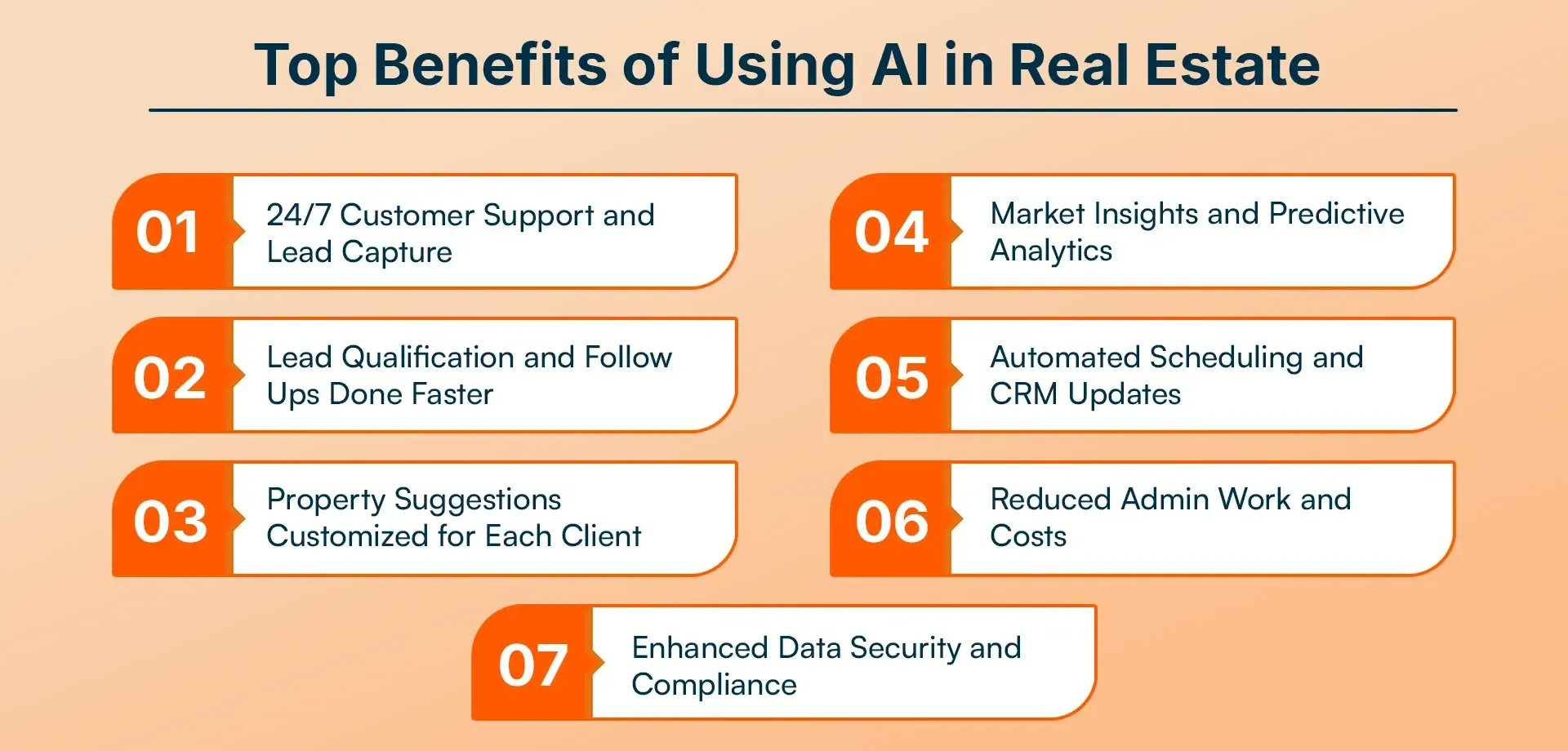
24/7 Customer Support and Lead Capture
Your future customers do not look for houses only from 9 AM to 5 PM. They check the listings at midnight, on weekends, and basically during their lunch breaks. The integration of AI real estate chatbots and virtual agents ensures that you catch every lead that comes in, irrespective of the time of day or night they come in.
-
Lead Qualification and Follow-Ups Done Faster
Most agents lose opportunities because they take too long to reply. From what I've seen, the first agent to answer a lead has a 78% chance of winning. AI in real estate qualifies leads instantly according to their conduct, economic capability, and needs.
-
Property Suggestions Customized for Each Client
Clients are not alike; there is variation among them. Some seek dilapidated houses in old communities. Others prefer chic apartments close to the business district. AI real estate agents not only look at the client's requirements but also analyze their searching habits and machine interaction to come up with a list of properties that the client is going to fall in love with.
-
Market Insights and Predictive Analytics:
Are you curious about a neighborhood that is on the verge of a boom? Are you looking for the right price for an unusual property? AI for real estate agents goes through market data, economic indicators, and buyer trends to make predictions about future movements.
-
Automated Scheduling and CRM Updates
What is the amount of time that you are wasting doing the manual updates of your CRM, sending appointment reminders, and coordinating schedules? AI in real estate takes care of all this automatically.
-
Reduced Admin Work and Costs
Administrative work consumes 30-40% of the time of the majority of the agents. Through AI real estate automation, it is possible to function like a big team with low overhead costs. Automatically create property descriptions, generate marketing materials, and manage documents.
-
Enhanced Data Security and Compliance
Real estate deals contain private information such as financial and personal data. AI for real estate systems comes with integrated compliance checks and security measures that not only safeguard your clients' data but also ensure that you are always in compliance with the law.
Key AI Tools and Technologies for Real Estate
Please follow me into today's industry-shaping AI tools for real estate agents.
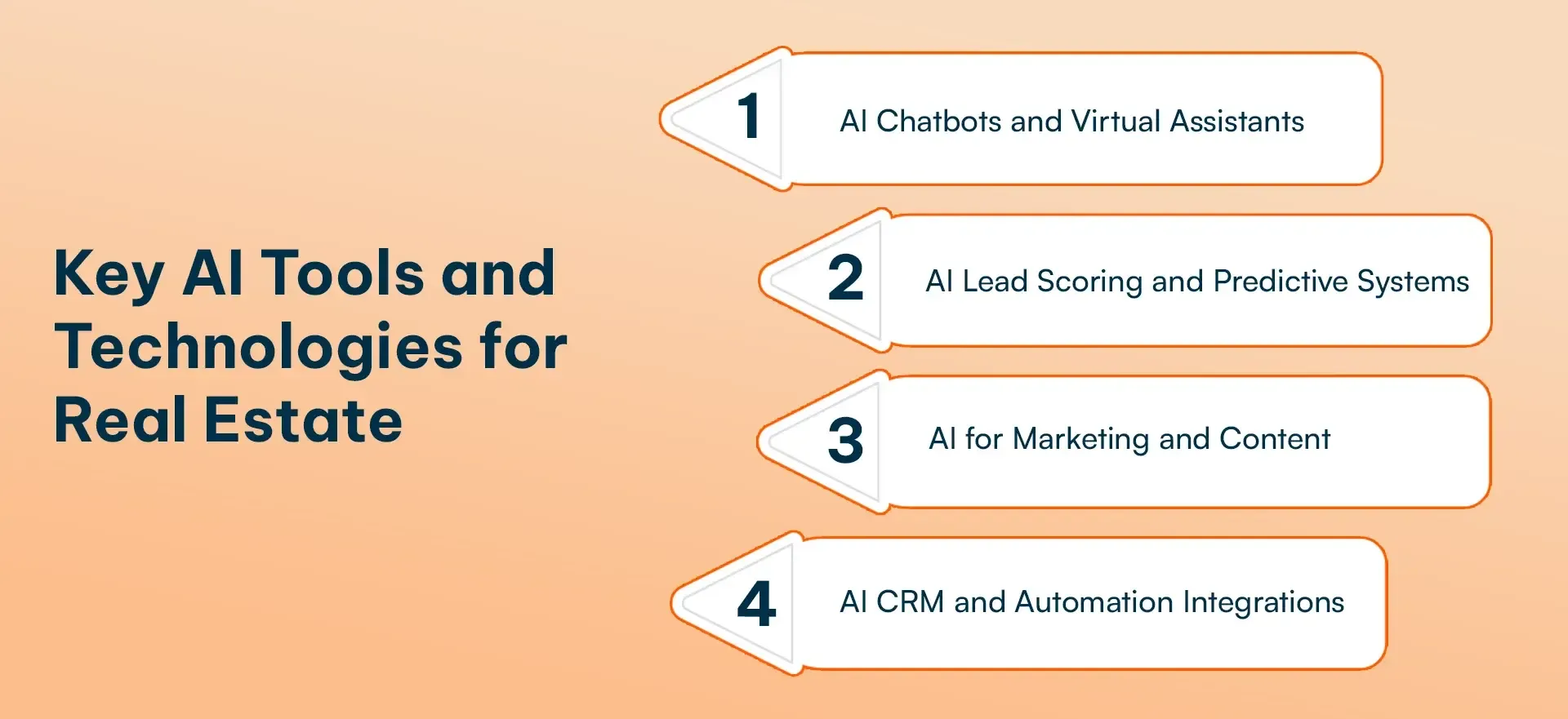
1. AI Chatbots and Virtual Assistants
AI real estate chatbots are the main protectors for lost leads. The extensible and smart systems interact with website visitors right away, give answers to common queries about properties, take the contact information, and then pass the qualified prospects on to you.
The top chatbots are equipped with natural language processing that enables them to grasp difficult queries and respond politely and conversationally.
2. AI Lead Scoring and Predictive Systems
Leads are not all the same. The AI for real estate evaluates a large number of signals, like buying behavior, response times, favorite properties, and signs of budget, to indicate the best prospects for generating conversion.
The scores are allocated by the system to every lead, which in turn assists you in prioritizing your work.
3. AI for Marketing and Content
The making of appealing property descriptions, social media postings, and email campaigns consumes an enormous amount of time. However, the AI real estate tools are capable of producing professional marketing content in moments.
The mentioned systems study the effective listings, comprehend the buyer's language that attracts, and generate personalized descriptions focusing on the most favorable features of the property.
4. AI CRM and Automation Integrations
The cutting-edge AI system for real estate professionals surpasses the contact management type of solution. Besides, the AI-enabled CRMs calculate the right moment to reach out to potential customers, propose the next steps according to the client's activity, and even execute the whole nurturing process.
Also Read: How to Implement Business Process Automation
How Real Estate Agents Can Implement AI (Step-by-Step)
Let me simplify and offer a straightforward, practical method to implement AI in the real estate agent business of your company.
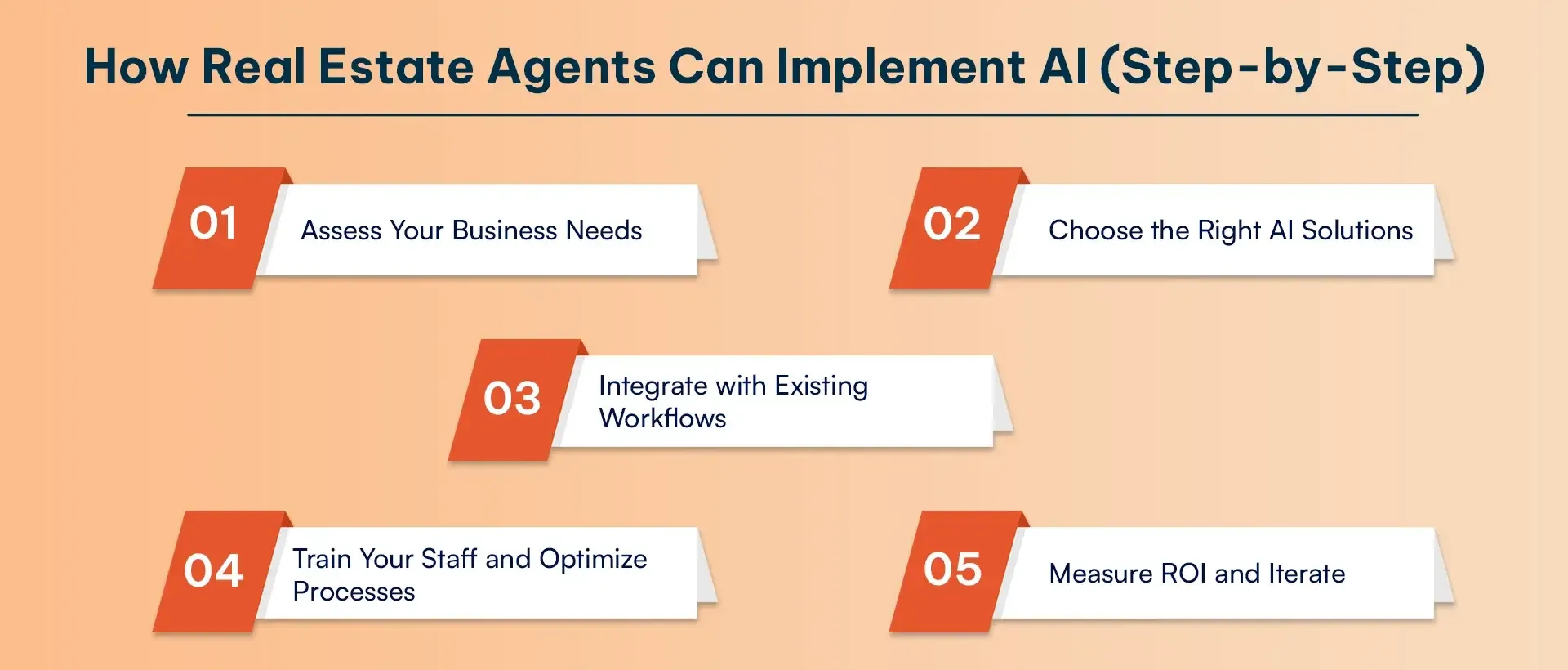
Step 1: Assess Your Business Needs
It is recommended that you first spend time determining your most pressing issues before diving into any AI real estate tools. What activities are the most time-consuming for you? Where are you losing potential clients? Which jobs do you most dislike performing?
Step 2: Choose the Right AI Solutions
Not every AI real estate tool available in the market is a necessity for you. One or two solutions dealing with your most significant problems should be your starting point.
In case poor lead response time is ruining your business, an AI chatbot should be the first implementation.
Step 3: Integrate with Existing Workflows
One of the major errors that I see most often is the attempt to recreate everything from the ground up. On the contrary, search for a real estate agent AI that works with your existing systems, your CRM, website, email platform, and calendar.
Step 4: Train Your Staff and Optimize Processes
The performance of AI in real estate is highly dependent on the knowledge and skills of your team in utilizing it. So, investing in training should be a priority. Instead of showing your team how AI works, present it as a part of their work that makes life easier.
Step 5: Measure ROI and Iterate
Without a doubt, keeping tabs on certain metrics prior to and after the utilization of AI in real estate will give us a clear picture of the situation. Do you see a major leap in the number of leads captured? And then, how much time are you saving? Lastly, what about your close rate?
Real-World Examples and Case Studies
In your opinion, is it time for big data to get woven into the real estate business?
-
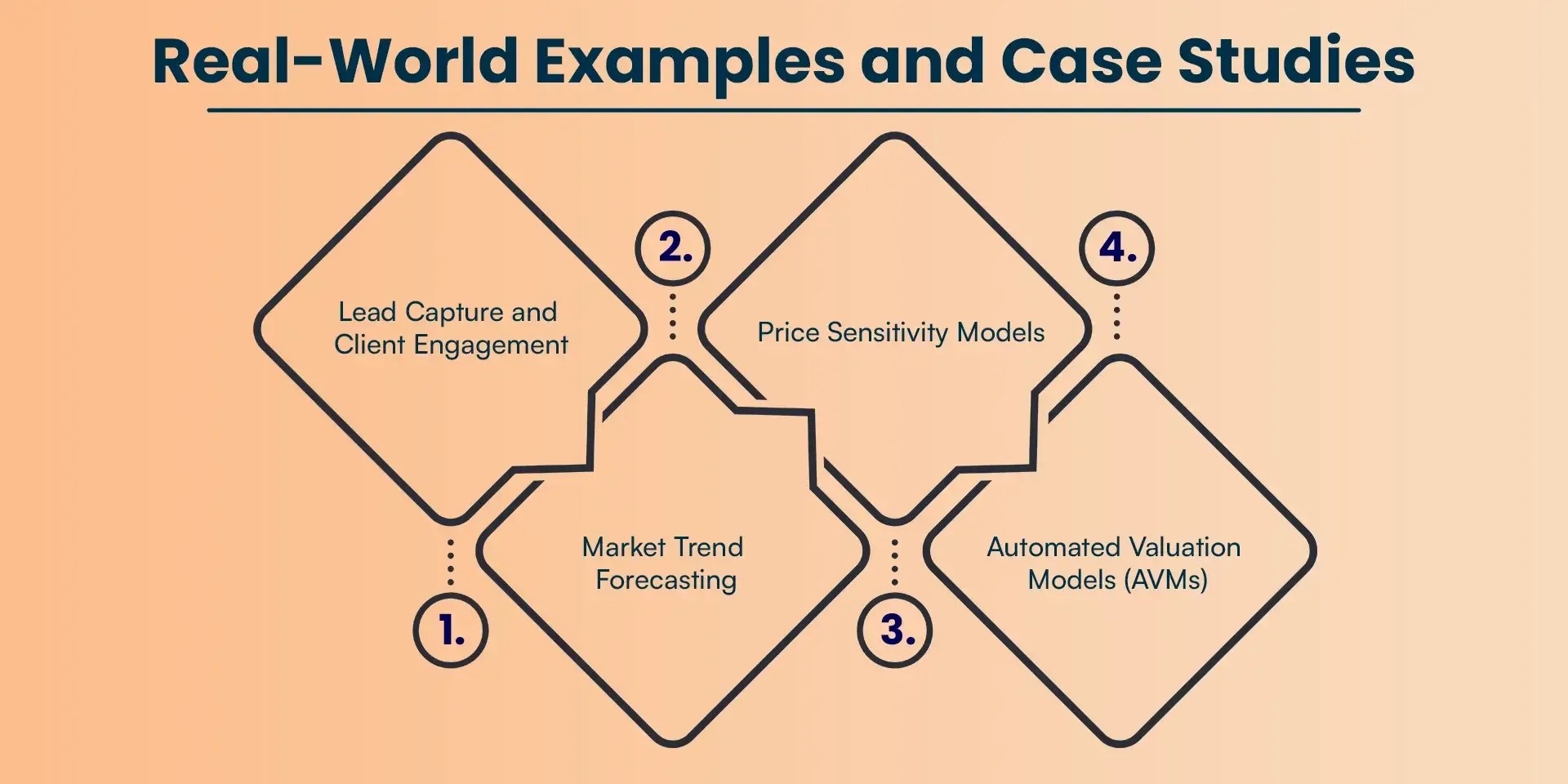
Lead Capture and Client Engagement:
Portland's mid-sized brokerage put an AI real estate chatbot on its site. In three months, they secured 47% more qualified leads. The chatbot dealt with first inquiries, assessed potential buyers according to price and time, and coordinated appointments with agents on the fly.
-
Market Trend Forecasting:
The AI-based model incorporates data from various sources, such as neighborhood characteristics, economic indicators, and buyer behavior,r to create a big picture for real estate agents. The AI predicted a 15% increase in the value of a specific ZIP code, which happened to be very accurate, six monthbeforeto the event.
-
Price Sensitivity Models:
Correctly pricing homes is of utmost importance. A group that utilized AI real estate valuation models reached 93% accuracy in their listing prices. They managed to reduce the time for which properties were on the market by 22% and also remarkably improved client satisfaction.
-
Automated Valuation Models (AVMs):
AI-driven modern AVMs for real estate take into account hundreds of factors which are often overlooked by human appraisers, like alterations in school districts, new commercial projects, changes in crime rates, and even social media perception of communities. The use of these tools supports agents in giving trustworthy pricing suggestions grounded in data to the clients.
Conclusion
In the year 2026, the use of AI in the real estate business was still very hard to imagine, and all of the agents were completely dependent on it. Daily agents' activities were cut down; on the other hand, clients' experiences were upped in quality. By using AI for screening leads, gaining insights, and scheduling the like, agents would already devote their time to relationship building and closing the deals.
Rejoicehub Simple AI implementation consists of step-by-step, small-scale, and results as the keys. The future offers us things like smarter personalization, predictive analytics, and AI-assisted negotiations. AI will not replace agents but will rather be their partner in augmenting the human expertise and giving the forward-thinking professionals a sustainable competitive advantage.
Frequently Asked Questions
1. What is an AI real estate agent?
An AI real estate agent is smart software that handles property tasks like lead capture, scheduling, and client follow-ups automatically without needing constant human supervision.
2. How can real estate agents use AI in their business?
Real estate agents use AI for automating lead responses, scheduling appointments, creating property descriptions, analyzing market trends, and qualifying potential buyers based on their behavior.
3. What are the main benefits of AI for real estate agents?
AI helps agents save time on admin work, capture leads 24/7, respond faster to inquiries, personalize property suggestions, and make smarter pricing decisions using data.
4. Can AI replace human real estate agents?
No, AI won't replace agents. It works as a partner that handles routine tasks so agents can focus on building relationships and closing deals with clients.
5. What's the difference between AI assistants and AI autonomous agents in real estate?
AI assistants like chatbots respond to basic questions, while AI autonomous agents make decisions independently, predict trends, and take actions without constant human input.
6. How does AI help with lead generation in real estate?
AI real estate chatbots engage website visitors instantly, answer property questions, collect contact information, qualify leads based on budget and needs, and schedule viewings automatically.
7. What AI tools do real estate agents need in 2025?
Agents need AI chatbots for lead capture, predictive systems for lead scoring, content generators for marketing, automated CRM integrations, and valuation models for pricing.
8. How much time can AI save real estate agents?
AI can save 30-40% of an agent's time by automating administrative tasks like CRM updates, appointment scheduling, follow-up emails, and creating property descriptions.
9. Is AI expensive for small real estate agencies?
Not necessarily. Many AI real estate tools offer affordable plans that help small agencies work like bigger teams without hiring additional staff or increasing overhead costs.
10. How accurate is AI for property pricing and valuation?
Modern AI valuation models achieve 93% accuracy by analyzing hundreds of factors, including neighborhood trends, economic data, school districts, and buyer behavior patterns.
11. Can AI help real estate agents predict market trends?
Yes, AI analyzes market data, economic indicators, and buyer patterns to predict neighborhood growth, price increases, and emerging hotspots months before they happen.
12. How do I start using AI in my real estate business?
Start by identifying your biggest problems, choose one or two AI tools that solve those issues, integrate them with existing systems, train your team, and track results.
13. Does AI for real estate comply with data security regulations?
Quality AI real estate systems include built-in compliance checks and security measures that protect client financial and personal data while keeping you legally compliant.