Now, I am telling you something quite understandable. Just five years ago, if someone said that artificial intelligence would be the next writing code, I would laughed it off. But in 2026, AI in software development is not a big concept anymore. Now it is changing every thing how to build software.
I remember with debugging code, and wondering into a better way, various AI tools can detect these bugs in a few seconds. This is not science fiction. And if you're a software developer or thinking about one, you can definitely understand what's happening in a space.
What is Artificial Intelligence in Software Engineering?
Just think, AI software development is like receiving a very intelligent assistant who is always ready to assist. It is a combination of machine learning, natural language processing, and automation that are doing the coding tasks that previously took hours.
The one thing that AI's learning feature is its capacity to not only follow orders but also to learn from patterns. It processes millions of code lines, understanding what is effective and what is not. Thereafter, it applies that understanding to make you write better and faster.
Why AI is Reshaping the Development Industry?
The transformation is taking place due to the fact that we have reached an impasse with traditional development. The complexity of projects is increasing. The deadlines are becoming more stringent. And there are not enough skilled programmers to meet the demand.
Market Growth & Industry Adoption Stats:
The figures tell a very interesting story indeed. It is expected that the AI software market will amount to $826 billion in 2030. This is a tremendous increase from where we were only a few years back.
What was the biggest surprise to me? Startups are also adopting AI in software development just as fast as big tech companies are. The tools have been made so easy to use that they can now be of help to any team, regardless of its size.
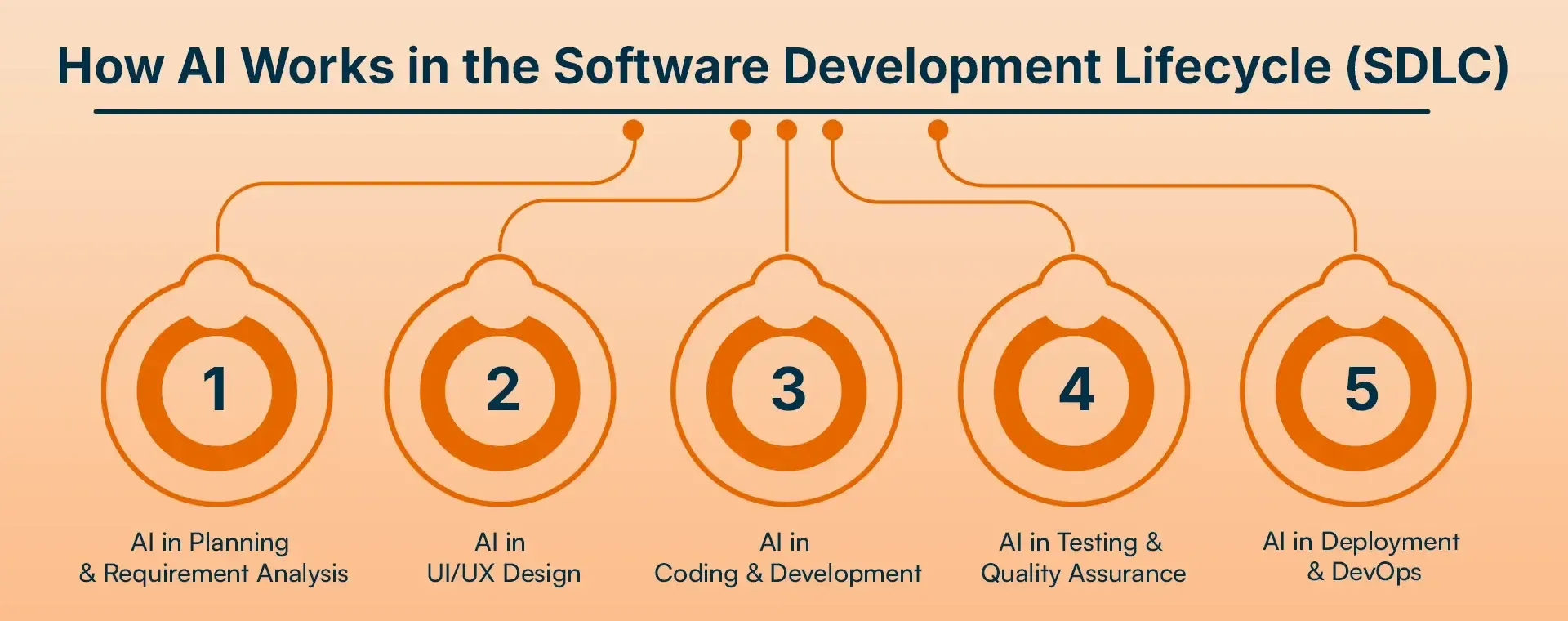
How AI Works in the Software Development Lifecycle (SDLC)
I will explain to you, step-by-step, the ways artificial intelligence software development tech is involved at all stages of the creation of the software. This isn't a theory; that is, it is what really takes place in the day-to-day work of the developers today.
-
AI in Planning & Requirement Analysis
Initially, planning was a combination of guesswork and experience. You would come up with the time duration for a task, pray for the best, and wish your estimation was correct. But, AI is here now to look into the past project data and give you the timelines that are more likely to happen.
-
AI in UI/UX Design
AI is radically transforming design. Wireframe creators, now capable of understanding a basic depiction such as "e-commerce checkout page," can generate several design proposals in just a few seconds. It is true, however, that a designer's eye is still needed to spot the best option and polish it, but there is no more hard work at the beginning.
-
AI in Coding & Development
In fact, this is the area where AI software development technology really stands out. I have been using GitHub Copilot, Tabnine, and Codeium, and they have become my everyday tools. They are as good as having a skilled software developer next to you.
Now, let me give you a practical example of this scenario. You begin to write a function name, and AI gives you the implementation idea altogether. The code is not just random, but the solutions are contextually relevant according to your project. It knows your coding style, your project's structure, and the libraries that you are using.
-
AI in Testing & Quality Assurance
Testing has ever been the hindrance. Writing tests require a lot of time. Running tests takes even longer. And somehow, the bugs still get through.
Artificial intelligence-based bug detection is a complete game-changer. New tools can examine your code while you're writing it and point out possible problems even before you have run the program. They pick up the issues like memory leaks, security flaws, and slowdowns that could take hours to fix through trial and error.
-
AI in Deployment & DevOps
The deployment used to be a source of anxiety for me. I would think, wouldn't it work? What if something broke? Did I overlook any configuration?
However, AI-integrated CI/CD automation makes the deployment process a whole lot easier. It can tell if a deployment might fail by looking at code changes and past patterns.
Key Benefits of AI in Software Development
I do not want to beat around the bush with you. AI to support programming is not just a hype word. The advantages are tangible and quantifiable. I have gone through them, and so have thousands of other programmers.
- Faster development cycles: most discernible advantage is the swifter development cycles. Activities that used to demand days of work are now done in hours.
- Reducing human errors: is an even greater advantage. Mistakes are unavoidable, and the likelihood of making them is higher when one is tired or doing something repetitive.
- Cost optimization: is a factor not to be ignored, particularly by small businesses and startups. In case the development is faster and there are fewer bugs, the overall money spent is less.
Real-World Use Cases of AI in Software Development
Theoretical concepts are very helpful; however, let us focus on the practical happenings in the industry:
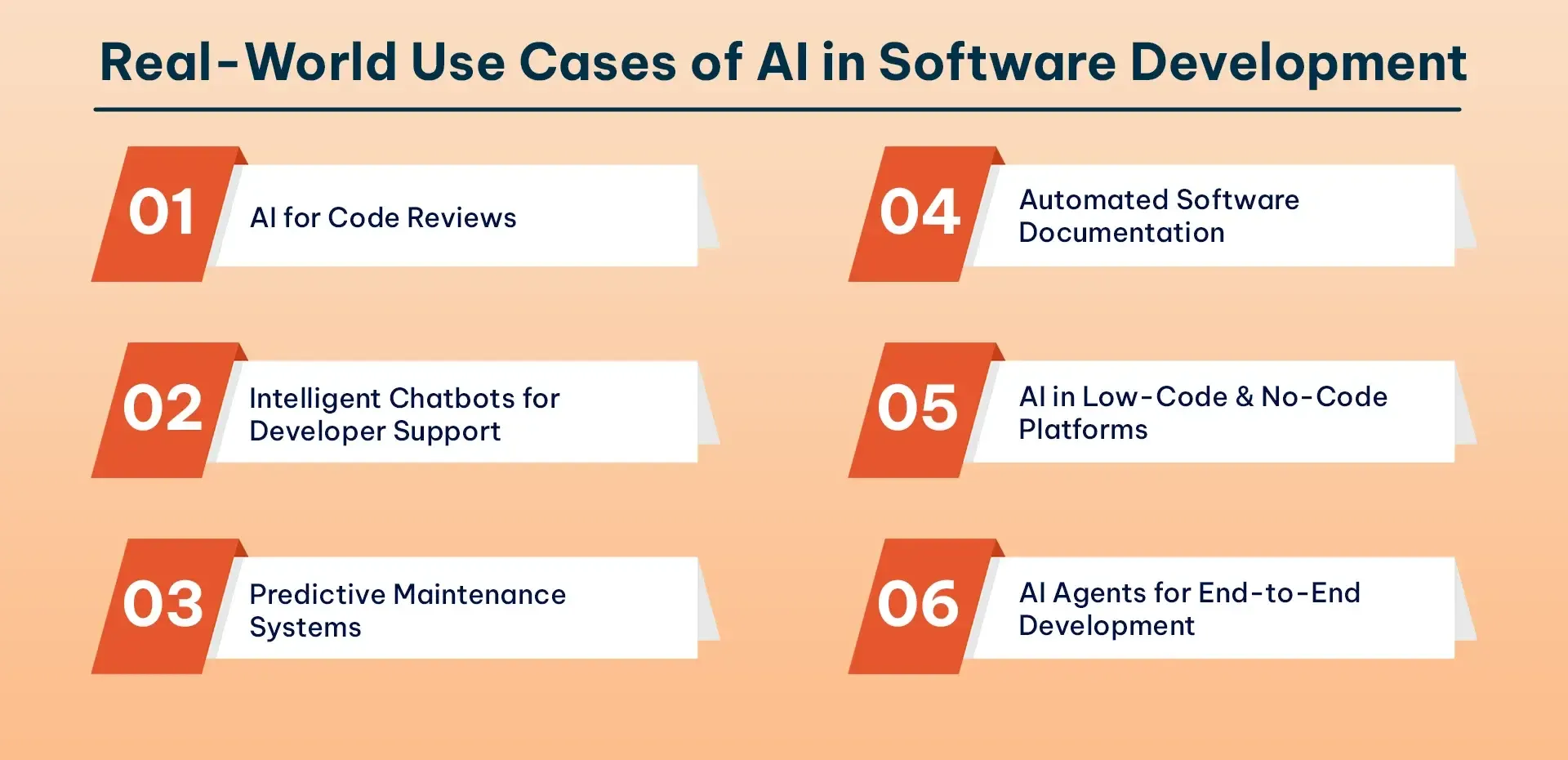
1. AI for Code Reviews
Code reviews were a time-consuming task for the senior developers. However, nowadays, AI is capable of doing the first round of the reviews by identifying the common problems such as security holes, performance issues, and coding style violations.
2. Intelligent Chatbots for Developer Support
The situation of needing assistance at 2 AM when nobody else is around has happened to many people.
3. Predictive Maintenance Systems
This is very good for production systems. AI is monitoring the application behavior and predicts the potential failure even before it actually occurs.
4. Automated Software Documentation
Let us be true. No one has an affection for writing documentation. But nowadays, AI can automatically produce extensive documentation directly from your source code. It describes the functions, specifies the arguments, and shows practical examples of usage.
5. AI in Low-Code & No-Code Platforms
This is to say, the software development is left in the hands of the users. Non-technical users are now able to voice their needs in simple English,h and the AI will automatically create functioning programs. The standard of code is not always the highest, but for most business apps, it is enough.
6. AI Agents for End-to-End Development
This is the future already in the making. AI agents are capable of taking a feature request and managing it through all the phases from design to testing and deployment.
Also Read: AI in Payments - How AI Is Transforming Digital Payments
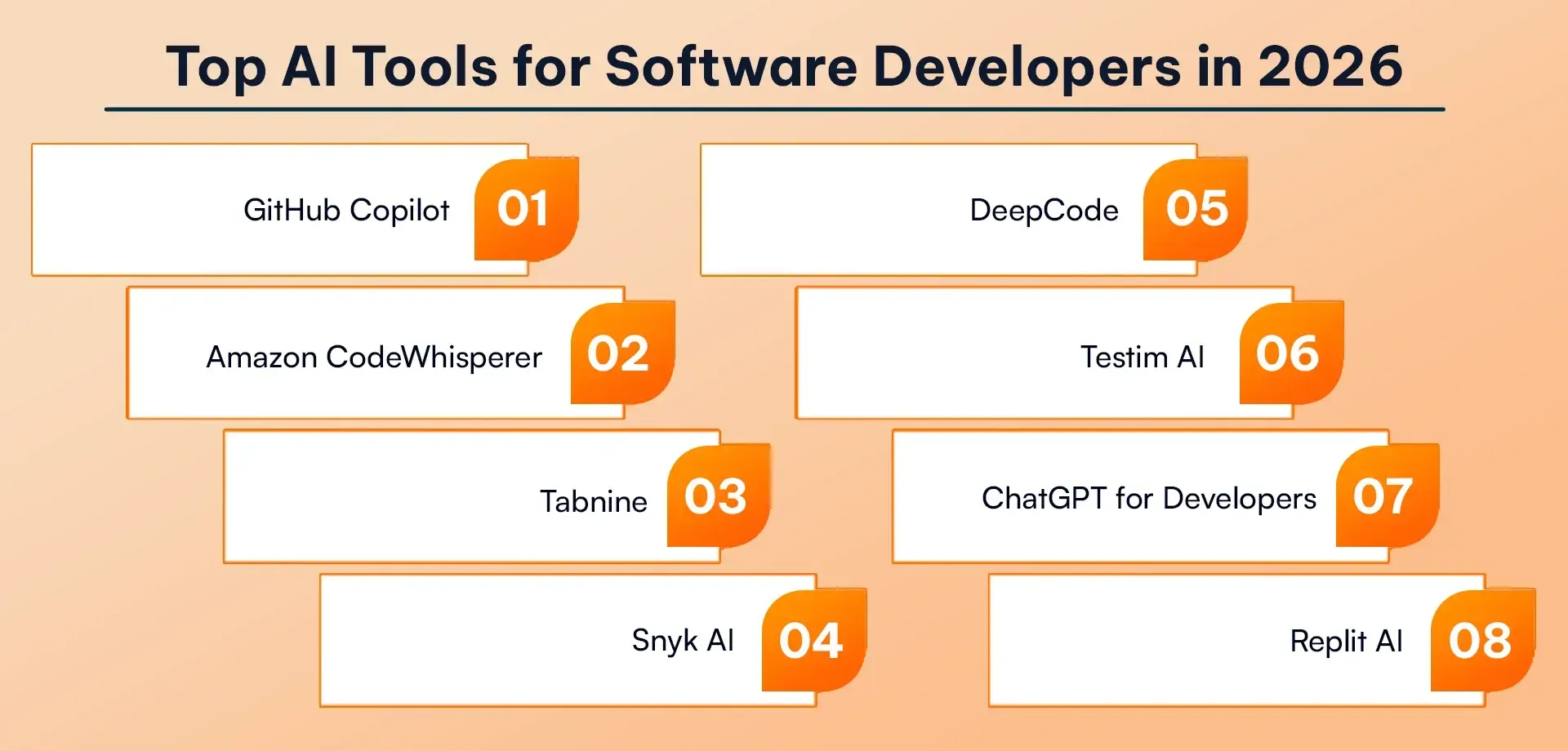
Top AI Tools for Software Developers in 2026
These are really the tools that I personally use and also recommend.
-
GitHub Copilot
It has set the bar for AI code completion at a lofty level.
-
Amazon CodeWhisperer
It is the product of Amazon that competes directly with Copilot. Its main area of focus is AWS services, with security scanning as the second feature.
-
Tabnine
It emphasizes data privacy. The software can operate completely on a user's local computer, which is important for organizations with security requirements that are very strict.
-
Snyk AI
The tool tests the code and the packages used to find any vulnerabilities and then offers solutions for fixing them.
-
DeepCode
DeepCode is an AI-powered code reviewer that takes syntax and then some. It can identify issues with logic and performance and thus makes suggestions for improvement.
-
Testim AI
Testim AI is basically the automation of testing that lets users create and maintain test cases just by automatically taking care of the whole process.
-
ChatGPT for Developers
When I needed to clarify complicated ideas, troubleshoot difficult problems, and come up with solutions.
-
Replit AI
Replit AI is the best choice for making fast prototypes and for beginners
AI in Software Development for Businesses
Business executives usually inquire about the business value of AI software development. It is my pleasure to provide a detailed explanation of the matter through practical examples.
-
Enterprise digital transformation
AI is accelerating the process of enterprise digital transformation. Corporations are applying AI techniques to revamp their outdated systems without the need for full rewrites. The AI system examines the legacy code, indicates the areas that need to be improved, and assists in moving into the new system architecture.
-
SaaS product development
I worked with one bank that managed to cut the timeline for the migration of their mainframe from three years to a year and a half.
Challenges & Limitations of AI in Software Engineering
I'm afraid I have to tell you the truth, AI being a part of a software development process is not flawless. Some significant difficulties and shortcomings are worth knowing before you fully embrace the use of AI.
-
Data privacy and security issues
are the main reasons to be concerned. The use of AI coding instruments may send your code to external servers. Of course, that is ok for open-source software projects, but it is absolutely unacceptable for sensitive business logic or secret algorithms.
-
AI code accuracy issues
The problems with AI code accuracy occur more frequently than the suppliers acknowledge. The AI will very confidently give you a code suggestion that looks correct but has very slight bugs in it.
AI vs Traditional Software Development
Here's a clear comparison showing how artificial intelligence software development differs from traditional approaches:
| Feature | Traditional Development | AI-Powered Development |
|---|---|---|
| Speed | Manual | Automated |
| Code Quality | Developer-dependent | AI-assisted |
| Cost | Higher | Optimized |
| Scalability | Limited | Highly Scalable |
This table shows the shift clearly. Traditional development relies on manual effort and individual developer skills. AI-powered development automates routine tasks, maintains consistent quality, and scales much more easily.
Future Trends of AI in Software Development (2026-2030)
The future of AI in software development is uncertain, but some trends and technologies might indicate what is to come soon.
1. Autonomous AI developers
are not far off as they are closer than you might think. The simplest features are already being completed by AI agents, though they are still quite limited in their capabilities. Complexity will provide the major milestone that they will pass within a few years.
2. AI-powered dev teams
The usage of AI in software development will become so widespread that it will be considered normal. Envision one team where the AI takes care of the frontend, another with backend AI, while the humans do the coordinating and creative parts.
How to Implement AI in Your Development Workflow
Let me present to you the very same practical method that has worked with all the teams I have assisted in switching to the AI world. Step-by-Step AI Adoption Strategy:
1. First, identify automation opportunities
The very first thing to do is to spot areas in the process that can be automated. Analyze your existing operations and identify the most troublesome spots.
2. Second, select the correct AI instruments
Harmonize instruments with your precise requirements. If you create a considerable amount of boilerplate code, acquire a code completion tool such as Copilot.
3. Third, train your development team
If privacy is an issue, consider Snyk. If testing causes delays, consider automated testing tools. Refrain from purchasing all the tools on the market. Begin with the essentials and grow your collection as the results become evident.
4. Fourth, monitor and optimize performance
Track metrics like development speed, bug rates, and developer satisfaction. Are things actually getting better? If not, adjust your approach. Maybe you need different tools or better training. Continuous improvement is key.
AI in Software Development for Different Industries
Distinct sectors have specific requirements. However, the use of AI for software development is common among different sectors.
-
FinTech software
The FinTech industry has made it possible to utilize software development to the maximum by the use of AI, which could resolve the issues with going through the complicated regulations and security requirements.
-
Healthcare systems
The health care sector benefits the same way from AI that it uses to process huge amounts of medical data, make estimates of patient situation and monitor HIPAA compliance. Moreover, AI can be a great support in dealing with complicated medical coding, where human errors are common.
Conclusion
AI, or artificial intelligence, is one of the most significant advancements in the current software production ecosystem. It has made the process of software development speedier, smarter, and more productive.
The use of AI allows programmers to produceclearer, more concise, and correct code, thereby reducing the number of bugs, which in turn fastens the debugging process, and it also makes it possible to automate repetitive tasks so that the developer can use the time for the actual problem-solving.
At RejoiceHub, we help businesses and developers leverage AI-powered development strategies and tools to build high-performing, scalable, and future ready software solutions. Mastering AI today isn't just an advantage it's a necessity to stay competitive in the fast-moving tech world.
Ready to Build Smarter Software with AI?
Partner with RejoiceHub today and get a FREE AI Development Consultation to transform your ideas into powerful, production-ready solutions.
Frequently Asked Questions
1. What is AI in software development?
AI in software development refers to using artificial intelligence tools and algorithms to automate coding, testing, debugging, deployment, and project planning to improve speed and code quality.
2. How does AI help developers write better code?
AI analyzes millions of code samples to suggest optimized, secure, and context-aware code, helping developers reduce errors, improve performance, and follow best practices.
3. What are the best AI tools for software developers in 2026?
Top AI tools in 2026 include GitHub Copilot, Amazon CodeWhisperer, Tabnine, Snyk AI, DeepCode, Testim AI, ChatGPT, and Replit AI.
4. Can AI replace software developers?
No, AI cannot fully replace developers. It automates repetitive tasks, but human skills like problem-solving, system design, creativity, and ethical decision-making remain essential.
5. How is AI used in software testing and quality assurance?
AI automates test creation, detects bugs early, identifies security vulnerabilities, and predicts performance issues to improve software reliability and speed up release cycles.
6. Is AI-powered software development secure?
AI tools can improve security by detecting vulnerabilities, but data privacy risks exist if source code is sent to external servers. On-premise tools help reduce these risks.
7. What industries benefit most from AI in software development?
Industries like FinTech, healthcare, SaaS, e-commerce, and enterprise IT benefit greatly from AI due to their need for automation, security, scalability, and faster development.
8. How does AI improve DevOps and deployment?
AI predicts deployment failures, optimizes CI/CD pipelines, monitors system performance, and automates rollbacks to ensure smoother and more reliable releases.
9. What is low-code and no-code AI development?
Low-code and no-code platforms use AI to let users build applications using natural language or visual interfaces without deep programming knowledge.
10. What is the future of AI in software development?
The future includes autonomous AI agents, AI-powered development teams, smarter code generation, and fully automated software lifecycles from planning to deployment.