Imagine you're running an ad campaign that automatically optimizes and targets the perfect audience at precisely the right moment and generates creative content that redirects to individual customers. That's whyit's called AI in advertising.
AI advertising represent bith automation and machine learning to manage and help to optimize and personalize digital ad campaigns with supplemental precision. Instead of manually adjusting bids, testing ad variations, ot guessing which audience segments will convert, AI-powered advertising systems analyze millions of data points that help to maximize your return on investment.
In this blog, I will explain how AI in the advertising ecosystem cannot be overstated. Some of the businesses that delay adoption risk falling behind is an increasingly that increasingly confirm hyper-personalized experiences.
What Is AI Advertising?
AI advertising is the use of artificial intelligence and machine learning technologies to automate, optimize, and personalize advertising campaigns across digital channels. These systems can process huge amounts of consumer data, discover patterns that human analysts might overlook, and instantly decide on ad placement, bidding, creative selection, and audience targeting.
Manual processes are still at the forefront of the traditional digital advertising world. Campaign settings are defined by the marketers, audience segments are created with demographic assumptions, and performance metrics are reviewed to make adjustments by the marketers periodically.
The transition to AI-powered methods implies having a very efficient and capable co-pilot that is always learning and upgrading its skills with every flight, but it is still the pilot's decisions that are followed.
How AI Works in Advertising
Understanding the mechanics of AI when used in ads helps dispel the myth about its workings and how to better use it constructively from a strategic perspective.
-
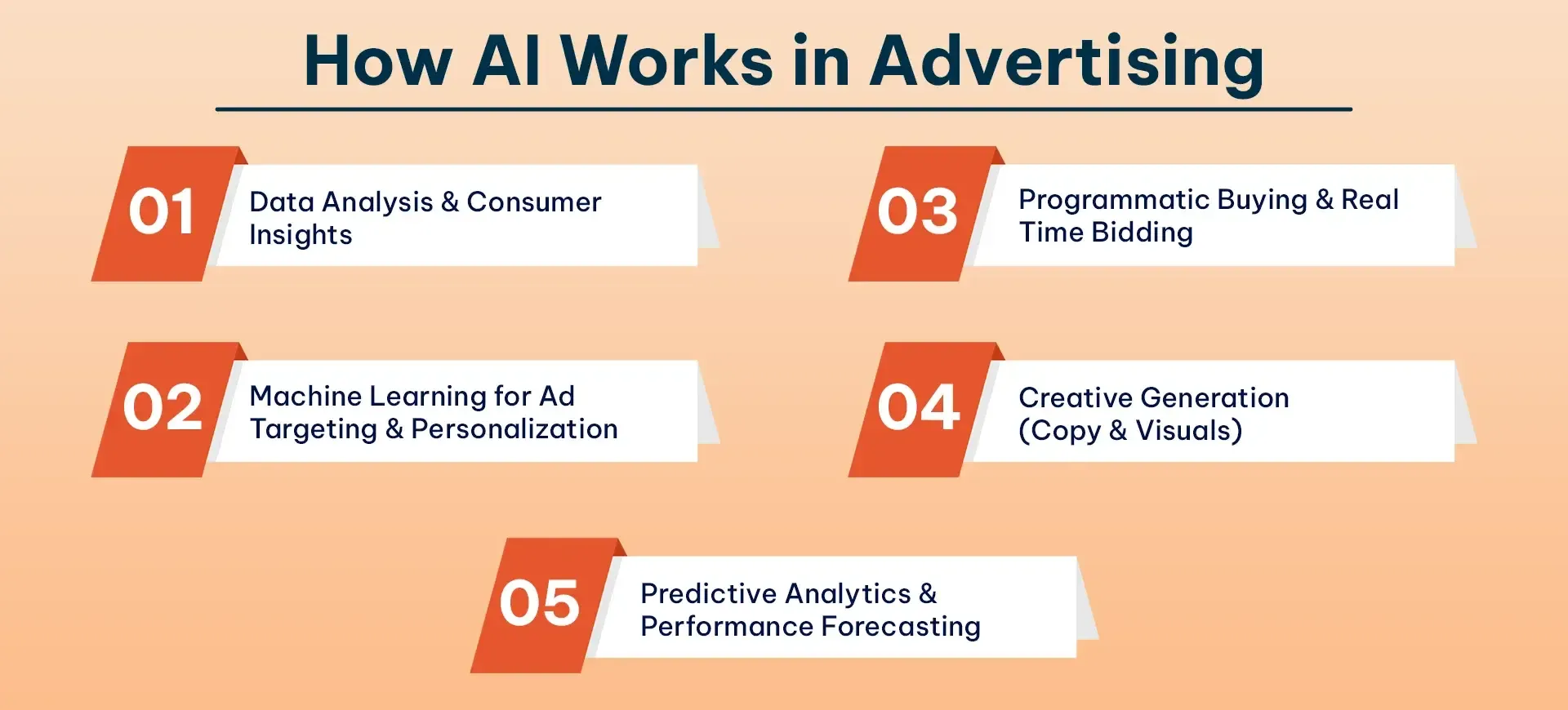
Data Analysis & Consumer Insights
The AI advertising platforms accumulated information from various sources such as website analytics, CRM (customer relationship management) systems, social media interactions, purchase histories, and data from third-party providers.
The application of sophisticated algorithms was employed to analyze the data and eventually identify customer behavior patterns, their preferences, and even their readiness signals for purchase.
-
Machine Learning for Ad Targeting & Personalization
Among the various applications of machine learning, the recognition of patterns in vast datasets comes at the top.
This opens the door to not just the true one-to-one personalization but also the entire scale of it, which is a big advantage over manual campaign management cases, where one can only imagine the resulting personalization.
-
Programmatic Buying & Real-Time Bidding
Programmatic advertising is a very advanced technique that relies heavily on artificial intelligence (AI) to trigger the purchase of ads automatically through the Real Time Bidding (RTB) auctions. An auction takes place in milliseconds when a user opens a webpage, and the advertisers place their bids to get the right to show their ad to this very user.
-
Creative Generation (Copy & Visuals)
Nowadays, Generative AI technologies are responsible for creating all sorts of advertising content, including copy, pictures, and even videos. Natural language processing models first scrutinize successful ad copy to detect which phrases, feelings, and structures engage people the most, and then they create new distributions that are tailored to particular audiences.
The technology doesn't supplant human creativity, but it does boost it, doing the labor of frequent variations while letting the creative people work on the more important stuff, like the strategy and the great ideas.
-
Predictive Analytics & Performance Forecasting
The system is powered by AI, which is a predictive analytics model that can predict the effectiveness of a campaign before even spending a dollar. By examining past data, market trends, seasonal fluctuations, and rivalry dynamics, these systems forecast the expected number of impressions, clicks, conversions, and costs for ups proposed campaigns.
Top Use Cases of AI in Advertising
Some of the best use cases that use AI in advertising are described below:
-
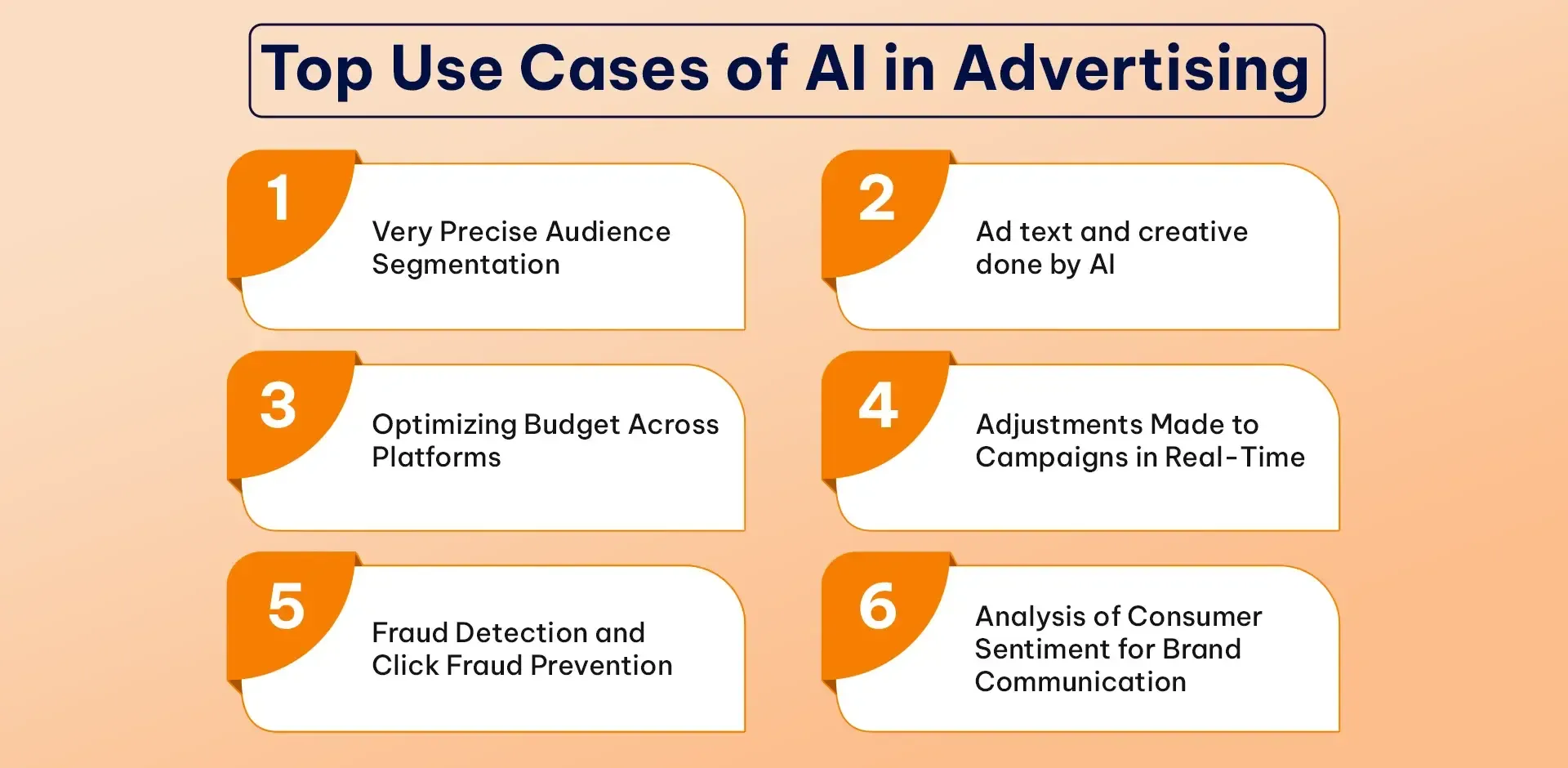
Very Precise Audience Segmentation: AI sorts out very small groups of audience that are very precise with behavioural patterns and not just demographic factors. Instead of targeting "women 25-34", the AI could identify "the frequent online shoppers who browse sustainable fashion brands during nighttime and are responsive to limited-time offers."
-
Ad text and creative done by AI: The platforms now generate an enormous number of variations of ad text, headlines, es and descriptions that are optimized for different audience segments, at the same time testing and scaling the best performers while retiring the underperforming creative.
-
Optimizing Budget Across Platforms: AI algorithms, based on the real-time performance, dynamically allocate budgets across different types of channels (search, social, display, video) and platforms (Google, Meta, TikTok), thereby automatically shifting resources towards the highest-performing placements.
-
Adjustments Made to Campaigns in Real-Time: AI does not hold up to weekly performance reviews, but rather, it makes continuous micro-adjustments to bids, targeting parameters, and ad delivery based on current performance signals and market conditions.
-
Fraud Detection and Click Fraud Prevention: Fraud detection involves the use of different machine learning models that can recognize certain patterns of behaviors which are deemed suspicious and are typically indicative of click fraud, bot traffic, or invalid impressions. The company thereby excludes fraudulent sources and also protects its advertising budget from waste.
-
Analysis of Consumer Sentiment for Brand Communication: By means of natural language processing, consumer sentiment in comments, reviews, and social media is analyzed so that the messaging strategies can be adjusted accordingly, and it is the emotional appeals and brand narratives that are identified to be most positive with the target audiences that are already known.
Also Read: How to Maximize ROI on AI in 2026: A Complete Guide
Benefits of Using AI in Advertising
Some of advantage of AI advertising that exist beyond simple automation:
-
Enhanced Advertising Targeting & Customization: AI evaluates considerably more factors than a human analyst could ever handle, finding and classifying potential customers with even better accuracy. The resulting high precision not only eliminates but also combines one wasted group (unlikely to convert) and the other (relevancy for users viewing your ads), thereby leading to the overall improvement of both efficiency and user experience.
-
Efficient Budget Allocation For Higher ROI: AI systems are able to draw the utmost value from the advertisement budgets by consistently adjusting the bids, placements, and targeting according to the performance data. A large number of advertisers notice the 20-40% enhancement of cost-per-acquisition after the adoption of AI-driven optimization.
-
Time Savings & Automation of Manual Tasks: AI handles routine optimization tasks that previously consumed hours of analyst time bid adjustments, A/B test management, budget reallocation, performance reporting. This frees marketing teams to focus on strategy, creative development, and customer insights rather than spreadsheet manipulation.
-
Better Decision-Making with Predictive Insights: Access to accurate performance forecasts and predictive analytics enables more confident strategic decisions. Rather than guessing which campaign approach might work, marketers can model likely outcomes and choose strategies with the highest probability of success.
Common Challenges & Considerations
AI in advertising, despite being a powerful tool, also entails some difficulties that have to be navigated thoughtfully:
-
Data Quality and Privacy Issues: AI is as good as its data; therefore, if the data is of poor quality, unreliable insights and bad decisions will be the result. Moreover, the new privacy regulations (GDPR, CCPA) and the banning of third-party cookies necessitate new methods of data gathering and consumer target marketing that not only safeguard the privacy of individuals but also retain their effectiveness.
-
Dependence on Automation: This may be the case that AI can manage the whole process very efficiently when it comes to optimization; however, it lacks the ability for strategic decision-making and creative rendering. Over-automation may result in a situation where the campaign is technically efficient but is strategically wrong or has lost its creative edge. Technology should be a human decision-maker's assistant and not its competitor.
-
Need for Human Review & Strategic Input: AI systems require clear objectives, appropriate constraints, and ongoing oversight. Without proper governance, algorithms might optimize for metrics that don't align with true business goals or fail to recognize when market conditions require strategic pivots. Human expertise remains essential for setting direction, interpreting results in broader business context, and ensuring ethical implementation.
Future Trends in AI Advertising (2026 and Beyond)
The development of AI-integrated promotion is still picking up speed rapidly:
-
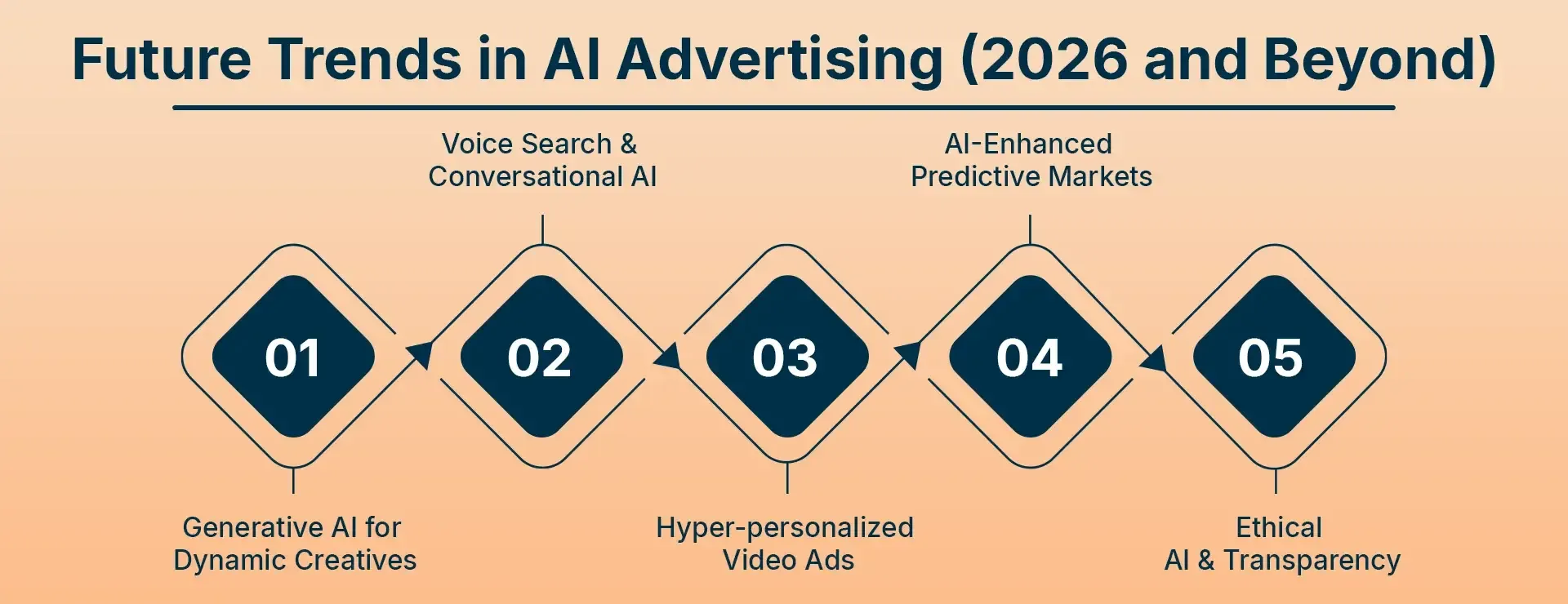
Generative AI for Dynamic Creatives: The time is coming for the audience to be able to see the AI-made video contents being ever more elaborate, the participation in the advertisement being informative, and the personalized user-friendly creative to be able to mold to the preferences of each user and thus to the individual creation of the advertisements for the whole audience.
-
Voice Search & Conversational AI: With the rising number of voice-controlled devices, AI would be able to optimize advertising campaigns for the searches made by voice and for the chatting interfaces. This will, in turn, necessitate the introduction of new strategies to identify the right keywords and ad formats, and also to understand the user intent.
-
Hyper-personalized Video Ads: AI will grant advertisers the privilege of making video ads that will be able to change according to the viewers' traits, the choice of the product, the person talking, the place, and the message being sent.
-
AI-Enhanced Predictive Markets: The future of the marketplace will see the use of complex predictive models that will look at a wider variety of signs from the market, such as economic indicators, social trends, and the actions of competitors, to make predictions about the effectiveness of advertising and the emergence of markets with higher accuracy.
-
Ethical AI & Transparency: More consumers will be educated about AI and its ethical implications, which will, in turn, lead to more regulatory scrutiny and will thus force the demand for an AI that can explain itself and justify its targeting decisions, treating all demographic groups fairly, and being the transparency bridge when it comes to data usage and algorithmic decision-making.
Step by Step Guide to Implementing AI in Your Ad Strategy
Are you ready to take advantage of AI advertising? Then you should follow this easy-to-use roadmap:
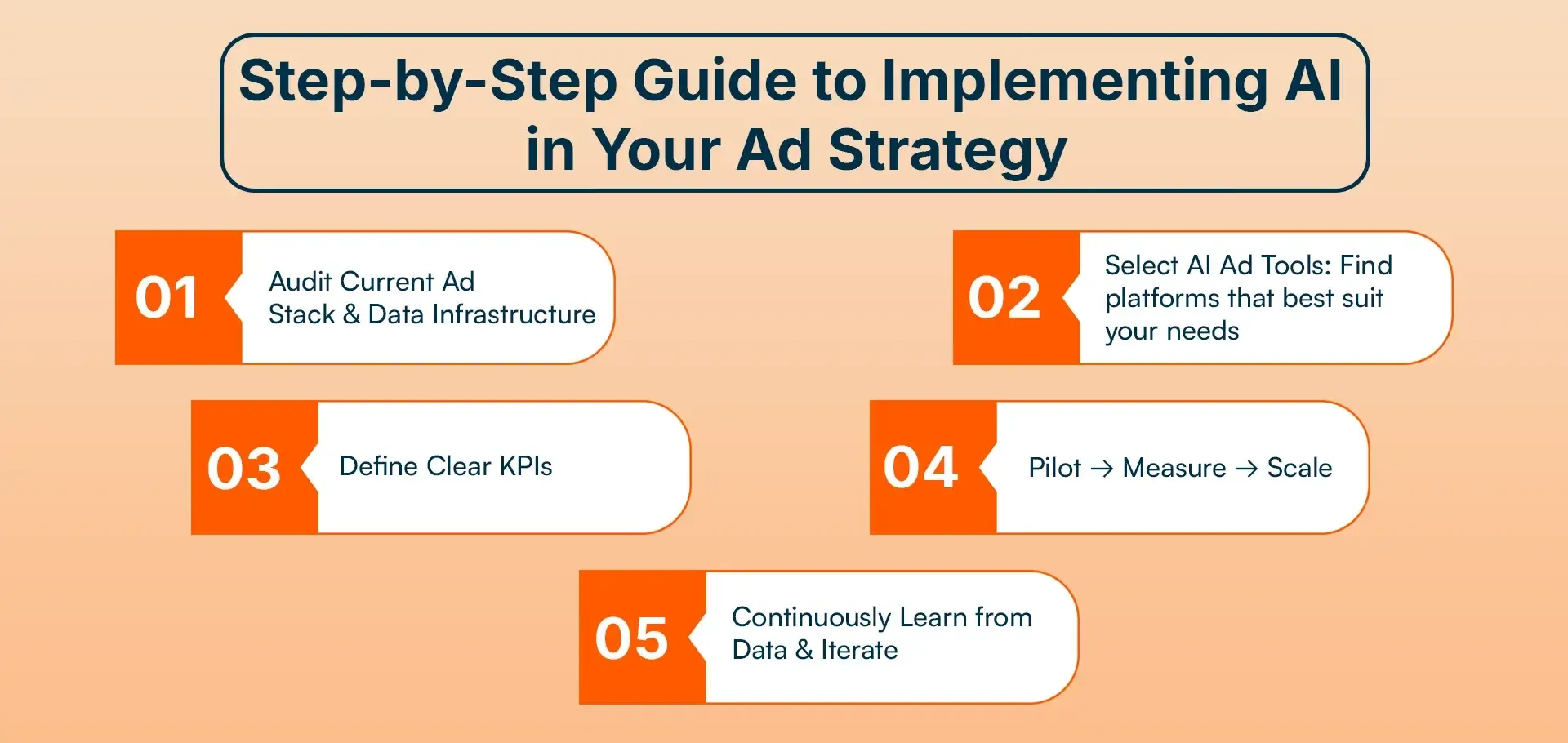
1. Audit Current Ad Stack & Data Infrastructure: Evaluate the existing advertising technology, data sources, and analytics capabilities. Find out where the data can be collected, the systems' integration points, and the quality issues that need to be resolved before the AI is put into production.
2. Select AI Ad Tools: Find platforms that best suit your needs, programmatic buying platforms (The Trade Desk, Google DV360), creative AI tools (Jasper, Canva), and optimization solutions (Albert.ai, Adext), etc. Evaluate on the criteria of integration capabilities, ease of use, and alignment with advertising goals.
3. Define Clear KPIs:
Be clear in your measurements and goals for AI. For instance, instead of setting a general objective like "better performance," give specific targets like "lower cost-per-acquisition by 25% while keeping conversion volume" or "raise return on ad spend from 3.5x to 4.2x."
4. Pilot,Measure,Scale:
Run limited pilots at the outset that will let you see AI capabilities on specific campaigns or channels. Measure results against control groups and do it rigorously, document learnings, refine approaches based on insights, then gradually expand successful implementations across your advertising program.
5. Continuously Learn from Data & Iterate:
AI is not a one-time project but rather an ongoing process of optimization. Keep on reviewing performance data, testing new capabilities as they become available, and altering your approach based on results and market conditions.
Real-World Case Studies / Examples
- E-commerce Retailer: A medium-sized online fashion retailer made use of AI-powered product recommendation ads that dynamically displayed items according to individual browsing history and similar customers' purchase patterns.
After three months, their return on ad spend had gone up from 2.8x to 4.3x while the cost of acquiring new customers was lessened by 34%.
-
B2B Software Company: A SaaS provider was able to tell which prospects were highly interested in their products thanks to AI, which did this by analyzing behavioral signals on their site, content engagement, and third-party intent data. The combination of AI-powered lead scoring and automated ad targeting helped the company to focus its budget on the most promising prospects and, in the process, increased the number of qualified leads by 67% and reduced the cost of each lead by 29%.
-
Local Service Business: A multi-location service provider utilized AI to automatically move the budget around between different geographic markets and platforms according to real-time performance with the help of a system that was always grounded in data. It was discovered that certain locations had very good performance on specific days and times, so delivery was adjusted accordingly, and overall campaign ROI was improved by 41%.
Conclusion
AI in advertising has made the biggest change in digital marketing since the introduction of social media. With the help of automation, machine learning, and predictive analytics, AI-powered ads bring about an astounding level of targeting accuracy, creative personalization, and budget efficiency that has never been experienced before.
The key points to remember are the following: AI advertising gives better targeting, measures the return on investment by continuous optimization, time-saving through automation, and so on. Nevertheless, it is still important to restrict the issue of data quality, to use less automation, and to provide human main strategic control in achieving success.
Your rivals have already started to try out these technologies; now it is up to you to decide whether to be at the forefront or to follow in the rear in the AI advertising revolution.
Ready to Scale Your Ads with AI?
At RejoiceHub, we help brands unlock AI-powered advertising strategies that drive higher ROI, smarter targeting, and faster growth.
Frequently Asked Questions
1. What is AI advertising in simple terms?
AI advertising uses artificial intelligence and machine learning to automatically create, target, and optimize ads by analyzing user behavior, data patterns, and real-time performance to improve results.
2. How does AI improve ad targeting?
AI improves ad targeting by analyzing browsing behavior, purchase history, location, interests, and engagement signals to identify high-intent users and deliver personalized ads at the right time.
3. Is AI advertising better than traditional digital advertising?
Yes, AI advertising is more efficient because it automates bidding, targeting, and creative testing in real time, reducing wasted ad spend and increasing conversion rates compared to manual methods.
4. What platforms support AI-powered advertising?
Popular platforms include Google Ads, Meta Ads (Facebook and Instagram), TikTok Ads, The Trade Desk, DV360, and AI tools like Albert.ai, Jasper, and Adext.
5. Can small businesses use AI in advertising?
Yes, small businesses can use AI advertising tools to automate campaigns, improve targeting, and optimize budgets without needing large marketing teams or advanced technical expertise.
6. How does AI help improve return on ad spend (ROAS)?
AI improves ROAS by reallocating budgets to high-performing ads, adjusting bids in real time, and testing multiple creatives to find the most profitable combinations.
7. Is AI advertising safe for user data and privacy?
AI advertising platforms follow data protection regulations like GDPR and CCPA, using consent-based and anonymized data to ensure privacy and ethical targeting.
8. What is programmatic advertising in AI marketing?
Programmatic advertising uses AI to automatically buy and place ads in real-time auctions, ensuring ads reach the most relevant audience at the lowest possible cost.
9. Can AI create ad copy and visuals?
Yes, generative AI tools can create headlines, ad text, images, and videos, allowing marketers to test multiple creative variations quickly and efficiently.
10. How can RejoiceHub help with AI advertising?
RejoiceHub helps businesses design and implement AI-powered advertising strategies, including audience targeting, automation, performance optimization, and scalable growth solutions.