The evolution of business over time shows that those businesses that have embraced and understood technology earlier have always remained at the forefront of the market. The same transition is occurring with Artificial Intelligence (AI) right now. AI is not just another fad in the business world; it is a transformative force that is changing how organizations are structured, operated, communicated about, grown, and innovated. I can say from my experience as I have been experimenting with AI for several years, building workflows for my business using AI tools/technologies, implementing automation using AI data applications and developing other business applications.
I have seen how AI has completely changed the ordinary things we do daily into power tools for our business. Many people believed that AI was only for large tech companies, but that is no longer the case. Anyone can take advantage of AI and use it to leapfrog their larger competitors simply by being more efficient and effective in their use of AI.
This article will help you understand how AI is providing companies with competitive advantages in the real world, and it will do so in a conversational format, with an extensive amount of information and supporting examples of various business cases. Whether you're new to AI or have been playing around with it, you'll gain insight into why businesses across the globe have come to view AI as their “growth engine”.
Quick Summary
Simply put, artificial intelligence or AI can give companies a competitive advantage by helping them work more efficiently and to improve customer satisfaction, streamline processes, minimise mistakes, and accelerate developing and introducing new products; as well as allowing them to make informed choices based on data that can't be quickly and accurately interpreted by a human. Essentially, AI is your "always available" digital assistant who works tamely and whose learning capabilities continuously improve.
Businesses using AI will tend to be able to save time, reduce the overall cost to run their business, increase accuracy, and boost productivity, while also providing a more personalised experience to their customers. Everything from market forecasts to the development of intelligent strategies to running the business can now be efficiently managed through AI as a "back-end" resource. Companies that adopt artificial intelligence will not only experience increased efficiencies, but they will also multiply their potential for growth.
Our focus in this article:
-
What is Ai and how it impact businesses.
-
How you can use Ai to improve your business efficiency
-
How current industries using artificial intelligence agents or tools to improve thier production
-
In the last we will know, what are the challenges facing by businesses in Ai deployments.
What is Artificial Intelligence?
When we think about artificial intelligence, we think of a machine's ability to think, learn and accomplish tasks that would typically require a human's ability to do them. Rather than tiring out or getting confused like us, AI will learn continuously and continue to improve and become more precise over time. In business, AI performs the same functions an extremely efficient employee would do, like observing and recognizing trends, collecting data from many different sources, communicating with customers, automating repetitive tasks, forecasting future trends, and assisting in making strategic business decisions.
AI can read and understand languages, recognise visual images, analyse human behaviour, and use logic and data to make decisions. As a result, companies are now able to operate without relying entirely on manual labour or guesswork to do their day-to-day operations. AI has added clearer, faster, and more precise processes and solutions to many processes that have not worked efficiently for years; AI allows you to quickly review and analyse huge volumes of data and receive actionable recommendations that allow you to act in an efficient manner.
AI provides businesses with insight into what customers think, which products will have the most successful sales performance, when demand is increasing, how your competitors are performing, and finally, which business decisions will lead to long-term success. In other words, AI will not take over your job as an employee but will enable you to work smarter and do more in a shorter period of time.
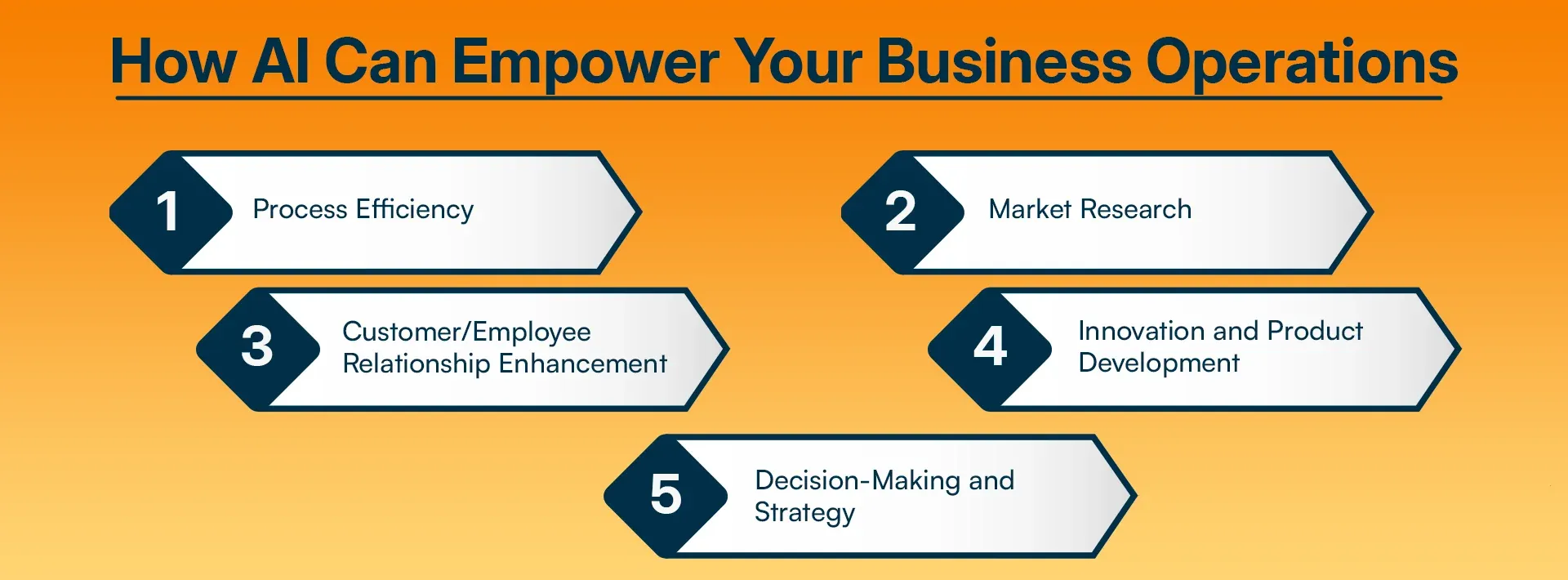
How AI Can Empower Your Business Operations
AI enhances business in multiple ways. Let's discuss in detail:
1. Process Efficiency
AI gives a business a competitive advantage through process efficiency. By streamlining internal business processes to be more efficient, faster, and automated, AI increases the overall productivity, responsiveness, and profit of the entire company.
-
Process Optimization
Regardless of business size, all businesses have a large number of processes operating concurrently. These processes could include inventory management, customer support, documentation, sales operations, marketing workflow, human resources (HR) functions, and project management coordination.
AI analyzes how a business's many processes function and helps the business optimize the processes. Instead of relying on manual systems that take a long time to complete tasks, AI creates smart workflows of interconnected and automated electronic processes, reducing the wait time between or throughout processes (i.e., processing sales orders).
For instance, by using an AI system to connect one's customer relationship management (CRM) system and the employee's email address, an employee may automatically receive notifications regarding new product listings added to a customer's shopping cart or new invoices created in their accounting system through email.
-
Reduction of Errors
Human error is often unpredictable and potentially costly. Regardless of the size of the error, AI significantly reduces the chances of error, as it verifies that data is accurate when entering, documenting, ordering, billing, scheduling, analyzing and reporting on data.
An example of this is that an AI system can evaluate and analyse thousands of invoices or financial documents for errors that are often undetectable to human viewers. In industries that require a high degree of accuracy, Logistics, Finance, Healthcare, Manufacturing, or Analytics, AI provides a layer of protection for losses to all parties involved.
-
Routine Task Automation
There is always a long list of redundant daily tasks that businesses engage in, such as responding to common customer inquiries, drafting basic email communications, setting appointments/meetings, completing mundane documents, building standard reports, managing file systems, and updating product listings. These repetitive tasks are time-consuming; therefore, by automating these tasks with AI, the business can regain lost productivity.
AI as a virtual assistant, completes the daily tasks of managing the day-to-day operations of the business much quicker than a human being would. It understands standard instructions, generates standard documents and scripts, completes standard spreadsheets, sends standard reminders, and keeps everything organized.
-
Predictive Maintenance
Breakdown of machines and equipment in any industry can have a significant negative impact on a company's profitability. AI provides a solution by collecting data from equipment and/or machinery that allows the user to establish a predictive model of machine performance through identifying patterns related to the use of the machine, vibration, temperature, performance, and previous failures.
This historical and pattern data allows a business to implement a preventative strategy that will prevent the business from having machine failures. Predictive Maintenance helps businesses save money, prevent delays and downtime, provide a safe working environment, and ensure an efficient operation.
-
Improving Supply Chain Efficiency
As a company expands, its supply chains will become increasingly complicated; therefore, it must establish an efficient way of monitoring its activities, rather than relying on someone to do it manually.
Historically, when assisted by technology in real-time (through AI), the company is able to get accurate information regarding how many products are ordered, how many products have been shipped, and what routes should be taken by the company’s suppliers to get their products from their warehouses to retailers.
AI provides those companies with recommendations regarding when to restock, how much inventory to keep, and how to optimally deliver their products.
2. Market Research
As opposed to the months of manual research that is the previous standard for completing a Market Research project, with artificial intelligence (AI), it could provide a much faster timeframe by performing the same task in a matter of minutes, but with a greater degree of accuracy. Businesses will have an enhanced and timelier insight into the target market, their competition and available opportunities.
-
Predictive Analytics
Predictive analytics represents one of the more significant areas of AI's potential. Predictive analytics uses past data combined with algorithms, patterns of a user's history to provide an estimate of likely future behaviour.
As such, predictive analytics can help predict future market trends and customers' demand for a product, users' purchasing habits, and the possible direction that competitors may take in the future.
The Cybersecurity Risk Assessment: Due to increased use of Online Services, there has been a significant increase of Cyber Threats. The use of AI offers businesses an option to remain protected by providing constant monitoring of the activities of your network, identifying any unusual behaviours, identifying malware, identifying potential weaknesses or vulnerabilities, and providing an automated way of blocking or preventing potential Cyber Attacks.
-
Use of Data to Provide Decision-Making
Today's businesses create massive amounts of Data; however, without being interpreted, it cannot be used for decision-making. By using Artificial Intelligence, raw data is translated into usable and meaningful Information.
For example, AI enables you to interpret user behaviour, sales performance, website traffic and engagement, customer preferences, and the effectiveness of marketing campaigns.
-
Automation of Competitor Analysis
In today's accelerated world, it is very important for companies to keep pace with their competitors. With the use of AI, companies can automate the monitoring of competitor activity, such as changes in pricing and their content strategies. AI also allows businesses to see overall Keyword performance and Customer Reviews, and to determine how their competitors are positioned within a specific market.
AI continuously collects and compiles data into information that will allow a business to make more informed decisions.
-
Forecasting Demand
To prevent waste or overstocking and to mitigate stock-outs or excess inventory, businesses need demand forecasting as part of supply chain management. AI models leverage the use of predictive analytics to forecast future demand through a variety of historical data sources, including seasonality, trends in purchasing behaviour, and market conditions.
Businesses will have the ability to create an accurate forecast, allowing them to appropriately plan their inventory, enhance their production processes, and allocate their available resources.
Also Read: How to Implement Business Process Automation
3. Customer/Employee Relationship Enhancement
AI allows customers to have personalized, responsive, and meaningful interactions with the businesses they patronize.
-
Customer Insights
Customer Engagement can occur at any time through customer interaction with the website, purchase history, social media, support chats, and customer feedback.
-
Personalization
By learning how customers interact with the brand, AI helps a company create a more accurate picture of who its customers are, what they desire, what frustrates them, and what motivates them, enabling them to develop better products and experiences for the consumer.
Today's consumer expects a high degree of personalisation. AI satisfies this need by delivering a unique experience for each customer, from providing specific product or service recommendations to preparing customized emails, creating personalised customer journeys, or sending customers relevant promotions.
-
AI Chatbots & Virtual Assistants
Chatbots and virtual assistants powered by AI serve the same functions as traditional customer service representatives but are available 24/7 to service customers.
Chatbots can quickly answer questions, resolve problems, track shipments, recommend products, and assist with appointment scheduling. In contrast to a human customer service team that takes breaks, chatbots are available 24 hours a day and 7 days a week.
-
Employee Productivity Tools
AI also supports employees in their roles, just as AI supports customers. AI assists employees in managing work tasks, writing emails, preparing reports, analyzing data, and performing routine functions.
With AI tools to assist with daily workflow, employees are more productive, more confident, and more capable of performing their roles efficiently.
-
Sentiment Analysis
AI is also capable of interpreting human emotions through the process of sentiment analysis.
By examining customer comments, reviews, messages, and feedback from a variety of sources, AI can determine how satisfied, frustrated, or angry customers may be with a service or product provided by an organization.
4. Innovation and Product Development
AI provides an acceleration to the innovation process and a shorter time to market for products and services.
-
AI Aids in Product Design
Product designs, prototypes, blueprints, and other congruent data are created quickly as AI provides simulated feedback on the performance of products with identified deficits prior to manufacturing. This significantly reduces the time and cost involved in developing a product.
-
Identify Trends
AI tracks global market trends, as well as customer activity and what products or services will be in demand in the future. This information is critical for companies to remain competitive in changing market conditions and trends. AI will also identify potential future directions, depending on customer interests and future market dynamics.
AI tracks global market trends, as well as customer activity and what products or services will be in demand in the future. This information is critical for companies to remain competitive in changing market conditions and trends.
-
Reduce Time to Enter Market
By utilising workflow processes that incorporate AI technology, the product development cycle is shortened.
This provides companies with the unique capability to design and manufacture products faster than any other company in the industry, thus allowing them to gain market share and start generating revenue sooner than competitors and establish themselves as industry leaders.
5. Decision-Making and Strategy
By putting real-time analytics right at their fingertips, AI empowers decision makers with the confidence needed to drive strategy through every layer of the organization.
-
Real-Time Analytics
Through the collection of live data from numerous sources, AI delivers user-friendly dashboards that present a clear view of performance metrics, customer behaviours, marketing ROI, as well as the financial status and operational performance of any business.
-
Scenario Planning
AI enables the creation of numerous business scenarios based on changing market conditions. No matter if there's a pricing change, a shift in the marketplace, competitor response, or a worldwide occurrence, AI will show how each may impact business operations.
-
Strategic Resource Allocation
By analyzing performance, costs, productivity, and returns, AI provides leaders with useful recommendations regarding how to allocate their resource budget, human capital, timeline, and/or investment effectively. Efficiently allocating resources improves ROI, minimizes waste, and increases revenue.
Best AI Tools for Small Business
Small Companies utilise Artificial Intelligence tools (AI) for the creation of internet-based content, automation, research, analytics, support, e-commerce, and basic operations.
Small companies are able to operate as large enterprises by utilizing such services as ChatGPT, Jasper, Midjourney, Zapier, Notion AI, SlackAI, SE Ranking, Looker, IntercomAI, Tidio, Shopify AI, QuickBooks AI, and Odoo, without significantly increasing costs or adding employees.
Such tools provide small businesses with an economical method of implementing new business management systems, while increasing their capabilities for enhancing the daily performance of their businesses.
Challenges and Considerations
Even though AI has many benefits, it also presents several challenges, including the potential misuse of personal data and the need for technical knowledge to implement and maintain systems.
As such, businesses need to prioritise data security, to determine how best to allocate financial resources, as well as develop training programs to increase the effectiveness of AI. Although these challenges exist, they can be effectively managed with proper planning and execution. When done properly, AI has proven to generate returns well over the amount initially invested.
Conclusion
Artificial Intelligence (AI) is one of the most powerful influencers in the world of business today. It helps organisations compete by increasing efficiencies throughout the production process, enhancing the customer experience, providing opportunities for data-driven decision-making, lowering the risk of making mistakes, and promoting innovation. AI will help any business, regardless of size, run smarter, quicker, and more profitably.
Early adopters of AI will become the leaders of tomorrow. Early adopters will have a competitive advantage over slow adopters. Companies that adopt intelligent technologies will create improved products, deliver great services, and make better decisions.
If you also want to deploy AI solutions to your systems or company, then you can prefer Rejoicehub firm, who are so experienced in deploying AI agents or custom software.
Frequently Asked Questions
1. In what ways does AI make it easier for a business to be ahead of its competitors?
AI helps improve efficiency, effectiveness and decision-making and will improve customer experiences to outperform competitors' businesses.
2. Is AI too costly to adopt for small businesses?
Many companies offer a wide range of free and low-cost tools that include most of the same features available to larger organisations.
3. Can artificial intelligence replace human employees in the workforce?
AI cannot replace the strategic or creative aspects of work that typically require a person's involvement; AI performs repetitive, tedious tasks, freeing up time for employees to work on higher-value assignments.
4. In what way does AI help with customer support?
The use of AI chatbots and assistants makes it possible for customers to receive immediate interaction with a company, decreasing wait times and improving the overall experience of customers.
5. How does AI improve marketing?
AI has improved the process of creating marketing materials, reaching out to target audiences, analysing marketing data and offering targeted messages.
6. Can I trust AI to be secure for business applications?
Businesses must rely on safeguards to protect their customers' data and choose only reputable vendors.
7. Who are the industries that stand to gain the most from using AI?
The retail, e-commerce, healthcare, finance, information technology (IT), human resources (HR), manufacturing and almost all service industries will benefit from AI.
8. Do I need to have a technical background to use AI?
No, you don't need a technical background. Most AI tools are very easy to use and require only basic digital skills.
9. Why should businesses implement AI today?
AI allows for rapid growth and increases the value of a company's existing customers, as well as creates a competitive edge that will last well into the future.