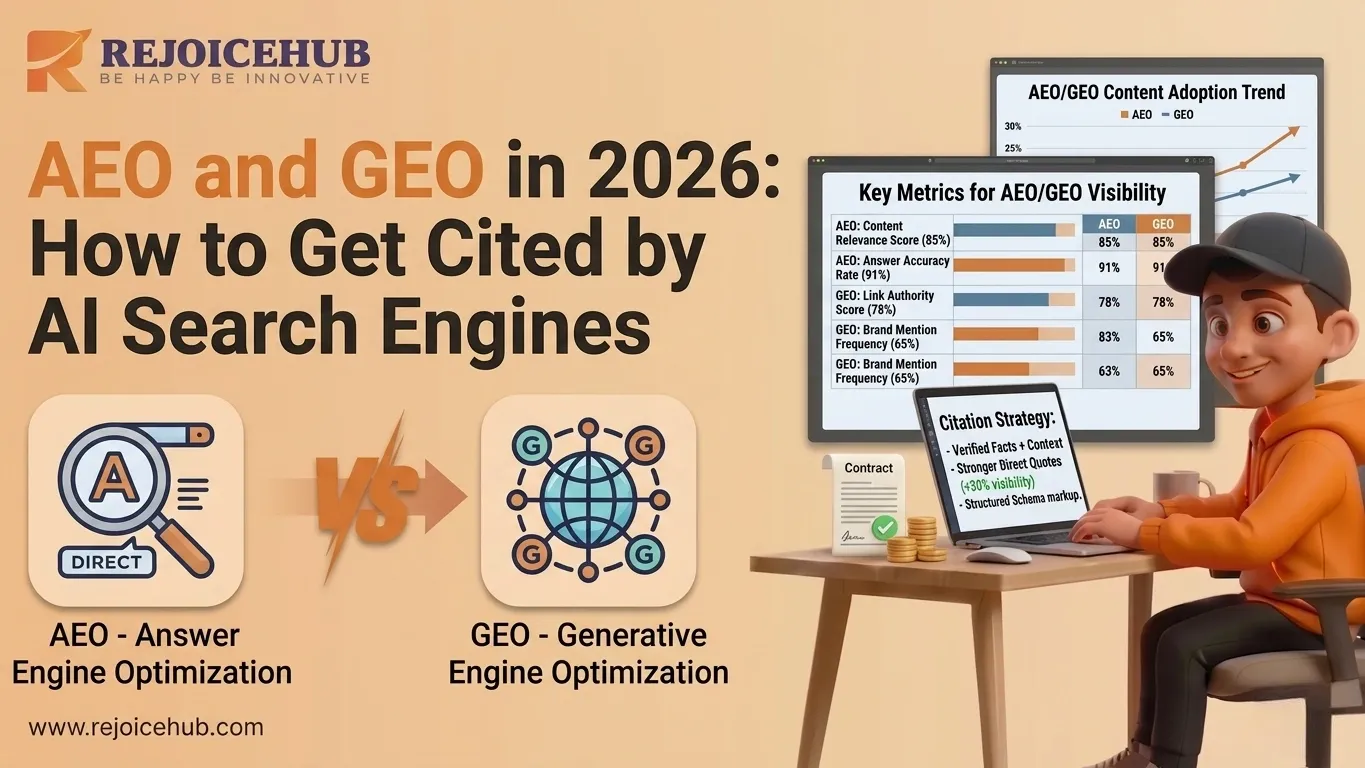
Google is no longer the only discovery engine, and that kind of thing changes everything for your brand, seriously.
For the last two decades, SEO basically meant one simple thing: rank on Google, get clicked. But in 2026, millions of people just skip the search results. They toss a question into ChatGPT. They ask Gemini for an explanation. They use Perplexity to research a vendor. And then these AI assistants answer them right there, no fuss, no linking to your site most of the time.
So yeah, that's the shift. AI-generated search results don't just show links anymore. They deliver the answer. And if your brand isn't being cited inside those answers, you're kind of invisible even if you still rank really well on Google.
This is why AEO and GEO have turned into the big marketing disciplines of 2026. Brands that understand those will end up leading the AI-driven discovery race. Brands that don't will sit there watching traffic fade quietly. Like, slowly, then all at once.
In this guide, we'll unpack what AEO and GEO mean, how AI search engines decide what to cite, and the practical steps you can take to get your brand mentioned by ChatGPT, Claude, Gemini, and Perplexity.
What Are AEO and GEO?
These two terms often get used interchangeably, but they're distinct disciplines, and you need both.
What is Answer Engine Optimization (AEO)?
Answer Engine Optimization (AEO) is basically the practice of setting up your content in a way so it shows up as a direct reply, instead of being just a blue link someone still has to click, you know. It's like you are trying to make the answer feel immediate, not delayed by someone doing an extra step.
AEO targets:
- Featured snippets: the box at the top of Google results that answers a query directly
- Voice search: when Siri, Alexa, or Google Assistant reads an answer aloud
- Direct answers: short, factual responses that Google or Bing extracts from your page
The goal of AEO is to be the answer to traditional search. It has been around for years, but it sorta laid the groundwork for what GEO builds on now, you know.
What is Generative Engine Optimization (GEO)?
Generative Engine Optimization (GEO) is a bit newer and, honestly, more complex too. It is largely about getting your brand seen in AI-generated responses that come out of large language models like ChatGPT, Gemini, Claude, and Perplexity.
GEO targets:
- AI-generated answers: full conversational responses that synthesize multiple sources
- LLM citations: when an AI model names or links your brand as a source
- Conversational AI visibility: appearing in follow-up questions, comparisons, and recommendations
Where AEO is about structure and snippets, GEO is about trust, authority, and semantic clarity across the web.
AEO vs. GEO vs. Traditional SEO
| Factor | Traditional SEO | AEO | GEO |
|---|---|---|---|
| Target | Google rankings | Featured snippets / voice | AI-generated answers |
| Goal | Drive clicks to the site | Be the direct answer | Get cited by LLMs |
| Format | Pages and backlinks | Concise Q&A content | Authority signals + semantics |
| Measurement | Rankings, traffic | Snippet impressions | Brand mentions in AI answers |
| Key tools | Keywords, links | Schema, structured data | E-E-A-T, entity building |
In 2026, the smart move is to optimize for all three, but GEO is where the bigger competitive gap still kinda sits, yeah.
How AI Search Engines Choose Sources
Before you can optimize for AI citation, you kinda need to get a grip on how systems like ChatGPT, Gemini, Claude, and Perplexity really choose what to reference. Not like, in a magic way, but more in how they scan signals, pick a trail, then decide. Often it feels almost human, but it is still mechanical, just with a different voice.
Each platform works differently, but they share core signals:
- ChatGPT (with browsing / SearchGPT) retrieves real-time web content for current queries, favoring authoritative domains with clear, structured answers.
- Gemini is deeply integrated with Google's knowledge graph, which means E-E-A-T signals and domain authority heavily influence what it pulls.
- Claude (Anthropic) prioritizes factual clarity, source credibility, and semantic coherence; it tends to favor content that is precise and well-organized.
- Perplexity is the most search-engine-like of the group. It cites sources visibly, pulling from high-authority domains and pages that answer questions directly.
All of them are trained on, or retrieve from, content that has established itself as believable, easy to follow, and pretty consistently accurate. Like, you know, it's not just random stuff, it's material that's been proven to work clear and trustworthy.
The Role of Entities and Authority
AI models don't only see the text, they kind of understand the entities inside it: people, brands, products, and even idea concepts, plus how these things relate to each other, somehow.
To get cited, your brand needs to exist clearly as an entity. That means:
- E-E-A-T (Experience, Expertise, Authoritativeness, Trustworthiness) Google's framework, but also a signal that LLMs weigh heavily. Expert authors, cited credentials, and accurate information all matter.
- Knowledge graphs if your brand appears in Wikipedia, Wikidata, or Google's own knowledge graph, LLMs are far more likely to reference you.
- Brand mentions consistent, unlinked mentions of your brand name across credible platforms signal to AI models that your brand is real, relevant, and worth citing.
Why AI Models Prefer Trusted Sources
LLMs are trained to minimize error and avoid misinformation. That creates a strong bias toward:
- Consensus signals: content that aligns with what multiple authoritative sources say
- Authoritative domains: .edu, .gov, major publications, established industry sites
- Semantic clarity: content where the meaning is unambiguous and the topic is well-defined
How to Rank in AI-Generated Search Results
Here's what actually moves the needle for GEO and AEO in 2026.
1. Build Topical Authority
AI models trust sources that consistently cover a topic in depth. One good article isn't enough.
To build topical authority:
- Create content clusters: a central pillar page on a topic, supported by 8–15 related articles that go deep on subtopics. This signals to LLMs that your site is a comprehensive resource.
- Use expert-led content: bylines from credentialed authors, quotes from industry specialists, and first-person experience all boost perceived authority.
- Publish original insights: proprietary data, original research, unique frameworks, and case studies are highly citation-worthy. LLMs favor content that can't be found anywhere else.
If you're building a content strategy for AI visibility, the RejoiceHub team can help you map out a topical authority framework tailored to your industry.
2. Use Structured Data and Semantic SEO
Structured data helps AI systems understand what your content means not just what it says.
Focus on:
- Schema markup: add Article, Organization, Product, and HowTo schema to relevant pages
- FAQ schema: question-and-answer format is one of the most retrieval-friendly content structures; AI models are essentially trained on Q&A patterns
- Entity optimization: use consistent naming for your brand, products, and people across all pages; link internally to reinforce relationships
3. Write Retrieval-Friendly Content
AI systems pull content in chunks, not in the "read everything" way, like a human would. They do not really take in the whole page at once. Instead, they sort of slice it up and then work with those fragments.
To make your content easy to retrieve:
- Lead with concise answers: answer the core question in the first 2–3 sentences, then expand
- Use chunked formatting: short paragraphs, clear subheadings, and bulleted lists all help AI systems extract the relevant portion
- Use question-based headings: "How does X work?" and "What is the difference between A and B?" align with how users actually query AI assistants
GEO Strategies Brands Should Use in 2026
These are the tactics most competitors are still ignoring.
4. Increase Brand Mentions Across the Web
LLMs are trained on the broader web. The more your brand is mentioned in credible, diverse contexts, the more "real" and "relevant" it becomes to AI systems.
Target mentions on:
- Reddit: active community discussions mentioning your brand signal genuine user interest
- GitHub: for tech brands, open-source contributions and repository mentions carry significant weight
- YouTube: video transcripts are indexed; getting mentioned in popular videos is a strong signal
- Industry forums and communities: niche forums, Slack communities, and newsletter mentions all contribute
- PR and media placements: coverage in recognized publications is one of the highest-value citation signals available
This isn't just about SEO backlinks anymore, it's more like presence the breadth of your footprint across the whole web, like really.
5. Optimize for Multi-Platform AI Visibility
Each AI assistant has a different retrieval behavior. A smart GEO strategy accounts for all of them:
- Perplexity: focuses on real-time web retrieval; ensure your pages load fast, answer questions directly, and are indexed by major search engines
- Gemini: prioritize Google's ecosystem: Google Business Profile, YouTube, Google News, schema markup
- Claude: favors clarity, accuracy, and structured explanations; long-form, well-cited content performs well
- ChatGPT: benefits from brand presence on high-authority domains and strong Wikipedia/knowledge graph presence
Understanding how AI agents help automate workflows can also give you a useful lens for thinking about how these systems retrieve and act on information.
6. Create Citation-Worthy Content
The single most reliable GEO strategy is publishing content that AI systems kind of want to cite, like in a very natural way. It's not just posting, it's making sure your pages, notes, or snippets basically match what those systems seem ready to reference and pull, even if it sounds simple.
That means:
- Original statistics and data: commission or conduct research; publish findings with clear methodology
- Frameworks and models: named frameworks (like the "AEO vs GEO vs SEO" matrix above) give AI systems a clear, citable structure
- Expert commentary: interviews, roundups, and quotes from recognized experts
- Comprehensive guides: long-form content that covers a topic end-to-end is more likely to be retrieved for complex queries
RejoiceHub helps brands build the kind of content infrastructure backed by AI automation services that makes citation-worthy content scalable.
The Future of SEO, AEO, and GEO
The traditional blue-link model of SEO isn't dead yet but its dominance is ending.
What's declining:
- Click-through rates from traditional search are falling as AI answers resolve queries without a visit
- Exact-match keyword targeting is losing importance relative to topical authority and semantic relevance
- Link-based ranking signals are being diluted by entity-based and trust-based signals
What's rising:
- Conversational search is becoming the default users expect answers, not links
- AI agents are emerging as discovery systems: tools like ChatGPT's Operator or Google's AI Mode don't just answer, they act researching, comparing, and recommending on a user's behalf
- Zero-click experiences are becoming the norm, which means your brand's mention and citation are now the primary unit of value, not the click
What this means for your brand: visibility in 2026 is about being the source AI agents trust, not just the page that ranks well. The brands investing in GEO now will build a compounding advantage that latecomers won't easily close.
RejoiceHub exists at exactly this intersection AI development, automation, and forward-looking digital strategy. We're not guessing at where search is going. We're building for it.
Conclusion
AI search isn't really a "trend" anymore, it's sort of the default thing for millions of users right now. ChatGPT handles business questions. Gemini digs into products. Perplexity swaps out those vendor comparison pages. Claude even drafts suggestions.
In this kind of world, your presence hinges on two things: authority and clarity. AI models drop citations that are reliable, steady, and simple to read back. Brands that tune their content for those signals using AEO, GEO, and a smart generative AI content strategy will show up in the responses. If they don't, they kind of disappear.
The chance to move early is still there, but it's closing up fast.
Frequently Asked Questions
1. What is the difference between AEO and GEO?
AEO (Answer Engine Optimization) focuses on getting your content featured as a direct answer in traditional search, like Google snippets or voice results. GEO (Generative Engine Optimization) is about getting your brand cited inside AI-generated responses from tools like ChatGPT, Gemini, or Claude.
2. How does Generative Engine Optimization actually work?
Generative Engine Optimization means shaping your content so AI models trust it enough to reference it. That includes building topical authority, using clear, structured formatting, earning brand mentions across the web, and making sure your content is easy for AI systems to pull and understand quickly.
3. How can I get my brand cited by ChatGPT or Perplexity?
To get cited by ChatGPT or Perplexity, your brand needs to show up consistently on high-authority sites, have clear and well-structured content, and be mentioned across places like Reddit, YouTube, and reputable publications. Strong E-E-A-T signals and original data also help a lot.
4. What does it mean to rank in AI-generated search results?
Ranking in AI-generated search results means your brand or content gets mentioned or referenced inside an AI assistant's answer, not just shown as a link. It is less about keywords and more about being seen as a reliable, clear, and consistent source across the web.
5. Is GEO different from traditional SEO, and do I still need both?
Yes, they are different. Traditional SEO is about ranking on Google and getting clicks. GEO is about getting named inside AI answers, where no click even happens. In 2026, smart brands are doing both because Google traffic still matters, but AI visibility is growing fast and the competition there is still low.
6. Which AI search engines should I optimize my content for?
The main ones to focus on are ChatGPT, Google Gemini, Perplexity, and Claude. Each works a bit differently. Perplexity pulls live web results, Gemini leans on Google's ecosystem, Claude prefers clear and well-cited content, and ChatGPT responds well to strong domain authority and knowledge graph presence.
7. What kind of content gets cited most by AI tools like Gemini and Claude?
AI tools tend to cite content that includes original research, clear frameworks, expert quotes, and comprehensive topic coverage. Content that directly answers questions, uses simple formatting, and comes from a trusted or frequently mentioned brand tends to get referenced far more often than generic blog posts.