 Let me ask you a question: Would you have confidence in a physician who was not able to give an explanation for prescribing a particular drug?
Most likely, no. The same reasoning is true for artificial intelligence. Since AI systems are taking on more and more vital tasks, such as approving loans and diagnosing patients, the need for us to understand their reasoning rises.
explainable artificial intelligence helps to answer this question, and it is rapidly turning out to be the most significant battle in the ethical development of AI.
In this post, I will guide you through all the essential information regarding explainable AI. The content will include its definition, significance, functioning, and business applications, the latter in times of trust-building and, consequently, improved decision-making.
What Is Explainable AI (XAI)?
Explainable AI (XAI), as the name implies, is the category of artificial intelligence that can provide explanations in human terms of how its models have arrived at their decisions.
Imagine it is akin to revealing your methodology in solving a math problem. The final result by itself is not enough for you, who have to prove your way of reaching it.
XAI's foundational tenets are anchored in three main ideas: openness in the decision-making process, confidence between people and machines, and taking responsibility for errors and wrong doings.
The Black-Box Problem:
Here is the problem we are encountering.
explainability in ai is a machine learning system that can perform deep learning like a black box. You put the input data in, and predictions come out, but the process in between is often completely obscure.
Even the technical experts who develop these algorithms are not always able to provide a rationale for the specific decision made by the model. This lack of transparency is a serious issue.
If an AI system does not provide the rationale behind its operation, then the system's trustworthiness should also be questioned. Is it not fair to know the reason behind the rejection if a bank's AI denies your loan application?
Explainability vs. Interpretability: What's the Difference?
You'll often hear that term used interchangeably; there's a distinction that's worth zero. How well can you understand the internal workings of a model before it runs? Some explain, which may focus on understanding specific decisions after the model that made them.
A simple decision tree is transparent, and you follow the logic path from start to finish. A complex neural network that requires tools to explain individual predictions after the fact.
Both concepts aim for the same goal, which makes an AI system that is understandable to humans.
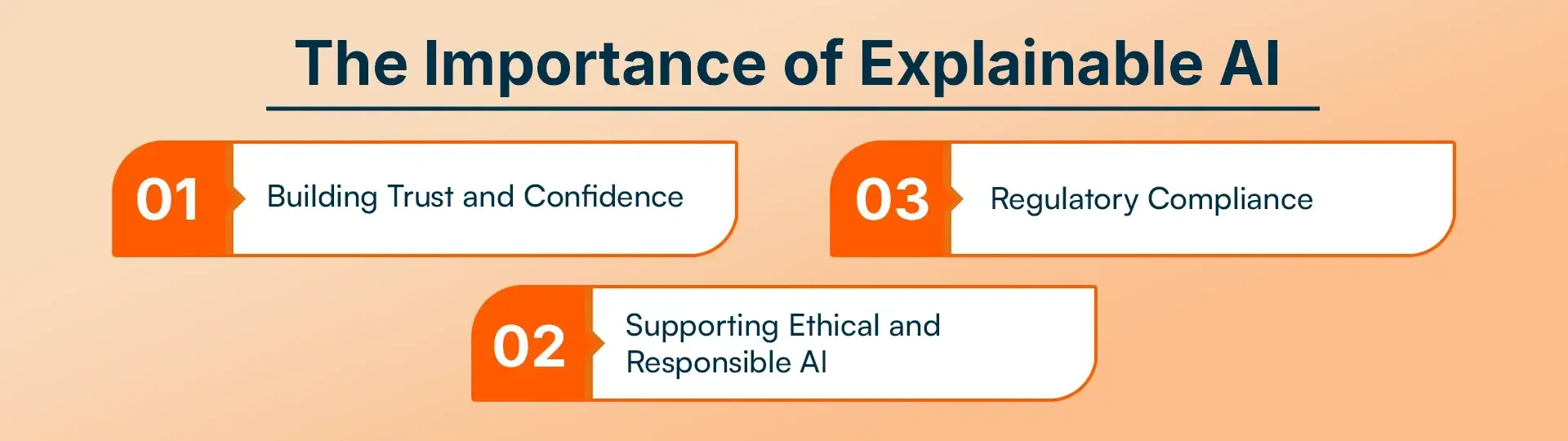
The Importance of Explainable AI
Let's understand some importance related to this AI, which uses fundamental concepts that help to interact more easily, and the user can explain any technical terms for specific and commercial purposes.
-
Building Trust and Confidence
No company will use AI systems whose workings are not clear to them, and no customer will accept the decision made by hidden algorithms.
Trust is the main factor in the AI adoption process. I have observed that businesses have been reluctant to use strong AI tools just because they can't break down the results to their stakeholders.
The moment you can demonstrate the thought process of AI to the top management, staff, and customers, the acceptance rates will soar. Explainability in ai converts the doubtful into the supportive by eliminating the anxiety caused by non-clarity.
-
Supporting Ethical and Responsible AI
There's a direct connection between explainable artificial intelligence and ethical AI development. When we see how an AI system performs AI decisions that can spot problems before they cause harm.
Explainability ai cannot be limited to merely creating powerful systems; it is crucial to make sure such systems comply with human values and societal norms. One of the roles of explainability is to protect us by allowing us to check if AI systems are not using characteristics like race, gender, or age in a forbidden way to make their decisions.
-
Regulatory Compliance
This has turned into a necessity and not a luxury. Around the globe, the regulators are prescribing that AI systems should be explainable to the end-user.
The European Union's General Data Protection Regulation grants individuals the right to be informed about the criteria used in automated decisions. Other countries are also enacting similar kinds of regulations.
Explainable artificial intelligence is becoming a legal requirement in very tightly governed sectors such as medical care, banking, and insurance. Firms that are unable to provide justifications for their AI-based decisions run the risk of incurring fines, going through lawsuits, and suffering a decline in their brand's image.
It is not only a wise move to meet these demands ahead of their time, but it is also a requirement for remaining in the market.
How Explainable AI Works
These Explainable AI works in various forms that can be inherited by some of the useful steps and factors considered to be :
-
Core Components of XAI
Every explainable AI system has three main components that support each other. The first component is the model itself, the prediction maker AI or machine learning system.
The second component is the explanation algorithm, which investigates the model's actions and produces comprehensible insights. The third component is the interface layer that conveys these explanations to people in an easily digestible manner.
These components are working together without any problems. The AI model is analyzing the data and providing predictions as usual. The explanation algorithm looks at the model's reasoning for the specific case, and it is mentioned here.
At last, the interface has to interpret the technical aspects into a language that is easy to understand by a layman, and this can be done through the use of visualizations, text descriptions, or interactive tools.
-
Common XAI Techniques
AI has been made more understandable through a number of powerful techniques that have now gone mainstream. LIME (Local Interpretable Model-agnostic Explanations) and SHAP (Shapley Additive Explanations) are among the foremost model-agnostic methods.
These instruments can be applied to any kind of machine learning model and do so by interpreting individual predictions and revealing the extent of influence of each synthetic feature in the decision.
Explainability ai is a distinction that exists between white-box and black-box approaches. White-box techniques are utilized to work with models that are already clear, such as linear regression or decision trees. On the other hand, black-box techniques are used to work with neural networks, which are not able to naturally divulge their logic.
For instance, when an AI system declines a loan application, feature importance may expose that credit history is given considerable weight, whereas employment duration hardly has any effect. This detailed breakdown transforms AI decisions into actionable and understandable ones.
Practical Benefits of Explainable AI
Now, I'll discuss some practical benefits that help to understand each various terms, so let's explain in detail:

1. Better Decision-Making and Debugging
When data professionals and developers can understand the decision process of their models, model improvement will take place more quickly than ever before. Explainable AI transforms model development from trial and error to knowledgeable iteration.
Valuable time for debugging has been reduced by half just through the use of application of explainability tools in the teams I've observed.
2. Bias Detection and Risk Mitigation
This is the point where explainability really shows its great potential. Biases that are not easily seen in AI systems can still lead to discrimination and harm in the real world. The unaccounted biases, in the scenarios without explainability, are gradually made visible only when damage occurs.
3. Increased Adoption Across Stakeholders
The approval of stakeholders determines the success of AI projects. When the AI systems are understood by the executives, compliance teams, customers, and end-users, the resistance is reduced, and the acceptance is increased.
The sales teams would not have any doubts while explaining the recommendations made based on AI to the customers. The customer service representatives reply to the customers worries about the decisions made by automated systems would be that the decision would be taken after consulting the AI.
4. Regulatory Insight and Auditability
explainable AI is a tool that compliance teams adore since it allows them to do their work. In case regulators or auditors inquired about particular decisions, you could submit a detailed record of how the AI arrived at its verdicts.
This traceability is not only for regulatory compliance but also for other purposes. Internal risk management professionals have to be informed about AI's decisions to evaluate the possible liabilities.
Challenges and Limitations of XAI
Honestly speaking, the AI that can explain itself still has major problems to deal with. One of such problems is the codec processing. The additional resources in terms of power and time required to make the AI model understandable and user-friendly are not tolerable in some systems that work in real-time, and thus affect them negatively.
And also, there is always a huge overlap between the issues of accuracy and interpretability. The AI models that are able to give the most accurate results are usually the most difficult to explain because of their complicated nature.
Explainability in ai models that are straightforward and can be easily interpreted are friendly for the user, but they also have the drawback of being less efficient. It is a matter of finding the right trade-off for a specific case, which is often a difficult task.
Real-World Use Cases
Some of the use cases that can be described are also helpful to Explainable AI, where every niche productive developer can use AI tools:

-
Healthcare
In hospitals and clinics, AI that is explainable could be a source of life. If an AI application points to a possible tumor in a diagnostic imaging or suggests a certain treatment, then it is vital for the doctors to know the logic behind it.
-
Financial Services
Explainable AI is employed by banks and other financial institutions for applications like loan approval, credit scoring, and fraud detection. The stipulation of explainability guarantees that the bank will be able to provide unambiguous reasons for the approval or denial of the mortgage application, thus complying with the rules and at the same time fostering the trust of the customer.
-
Data Analytics and Business Intelligence
It is essential for organizations that apply analytics platforms to put their faith in the forecasts of their models. Explainable AI is one of the main reasons that help firms gain knowledge of customer churn causes, sales influencers, and market trends. Such knowledge employs transforming pure predictions into guiding business strategies.
Best Practices for Implementing Explainable AI
Start by establishing cross-functional AI governance teams that include data scientists, ethicists, legal experts, and business stakeholders. This diverse perspective ensures that explainability efforts address everyone's concerns.
Choose your tools based on your specific needs. Some situations require global explanations showing overall model behavior, while others need local explanations for individual decisions. Understanding this distinction helps you select the right approach.
Most importantly, integrate explainability AI into your entire machine learning lifecycle.
Conclusion
Explainability in ai is a revolutionary concept that enables us to create and integrate artificial intelligence differently. Rejoicehub also provides some of the AI systems' transparency, clarity, and accountability. We can make technology that can be trusted by people and used confidently.
explainable AI gives better decisions, eliminates biases, has wider usage, and meets regulations. However, there are still bumps on the road to explainable AI, but its advantages are already huge, and it is coming anyway.
The future of AI is not only about the development of intelligent systems but also about the building of comprehensible systems. The journey of the future of AI starts with explainable AI. And it is a journey that starts now.
Frequently Asked Questions
1. What is explainable AI in simple terms?
Explainable AI (XAI) refers to artificial intelligence systems that can clearly show how they reached specific decisions, making their reasoning transparent and understandable to humans.
2. Why is explainability in AI important?
Explainability in AI builds trust, ensures fairness, helps detect bias, and meets regulatory requirements. It allows people to understand and verify how AI systems make decisions.
3. What is the difference between explainable AI and regular AI?
Regular AI often works like a black box with hidden processes, while explainable AI provides clear reasons for its decisions, showing which factors influenced each outcome.
4. How does explainable artificial intelligence work?
Explainable artificial intelligence uses special algorithms to analyze AI model decisions and translate them into human-understandable explanations through visualizations, text descriptions, or interactive tools.
5. What are the benefits of using explainable AI?
Benefits include better decision-making, bias detection, increased stakeholder trust, regulatory compliance, easier debugging, and the ability to audit AI systems for fairness and accuracy.
6. What industries need explainable AI the most?
Healthcare, banking, insurance, and legal sectors need explainable AI most because their decisions directly impact lives and require clear justification for regulatory and ethical reasons.
7. Can explainable AI detect bias in algorithms?
Yes, explainability ai helps identify hidden biases by revealing which factors influence decisions, allowing teams to spot and fix unfair patterns before they cause real harm.
8. What is the black box problem in AI?
The black box problem occurs when AI systems make decisions without showing their reasoning process, making it impossible to understand why specific outcomes happened or verify fairness.
9. Is explainable AI required by law?
In many regions, yes. Laws like Europe's GDPR require companies to explain automated decisions. Healthcare, finance, and insurance sectors face strict explainability requirements for AI systems.
10. What are common explainable AI techniques?
Popular techniques include LIME (Local Interpretable Model-agnostic Explanations), SHAP (Shapley Additive Explanations), feature importance analysis, and decision trees that show clear reasoning paths.
11. Does explainable AI make models less accurate?
Sometimes there's a trade-off. Highly accurate deep learning models can be harder to explain, while simpler interpretable models may sacrifice some accuracy for transparency.
12. How can businesses implement explainable AI?
Businesses should create cross-functional teams, choose appropriate explainability tools, integrate transparency throughout the AI development process, and document all decision-making factors clearly.
13. What's the difference between interpretability and explainability in AI?
Interpretability means understanding how a model works internally before it runs, while explainability focuses on understanding specific decisions after the model makes them.
14. Can explainable AI help with customer trust?
Absolutely. When customers understand why AI made certain recommendations or decisions about them, they're more likely to trust and accept those outcomes, increasing adoption rates.
15. What are the main challenges of explainable AI?
Key challenges include increased computational costs, potential accuracy trade-offs, complexity in explaining deep neural networks, and balancing simplicity with technical accuracy in explanations.