The role of artificial intelligence in today’s risk management is so crucial that it has literally taken the place of the traditional ways of risk management. It is capable of processing millions of data points in just a few seconds, and thus, it identifies threats that the old methods cannot even think of. So, the banks and other financial institutions have already prevented losses arising from fraud beyond $30 billion artificially per year by using the AI detection systems.
The present guide is about the role of AI in risk management through the various means of predictive analytics, to that of automated compliance monitoring, handing out at the same time the challenges of implementation that separate the successful deployments from the expensive failures.
Quick Summary
AI introduces a new era of risk management by using machine learning techniques that identify patterns, forecast risks, and execute responses with 95% precision. The companies get 60% quicker threat detection, 50% less compliance costs, and measurable ROI in 1.5 years.
On the other hand, the requirement for success is tackling algorithmic bias, guaranteeing data quality, and adhering to regulations. The author translates AI technologies, implementation frameworks, and successful organizations' strategies into actionable insights that deploy AI risk systems in the financial services, healthcare, manufacturing, and cybersecurity areas.
What is AI in risk management?
Artificial intelligence in the field of risk management makes use of advanced technologies such as machine learning, neural networks, and cognitive computing to instantly discover, evaluate, and reduce the risks that the organization is exposed to.
The data processing by such systems includes both structured data (financial transactions, sensor readings) and unstructured data (emails, social media, contracts) at the same time.
Credit risk assessment is one of the applications of AI in banking that results in a 30% increase in the prediction of defaults as compared to the traditional method. Claims fraud detection is another area where insurance companies are implementing AI, with an accuracy rate of 98%.
Why Risk Management in AI Systems Matters
AI systems handling sensitive matters must have strict measures of risk control placed on them. For instance, if a loan approval system is unfair and rejects creditworthy people, the consequences might include fines from authorities that cancel out the profits of such a system and even go as high as $10 million.
Another example is AI in medical diagnostics that wrongly identifies a patient's problem, and thus the patient gets harmed. Cybercriminals carrying out such attacks could take control over a self-driving car's sensory system, resulting in an accident.
What is the role of AI in risk management?
AI is revolutionizing the field of risk management through the automation of threat detection, facilitation of predictive insights, and provision of support for real-time decision-making in enterprises.
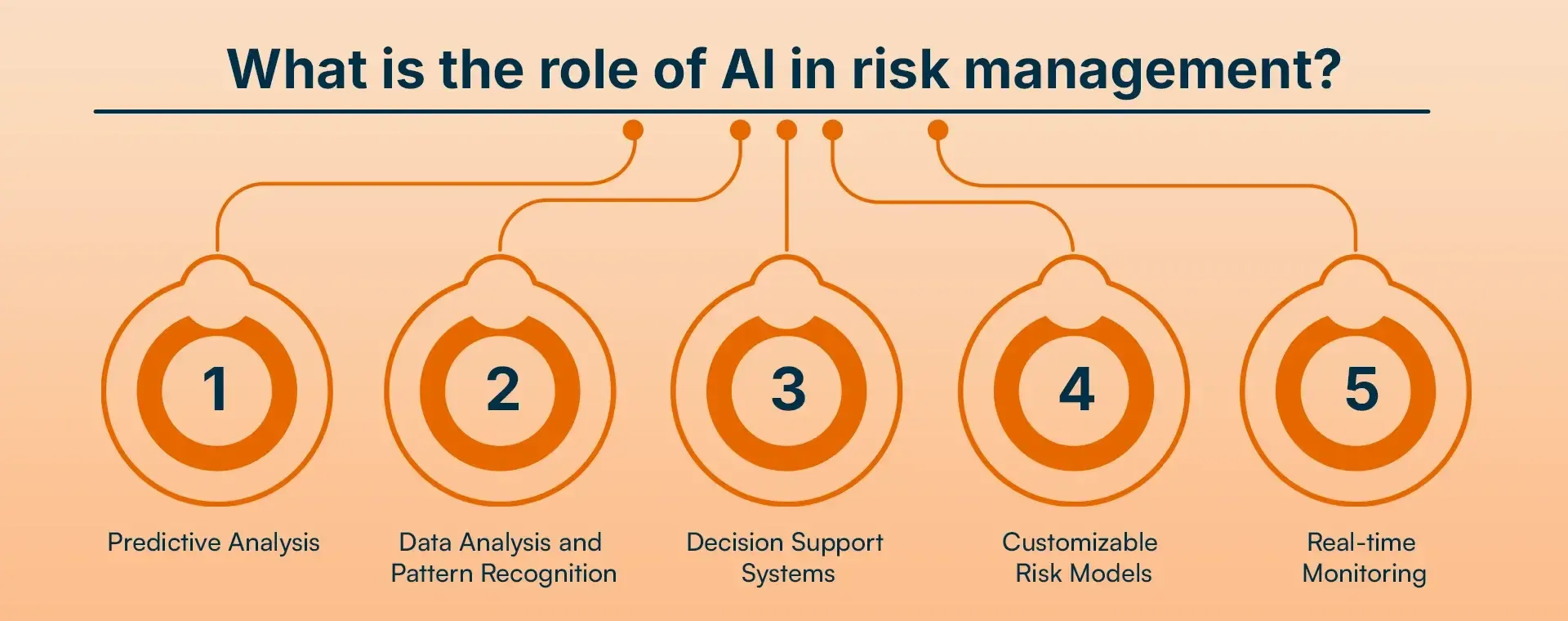
1. Predictive Analysis
The predictions made by AI for credit defaults are six months in advance and are 85% accurate, which facilitates proactive intervention before any loss occurs. Manufacturing systems, on the other hand, can forecast the breakdown of the equipment 14 days prior to the failure and also schedule the maintenance that would eliminate the possibility of incurring high costs due to the stoppage of the whole production process.
2. Data Analysis and Pattern Recognition
Through the AI algorithms, their use of catching fraud in its early stages is so powerful that they can process 10 million daily transactions, thus capturing 0.01% of anomalies for further investigation and leaving the usual activities to be ignored. These systems reveal very slight fraud indications through different accounts at the same time, thus recognizing the coordinated attacks that the individual transaction reviews miss.
3. Decision Support Systems
The AI systems classify risks in order of priority, taking into account severity, likelihood, and impact on the business, thereby making sure that the teams allocate their resources to the most serious threats first. The systems propose the mitigation measures along with a very detailed cost-benefit analysis, which compares the different approaches and thus leads to the identification of the best solution.
4. Customizable Risk Models
The financial sector uses AI in the processes of credit scoring, assessing market risks, and managing liquidity, which are customized for the specific portfolios and the regulatory requirements.
5. Real-time Monitoring
An AI system provides nonstop monitoring and analysis of network traffic, transactions, and system operations all the time. The system generates alerts immediately when the conditions exceed the defined limits, immediately pointing out anomalous login attempts, questionable transfers, or system irregularities.
How is AI risk different from traditional software risk?
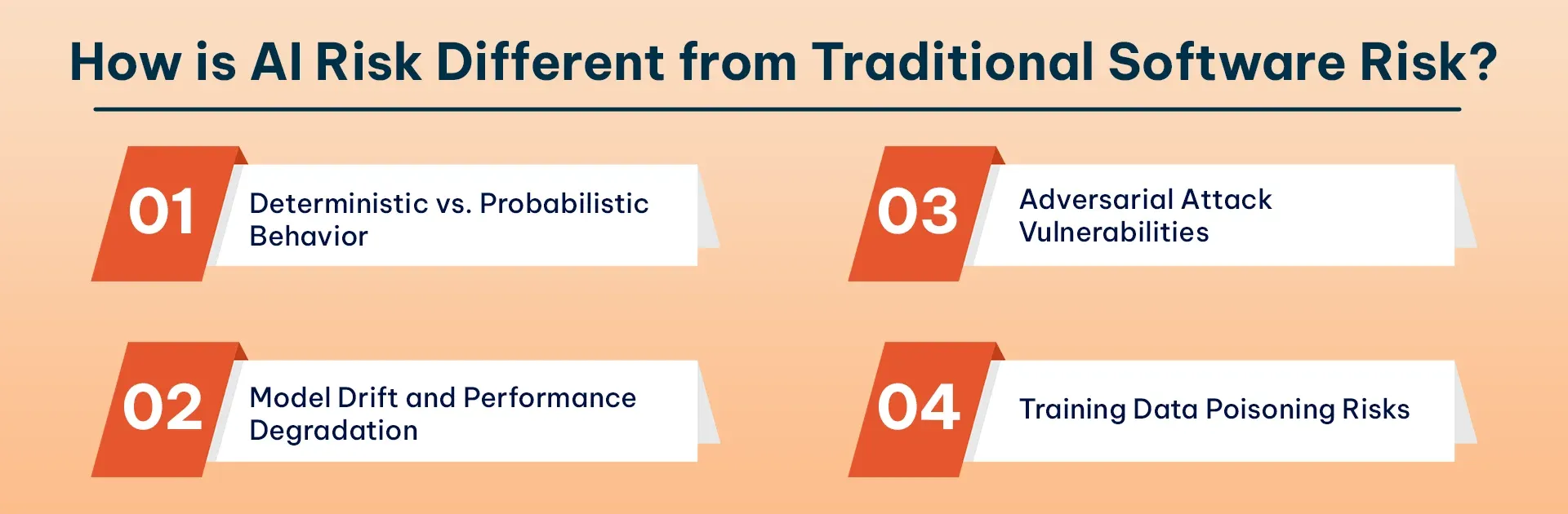
AI systems have different risk profiles than conventional software and therefore require specially tailored management approaches.
-
Deterministic vs. Probabilistic Behavior
Classical software adheres to a deterministic logic where the same input will always result in the same output, thus making its behavior predictable and easily testable. On the other hand, AI uses a probabilistic approach in which it produces predictions that vary in terms of confidence level, context, and the pattern of the data being used.
-
Model Drift and Performance Degradation
The performance of traditional software remains constant until it is altered by updates or patches. However, AI models are subjected to drift as the distributions of data from the real world change over time: customer behaviors change, markets develop, and fraud tactics vary.
-
Adversarial Attack Vulnerabilities
Traditional applications have to deal with security threats like SQL injection and buffer overflows, which are aimed at code vulnerabilities. AI systems, on the other hand, are subjected to specific adversarial attacks wherein inputs that are manipulated with great skill mislead the algorithms while still being perceived as completely normal by human observers.
-
Training Data Poisoning Risks
The main concern in the software security of traditional systems has been getting the production code and runtime environments safe from any meddling. The AI, however, has to deal with a new problem of training data poisoning, where bad actors mix traces of their work in the training process by injecting corrupted examples and, thereby, introducing hidden vulnerabilities that will be activated in specific situations.
Also Read: AI in Banking Explained: Benefits, Use Cases & Trends
Key AI Technologies in Risk Management
The present risk management is based on four primary AI technologies that are responsible for automating the whole process of detection, analysis, and reaction.
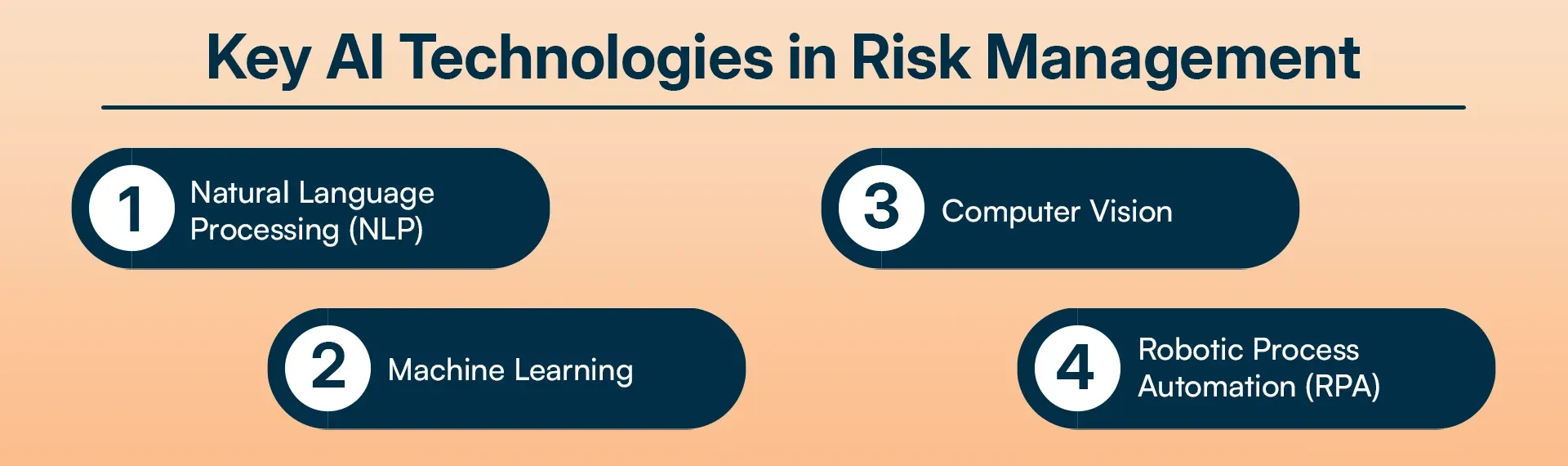
1. Natural Language Processing (NLP)
NLP is the fastest and most accurate method for identifying compliance requirements by taking and processing 10,000 regulatory documents every month.
2. Machine Learning
Supervised machine learning classifies transactions into the two categories of legitimate and fraudulent with 95% plus accuracy, and can thus handle millions of payment transactions daily.
3. Computer Vision
Computer vision technology is used to make the examination of manufacturing plants from a safety point of view more efficient through the analysis of video, thus automatically spotting unguarded machines, spills, and workers engaging in hazardous behavior.
4. Robotic Process Automation (RPA)
RPA is applied in KYC (Know Your Customer) verification, thereby speeding up the process by 80%. This is done by the instant extraction of data from identity documents and checking against other databases.
What is an API?
The API (Application Programming Interface) acts as a communication link, allowing different software systems to transfer data without any difficulty at all. In the field of risk management, APIs are used to connect AI models with business platforms, connecting fraud detection algorithms to payment gateways, combining compliance monitoring tools with transaction databases, and pooling threat intelligence from external sources.
What are the API functions provided? They consist of data retrieval endpoints, real-time alert systems, model inference services, and reporting interfaces. The API refers to the fact that your AI risk system is able to access live data streams, send alerts to security teams, and be integrated with dashboards, all without any manual intervention.
Best Practices for Implementing AI in Risk Management
For the proper cracking of the code of AI in risk management, the road of implementation, which includes, to a great extent, strategic planning, strong governance, and the right alignment of the entire organization, should be followed.
-
Start Small, Scale Gradually
Initiate a pilot project that focuses solely on one risk area (payment fraud, for instance). Use cases that provide significant ROI and a manageable scope should be the starting points of your project. Initially, direct your efforts towards areas with the highest impact, such as transaction monitoring or credit assessment, thereby allowing the teams to gain experience in AI deployment without heavily taxing the organization's resources or interfering with vital operations.
-
Collaborate Across Departments
Risk, IT, Legal, Operations: Create monthly meetings of cross-functional governance bodies that will monitor AI projects, sort out differences, and make sure there is agreement. Invite members from all departments that are affected so that different viewpoints can be heard risk managers state preferences, IT makes sure that there is technical potential, the legal department checks for legality, and the operations department takes care of the transition.
-
Promote a Climate of Ongoing Education
80% of the risk staff will be trained in AI basics. Create a detailed training program that will consist of all the aspects of AI mentioned above, and also the practical use of it in the risk departments. The training will consist of hands-on workshops, certification programs, and practical exercises, ensuring that the staff is aware of the instances in which they can rely on AI recommendations as opposed to the ones in which human judgment is necessary.
-
Invest in Cybersecurity
Penetration testing of AI systems is to be carried out every six months. Hiring ethical hackers to search for weaknesses in AI infrastructure is also suggested. The hackers will be probing with methods such as input attacks, model inversion, and data poisoning vectors. Security will be tested in such areas as authentication and API security, and the robustness of models against manipulation attempts.
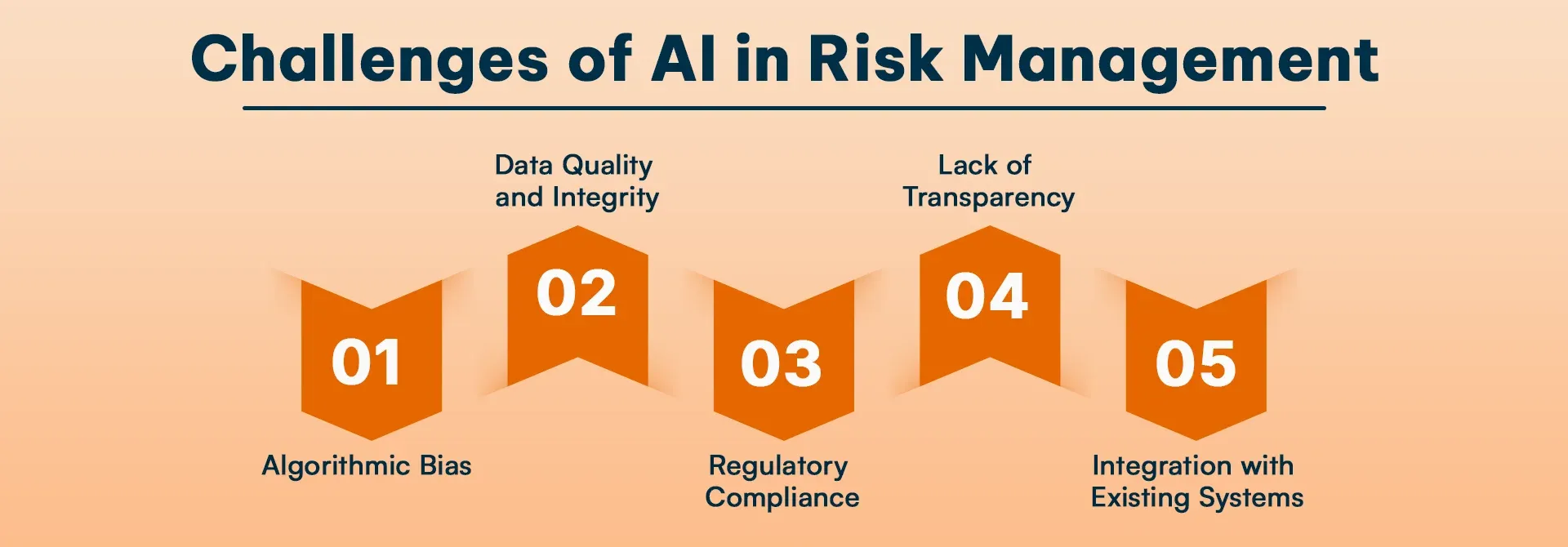
Challenges of AI in Risk Management
Although there are tremendous gains to be had from the use of AI in risk management, its application among organizations will have to face and deal with different obstacles that they will have to tackle proactively.
-
Algorithmic Bias
AI systems based on skewed historical data not only continue but also strengthen the negative patterns of discrimination, thus through demographic groups having risk assessments that are not fair. One of the largest banks in the US encountered $200M in penalties due to its lending algorithms that were biased by the violation of the fair lending laws through a tacit policy of not granting loans to minority applicants, even if they were qualified.
-
Data Quality and Integrity
The performance of AI is solely dependent on the quality of the training data, and thus, if the data is not good, the output will also not be good. Customer records that are not complete will lead to unreliable credit scores, while separate data areas will result in no overall risk perspective being created, where signals of fraud in different systems of disconnected systems.
-
Regulatory Compliance
The rapid progress of AI has caused a regulatory landscape that is not able to keep up, thus creating uncertainty and compliance difficulties for organizations. The EU AI Act has placed credit scoring under the high-risk category, thus making it mandatory to go through conformity assessments, human supervision, and documentation that current systems are unable to provide.
-
Lack of Transparency
Deep neural networks do produce very accurate outcomes, but they do not show why and how they reached those decisions; hence, the problem of accountability arises. Regulations stipulate that when a loan application is refused, an explanation must be provided; "the model said so" does not satisfy either the legal or the customer expectation.
-
Integration with Existing Systems
The risk management systems that were built years ago are now incompatible with the modern APIs, use proprietary data formats, and even run on outdated infrastructure, which is totally unsuitable for AI. The integration process would demand a considerable investment in IT. There is an instance of an insurance company that had to spend $5M only on upgrading the legacy systems before it could successfully deploy its fraud detection AI.
Conclusion
AI is transforming risk management from a reactive to a proactive level and allowing organizations to forecast threats as well as do the monitoring automatically with a level of precision never seen before.
Machine learning alone is able to get detection rates of 95% for fraud, and at the same time, predictive analytics is able to reduce equipment failures by 40%. On the other hand, success needs strong governance that will deal with bias, data quality, and regulatory compliance.
RejoiceHub gives the power to businesses to employ AI wisely, creating a balance between innovation and risk management, automation and human supervision, and efficiency and ethics.
Frequently Asked Questions
1. The Role of AI in Risk Management?
Using advanced technology and analyzing information will help an organization identify problems before they occur.
2. How does artificial intelligence compare with traditional risk management?
A 95% accuracy rating when detecting fraud through AI risk management tools is a huge increase over the traditional model. In addition to having fewer false alarms, AI finds legitimate risks much faster than previous models.
3. Are There Affordable Options for Small Business Owners for AI Risk Management Tools?
Many small businesses have ways of using AI-based risk management systems as inexpensive as $500-$2,000/month via cloud computing.
4. What's the biggest challenge with implementing AI risk management systems?
The most difficult aspect of working with artificial intelligence is ensuring that the data used for analysis is of high quality.
5. Will AI replace human risk managers in the future?
While AI will not replace humans, AI will allow risk managers to perform their jobs more effectively by enabling them to process greater volumes of data and identify trends more easily than they could without AI assistance.
6. How long before companies see results from artificial intelligence risk management?
Within 6 to 12 months of implementing an AI risk solution, most companies will experience significant improvements in the areas of fraud, cost savings, and improved regulatory compliance.