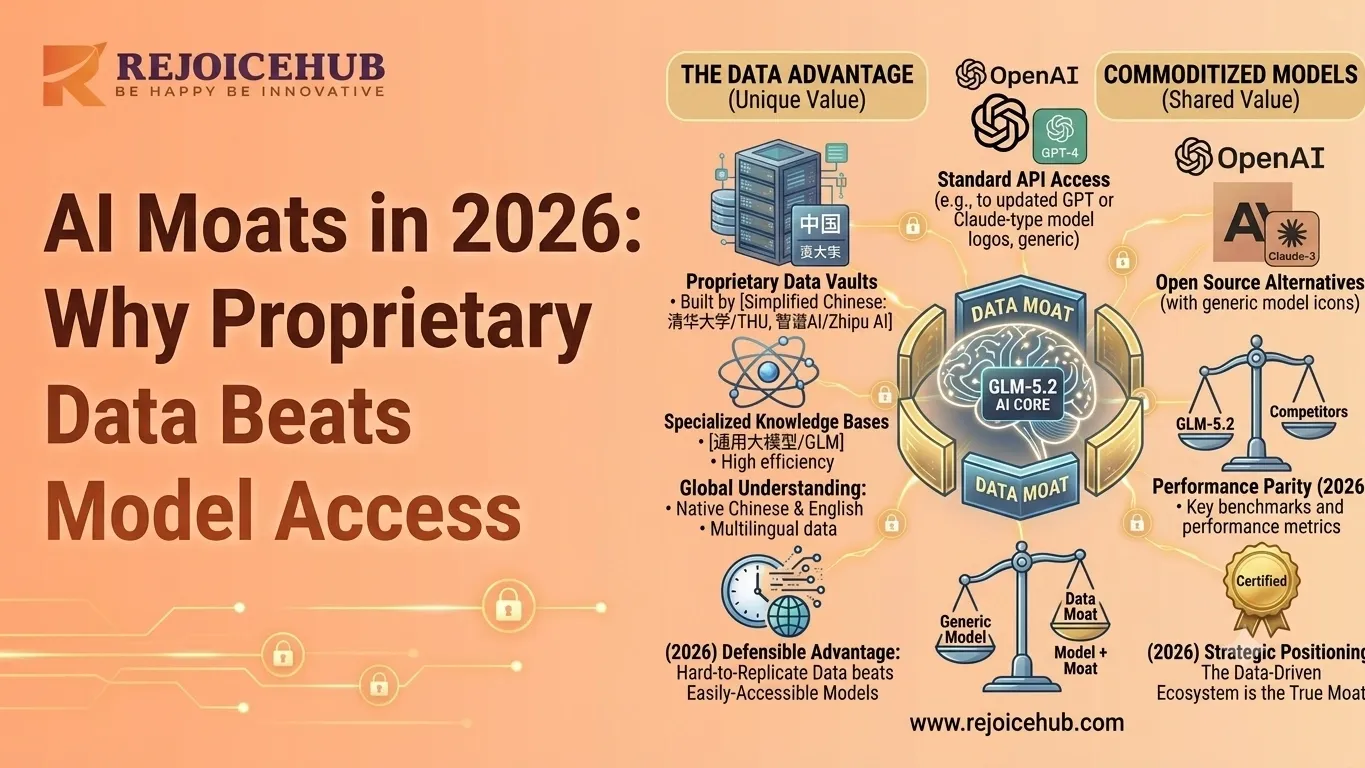
Everyone seems to be playing with the same roof.
GPT, Claude, Gemini, DeepSeek, and Llama are some of the most powerful AI models in history and are now basically a subscription away. Your competitors have them, your prospects have them, and yeah, even your interns have them.
So if everyone is using the same models, what do you think actually creates a durable competitive edge in 2026?
It's not some "superior" model, or a faster benchmark, or anything like that. The real answer is better data. More exactly, it is a self-reinforcing machine that turns every customer interaction into a strategic asset your rivals simply cannot replicate. And that system is called a proprietary data loop it's quickly becoming the strongest AI moat a business can build, without much ceremony.
What Are AI Moats?
An economic moat is this long-lasting kind of edge; it's a sustainable competitive advantage that kinda shields a business from competitors. Warren Buffett made the term more famous, and basically, the wider the moat, the more difficult it is for a rival to grind away your market standing over time.
In traditional software, moats came from network effects, switching costs, or proprietary technology. AI has reshuffled the deck.
Traditional Business Moats
- Network effects: more users make the product better for everyone
- Switching cost: changing providers is expensive or painful
- Proprietary technology: patented processes or trade secrets
- Economies of scale: unit costs fall as volume rises
AI Business Moats: The New Landscape
In the AI era, model access is not a moat anymore because it is now available to everyone. The real moat shifts to what you actually feed the model, how you train it, and how you manage to close that feedback loop.
Scenario: Two companies both use GPT-4. Company A uses it straight out of the box. Company B has spent two years feeding its proprietary customer conversations, support tickets, and outcome data. Company B wins, every single time.
Why AI advantages are changing:
- Foundation models are commoditized at the infrastructure layer
- The differentiation layer has moved up the stack, to data and workflows
- First-mover advantage in data collection compounds over time
- AI systems that learn from real business operations become impossible to replicate without equivalent operational history
Why Proprietary Data Is the Biggest AI Moat
Data isn't only some input; it's a kind of strategic asset that keeps gaining value the longer you gather it, curate it, and allow AI to absorb it and learn from it.
Here's the real insight most businesses miss, and honestly, it's simple enough, but they still skip it: it isn't the data on its own that builds the moat. It's the loop the repeating circuit, the feedback rhythm that never really ends.
Continuous Data Loops: The Flywheel That Compounds
A proprietary data loop is like a self-reinforcing cycle where each customer encounter makes your AI a bit smarter, which in turn sharpens your product, draws in more clients, and creates even more data. Keep it going, repeat it endlessly, basically forever.
1. Every customer interaction generates real-world data
                    ↓
2. New data becomes a training signal for your AI models
                    ↓
3. Smarter AI improves recommendations, responses, and predictions
                    ↓
4. Better product experience attracts and retains more customers
                    ↓
5. More customers create even more proprietary data  ↺
This flywheel is what makes it so that companies like Amazon, Spotify, and Salesforce are almost impossible to knock loose. Their AI isn't "better" only because of the model it is better because of years of private feedback, that sort of iterative grind.
How Real-World Feedback Creates Better AI
| Domain | Feedback Loop | Outcome |
|---|---|---|
| CRM | Every sales rep interaction (emails, calls, deal stages) feeds the AI pipeline models | AI predicts deal close probability with increasing precision over time |
| Healthcare | Patient outcomes refine diagnostic models after every clinical decision | AI catches rare conditions that generic models trained on public data cannot |
| Customer Support | Every ticket resolution teaches AI what works for your specific customer base | Deflection rates and CSAT scores improve continuously without manual retraining |
| Manufacturing | Sensor readings and defect reports train predictive maintenance models | Downtime predictions become specific to your machines, not industry averages |
Why Model Access Is No Longer a Competitive Advantage
Let's just be direct: in 2026, using GPT, Claude, Gemini, DeepSeek, or Llama is basically table stakes, not a differentiator. These foundation model families are starting to feel interchangeable, like cloud computing almost.
And because the whole race keeps pushing toward the bottom on raw capability, the foundation model providers end up competing so their clients don't have to. In about 18 months, the performance gap between the top options should look negligible for most business use cases, even when you zoom in.
What that means for your strategy:
- Proprietary workflows: your AI knows your internal processes, not just general ones
- Customer insights: patterns in your customers' behavior that no public dataset contains
- Business knowledge: domain-specific rules, pricing logic, and institutional memory
- Unique datasets: years of operational data that a new entrant cannot acquire overnight
The question is no longer which AI model you use. The question is what your AI knows that your competitors' AI does not.
AI Business Moat Examples by Industry
In 2026, the most defensible businesses aren't merely leaning on AI they're really building proprietary operational data at every single touchpoint. That kind of output can't be copied the same way by rivals, unless they have an equivalent market presence already, or a comparable set of relationships in place.
| Industry | Proprietary Data Source | ** AI Moat Created** |
|---|---|---|
| Healthcare | De-identified patient outcomes, treatment protocols, and physician notes | Diagnostic accuracy improves for rare conditions specific to the patient population served |
| Finance | Transaction patterns, credit decisions, fraud signals, customer behavior | Risk models calibrated to actual customer segments, not generic credit bureaus |
| Logistics | Route performance, driver behavior, weather impact, and carrier reliability | Predictive ETAs and cost optimization unavailable from off-the-shelf routing software |
| E-Commerce | Search queries, click-through, cart behavior, and post-purchase patterns | Recommendation and pricing engines tuned to a specific catalog and customer psychology |
| Legal Tech | Case outcomes, judge behavior, contract clause performance, and negotiation history | Win-rate predictions and clause recommendations grounded in real deal data |
Notice that common thread each business generates data just by operating. A competitor showing up tomorrow could license that same foundation model right away, but they cannot get five years of results data overnight.
Accelerate Your Workflows with Custom AI
Book a free consultation session with RejoiceHub. We'll map out a tailored automation roadmap for your company.
How Businesses Can Build AI Moats in 2026
Building a proprietary data loop is not exactly a one-time thing. It turns into a kind of organizational habit, and it quietly compounds in value the sooner you start.
1. Collect First-Party Data Intentionally
Every SaaS feature, sales call, support ticket, and operational moment becomes a data point. Most companies just leave that data sitting in siloed systems, untouched. The high-moat teams instrument everything, and then route all of it straight into one unified data layer, without much fuss.
- Audit your current data sources and identify gaps
- Instrument customer touchpoints with event tracking
- Consolidate data into a warehouse you control, not just your CRM vendor's system
2. Build and Deploy AI Agents
AI agents are the collection mechanism, really. Each time an agent handles a customer question, automates a task, or makes a decision, it turns into a data point that helps the next interaction get better.
- Deploy conversational agents on support and sales touchpoints
- Automate repetitive workflows to generate structured operational data at scale
- Use agents to capture decisions, not just outputs
Companies investing in AI agents and workflow automation today are not just saving time they are building the proprietary dataset that will define their competitive position in 2027 and beyond.
3. Capture and Embed User Feedback
Raw interaction data is useful. Labeled feedback data is gold. Build feedback mechanisms directly into your product so users signal what worked and what did not.
- Thumbs up / thumbs down on AI-generated outputs
- Implicit signals: time on page, conversion, re-engagement
- Explicit correction flows: let users fix AI mistakes and capture the delta
4. Improve Continuously With a Structured Loop
Data without a process to act on it is just storage. Build an operational rhythm around your data loop:
- Weekly: model evaluation against business KPIs, not just benchmark scores
- Monthly: fine-tuning or retrieval-augmented generation (RAG) updates
- Quarterly: strategy review which new data sources unlock the next layer of advantage?
5. Protect Data Quality Relentlessly
A data loop with garbage data produces a garbage moat. Data quality is a competitive advantage in itself. Businesses that understand the benefits of AI for business also understand that clean, well-governed data is what separates a real moat from a leaky one.
- Define data schemas and enforce them at ingestion
- Flag anomalies automatically and route to human review
- Document provenance know where every training signal comes from
Conclusion
In 2026, the AI landscape has changed the meaning of a competitive edge. Model access is basically a commodity. Compute is also a commodity. But what is not a commodity and likely never will be is the operational data generated only by your business, your customers, and your actual workflows.
So the companies that end up winning through the next decade won't necessarily be the ones that picked the "best" foundation model. It'll be the ones that built the strongest proprietary data loops, where every customer interaction turns into a learning signal, every workflow becomes a training asset, and each business decision compounds over time.
And the timing question? It's not "start when it looks obvious." It starts right now while it still isn't obvious to your competitors, before they catch on to what they're leaving on the table.
Frequently Asked Questions
1. What are AI moats and why do they matter for businesses?
AI moats are sustainable competitive advantages built using artificial intelligence. In 2026, they matter because every business has access to the same AI models. What separates winners from the rest is proprietary data and smart workflows that competitors simply cannot replicate overnight.
2. Why is proprietary data considered the biggest AI moat in 2026?
Proprietary data creates an AI moat because it is unique to your business. No competitor can buy or copy years of your customer interactions, outcomes, and feedback overnight. The longer you collect and use this data, the smarter your AI becomes, and the harder you are to beat.
3. How do proprietary data loops work in AI-powered businesses?
A proprietary data loop works like a flywheel. Customer interactions generate data, that data trains your AI, smarter AI improves your product, better products attract more customers, and more customers create even more data. This cycle keeps compounding and becomes stronger every single day.
4. Are AI moats only for large companies, or can small businesses build them too?
Small businesses can absolutely build AI moats. You do not need millions of users to start. Begin by collecting first-party data from support tickets, sales calls, and customer behavior. Even a focused dataset from a niche audience can give your AI a serious edge over generic, off-the-shelf tools.
5. Why is using GPT or Claude alone not enough to create an AI competitive moat?
Using GPT, Claude, or any foundation model out of the box gives you no real advantage because your competitors use the same tools. The actual moat comes from what you feed those models, meaning your proprietary customer data, workflows, and feedback loops that make AI smarter for your specific business.
6. What are some real-world AI business moat examples by industry?
Great examples include healthcare companies using patient outcomes to improve diagnostics, finance firms using transaction patterns to sharpen risk models, and e-commerce brands using cart behavior for better recommendations. In each case, the AI moat comes from operational data that no outside competitor can access or replicate.
7. How can a business start building an AI moat right now?
Start by auditing your existing data sources and closing the gaps. Instrument every customer touchpoint, consolidate data into a system you control, and deploy AI agents to capture interactions at scale. Add feedback loops so your AI learns from real outcomes. The earlier you start, the stronger your moat becomes.