We live in the age of AI, or at least it feels like that every week, new AI tools come out, enterprise budgets shift toward automation, and startups kind of sprint to ship "intelligent" software faster than ever.
But honestly, building AI is only half the story. The other half is deploying it where it actually does something useful, like inside a real business, solving real problems, not just playing with a demo for an afternoon.
That whole gap between great AI technology and real enterprise outcomes has created one of the most in-demand jobs in tech right now: the Forward Deployed Engineer. If you want to understand what's fueling this demand, it helps to first look at what AI agents actually are and how they're being adopted across industries.
By 2026, agentic AI is moving from shiny demos into production, and enterprise AI adoption is accelerating, so companies aren't only recruiting for "coding". They need people who can land inside a client organization, map the day-to-day workflow, get the AI to run, and keep running.
That's the Forward Deployed Engineer, and yeah, the demand is exploding.
This guide goes through it all: what the role actually means, what they do day to day, which skills matter most, how to become one, and why this position is quietly reshaping the future for AI startups.
What Is a Forward Deployed Engineer?
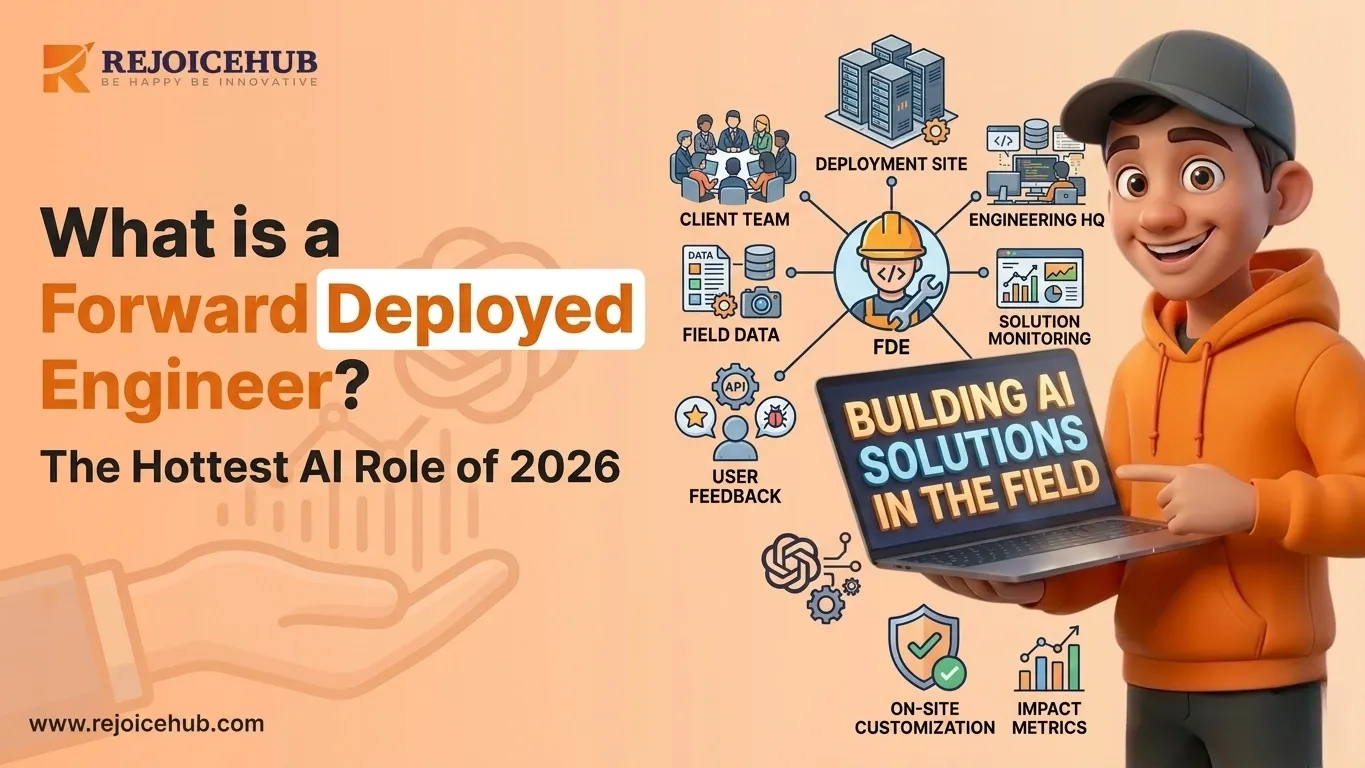
A Forward Deployed Engineer (FDE) is like a technical professional who works right in client sites, or inside enterprise environments, to deploy, tailor, and tune software especially AI systems.
Compared with the usual software engineer who tends to build products in-house, a Forward Deployed Engineer sort of bridges that gap between a technology company and its enterprise clients. In practice, they make sure the AI solutions are put into production the right way and that they actually deliver measurable business value, not just demos or fine words.
The term "forward deployed" comes from military strategy, where resources are set up near the point of action rather than hanging around in the rear. In tech, it kinda means the same thing; the engineer is deployed at the front lines, in other words, inside the customer's environment.
An AI Forward Deployed Engineer is usually centered on AI systems, deploying large language models (LLMs), AI agents, automation workflows, and enterprise AI tools directly within client organizations. A forward-deployed software engineer might also touch traditional software, data pipelines, or even SaaS integrations, depending on the project.
Try thinking about it like this: if a company like RejoiceHub helps a logistics company build an AI agent, then the Forward Deployed Engineer is the one who steps into that client environment, learns how the warehouse operations work, and makes the AI agent actually behave the right way not as some demo in a lab, but out there in the real world, on the ground.
What Does a Forward Deployed Engineer Do?
The FDE role is kind of a mix between engineering depth, business-minded judgment, and client handling. It's not a sales position, and it's not only about pure coding work either. It sits right there in the intersection, so yeah… It's more connected than it sounds.
Core Responsibilities
- Deploy AI systems directly into enterprise environments, including LLM integrations, AI agents, and workflow automation.
- Customize AI solutions to match the client's specific business logic, data structures, and team workflows.
- Work directly with enterprise clients: understanding their pain points, gathering technical requirements, and translating them into engineering tasks.
- Troubleshoot AI implementations in real-time: debugging model outputs, fixing API integrations, resolving edge cases in production.
- Optimize AI adoption across teams: training client staff, building documentation, and running feedback loops to improve the solution.
- Act as the primary technical point of contact between the AI company and the enterprise customer.
Real-world example: Palantir, one of the earlier players who adopted the FDE model, did something pretty bold they placed actual engineers inside government agencies, and also in big enterprises.
Their FDEs put together custom data pipeline systems and intelligence tools right within the clients' own environments, kind of a hands-in-the-fabric approach, and in the end, that pattern became pretty standard across many newer AI startups.
Now, companies like Scale AI, Cohere, Glean, and a lot of smaller AI startups are all bringing in FDEs to speed up enterprise rollouts, or "deployment," as people say.
Why AI Startups Need Forward-Deployed Engineers
- Faster deployment: FDEs compress the time between signing a contract and going live — critical when AI ROI depends on speed.
- Better customer success: Clients with an embedded FDE report higher satisfaction, lower churn, and faster value realization.
- Reduced onboarding friction: Most enterprises lack the internal expertise to configure and customize AI tools — an FDE removes that barrier entirely.
- Real-time iteration: An FDE in the field can identify what the AI does wrong and fix it immediately, rather than logging a support ticket.
- Competitive moat: Startups that deploy FDEs build deeper relationships and stickier enterprise contracts.
Understanding how AI agents can automate business workflows makes it even clearer why the FDE role has become so strategically critical for startups trying to win and retain enterprise customers.
Skills Required to Become a Forward Deployed Engineer
The FDE role sort of demands a rare mix of hard technical skills, and solid people skills too, you know. You've got to be able to write production code in the morning, then later present it to the C-suite in the afternoon.
1. Technical Skills
- Python: The dominant language for AI development, API scripting, and workflow automation non-negotiable for any AI Forward Deployed Engineer.
- APIs and integrations: Deep experience with REST APIs, webhooks, and third-party integrations most enterprise deployments involve connecting AI to existing systems like Salesforce, SAP, or custom databases.
- LLM integration: Hands-on experience with OpenAI, Anthropic Claude, Cohere, or Mistral APIs including prompt engineering, fine-tuning, and context management.
- Cloud platforms: AWS, Google Cloud, or Azure AI deployments almost always live in the cloud, and FDEs must configure, debug, and manage cloud infrastructure.
- AI agents and agentic workflows: Understanding of autonomous agent architectures (LangChain, CrewAI, AutoGen) and multi-step reasoning pipelines is increasingly critical in 2026. Familiarity with agentic AI workflows has quickly become a baseline expectation for FDE candidates.
- Data engineering basics: Working with SQL, vector databases (Pinecone, Weaviate), and data pipelines to connect AI to enterprise data sources.
- Version control: Git and CI/CD pipelines for managing code across client environments.
2. Business & Communication Skills
- Client communication: Being able to lay out tangled AI systems in plain language, for both technical and non-technical audiences, is kind of like translating on the fly which is what makes an average FDE stand out, and a great one really shine.
- Problem-solving under pressure: Big enterprise rollouts always run into a few surprises, so FDEs need to spot what's happening and untangle it quickly, most times right there in front of the client, with no time to wait.
- Deep product understanding: A solid FDE has to know their company's AI product inside out, including what it actually does, what it can't do, and also how it can be tuned or reconfigured to fit the context.
- Project management: Handling several parallel workstreams during a client engagement takes organized thinking and crisp updates, not just "working hard" but staying aligned all the way through.
- Empathy and patience: Enterprise teams aren't always technical, so FDEs who can actually meet clients where they are, with steady calm and a bit of patience, tend to produce outcomes that are way better.
The best FDEs are kind of the ones with real deployment experience, like they have shipped AI in production, managed rollbacks, and got stakeholder expectations sorted during a tricky go-live. That hands-on experience is kinda irreplaceable, honestly, you can't get it any other way.
Forward Deployed Engineer vs Software Engineer
| Category | Forward Deployed Engineer | Software Engineer |
|---|---|---|
| Focus | Client-facing AI deployment | Internal product development |
| Client Interaction | Daily direct contact with clients | Minimal or no client interaction |
| AI Deployment | Core part of the role | Occasional or none |
| Business Understanding | Essential must grasp client needs | Helpful but not critical |
| Work Environment | Startup/enterprise hybrid | Usually in-house product teams |
| Output | Working AI solutions for clients | Scalable software features |
The main difference is like context, you know. A software engineer tends to optimize for scalability, clean architecture, and the kind of codebase that won't fall apart later. A Forward Deployed Engineer is more about getting AI to actually work inside one specific business, today not after, like not waiting for the next product sprint.
Neither role is better; it's not a contest. They just serve different purposes. Still, in this current AI boom where enterprises are adopting AI faster than internal teams can keep up, the FDE has basically become the crucial bridge between AI technology and real-world business value. This is also why more companies are now exploring how to deploy AI agents without a full ML team and why FDEs have become the go-to answer.
How to Become a Forward Deployed Engineer in 2026
There isn't just one degree or certification that somehow turns a person into an FDE. It's more like a function, built up through a messy blend of technical depth, hands-on deployment work, and that day-to-day client exposure.
What you usually end up with is a role that you earn gradually, not something you "collect" once and done. Here's a practical kind of roadmap you can actually follow:
-
Build strong software engineering fundamentals. Start with Python, data structures, REST APIs, and just the cloud basics. You need to be able to build and debug software on your own before you can do it inside some client environment, even if it's messy.
-
Then go deeper into AI systems. Learn how LLMs work, how to actually use OpenAI and Anthropic APIs, and how to put together AI-powered workflows that do something useful. Courses from DeepLearning.AI, fast.ai, and the Hugging Face documentation are a great starting point, but don't stop there.
-
Build real deployment projects. Don't only follow tutorials. Build an AI agent that solves a real problem, deploy it, break it, and then fix it. Document what went wrong, too, so you can show you understand failure modes. That kind of hands-on experience is exactly what hiring managers look for.
-
Learn enterprise workflows. Understand how large companies run in practice CRM systems, ERP software, data governance, compliance requirements, the whole ecosystem. A FDE who gets enterprise context can add value right away, instead of learning on the job. It also helps to study how to build an AI agent stack for business to understand the full architecture FDEs are expected to navigate.
-
Gain startup experience. A lot of FDE roles live at high-growth AI startups. Working at a startup, even as a generalist engineer, teaches you the pace, the ambiguity, and the client pressure that basically define FDE work.
-
Contribute to open-source AI projects. GitHub contributions to LangChain, LlamaIndex, or similar frameworks signal technical ability and also community involvement. It's not just "coding" it's staying engaged.
-
Consider relevant certifications. AWS Solutions Architect, Google Cloud Professional Data Engineer, and developer credentials from Anthropic or OpenAI can show credible AI deployment experience.
Why Forward-Deployed Engineers Are the Future of AI Startups
The rise of agentic AI is sorta rewriting the rules for enterprise software. In 2024, AI was mostly a co-pilot, like a helper that kept human work moving along. But in 2026, agentic AI is taking the wheel more and more doing things on their own: booking meetings, handling invoices, triaging customer support tickets, and running those multi-step workflows that usually need eyes on them, without any human sitting there watching every single step.
So yeah, this shift brings a big, basic problem. Autonomous AI has to be deeply woven into the existing business systems. It can't just be plugged in or bolted on quickly. It demands configuration, careful customization, and then ongoing optimization, which is the very kind of "in the trenches" engineering that Forward Deployed Engineers tend to specialize in.
Key Trends Driving FDE Demand
-
Enterprise AI adoption is just… accelerating: In 2026, more than 70% of Fortune 500 companies already have active AI deployment work going on. And yeah, every one of those projects still needs proper implementation know-how, real practical expertise, not just "ideas."
-
AI customization is also ramping up quickly: The kinda generic AI tools don't actually fix the specific business issues. Enterprises want the AI adjusted to their real workflows, their own data, and also whatever compliance requirements they're stuck with. This growing need for tailored solutions is part of why custom vs off-the-shelf AI software has become one of the key decisions every enterprise must make before deployment.
-
Now, the human + AI part matters a lot: The most valuable deployments usually blend human judgment with automated AI execution. So when it comes to designing and deploying these mixed, hybrid workflows, that becomes a core FDE skill set.
-
Agentic AI is its own beast; Multi-agent setups, tool-use frameworks, and autonomous AI pipelines are a lot harder to roll out than regular software. But the upside, too, is different. The value of FDEs who can manage that kind of complexity tends to be significantly higher.
-
And finally, the competition in the startup world is intense; Startups that have better deployment abilities, usually supported by solid FDE teams, end up winning enterprise customers more often, and keeping them longer too.
The FDE is not just some job title; it kinda is the organizational model that makes enterprise AI actually work in the real world. Companies that put money and effort into FDE talent plus culture will end up moving faster than the ones that treat AI deployment like it is an afterthought.
Conclusion
The AI boom of the 2020s has brought some extraordinary technology. But also, technology by itself does not really move a business forward. The Forward Deployed Engineer is the one who closes that gap — who takes the newest AI systems and makes them run inside actual organizations, to fix actual issues, and yes, deliver measurable ROI.
In 2026, as agentic AI starts reshaping enterprise workflows and adoption keeps speeding up, the FDE has turned into one of the most strategically important roles in tech. Startups that really get this and put money into forward deployment capabilities will likely end up dominating enterprise AI.
Whether you're a founder looking at how to staff your AI product team, a software engineer thinking about a career pivot, or an enterprise leader mapping out your next AI rollout understanding the real benefits of AI for business is a solid first step, and the Forward Deployed Engineer is absolutely worth your attention.
Frequently Asked Questions
1. What is a Forward Deployed Engineer?
A Forward Deployed Engineer is a technical professional who works directly inside client or enterprise environments to deploy and customize software, especially AI systems. Instead of building products in-house, they bridge the gap between a tech company and its enterprise customers, making sure AI solutions actually work in the real world.
2. What does a Forward Deployed Engineer do on a daily basis?
Day to day, a Forward Deployed Engineer talks to clients, maps out their workflows, deploys AI tools into their systems, fixes bugs in real time, and trains staff on how to use the solution. It's a mix of hands-on coding, troubleshooting, and clear communication, often all on the same day.
3. How is an AI Forward Deployed Engineer different from a regular software engineer?
A regular software engineer builds scalable products for internal teams. An AI Forward Deployed Engineer works client-side, customizing and deploying AI systems inside one specific business. The focus is less on long-term architecture and more on getting AI running correctly inside a real company, right now.
4. What skills do you need to become a Forward Deployed Engineer?
You need strong Python skills, hands-on experience with LLM APIs like OpenAI or Anthropic Claude, REST API integrations, and cloud basics. Just as important are soft skills like client communication, calm problem-solving under pressure, and the ability to explain technical things to non-technical people clearly.
5. How do you become a Forward Deployed Engineer in 2026?
Start by building solid software engineering basics, then go deeper into AI systems and LLM workflows. Build real deployment projects, learn how enterprises actually operate, and get startup experience if you can. Contributing to open-source AI projects and earning cloud certifications also help you stand out to hiring teams.
6. Why are AI startups hiring so many Forward Deployed Engineers right now?
Because building great AI is only half the job. Enterprises need someone to step in, connect AI to their existing systems, and make it deliver real results fast. FDEs reduce onboarding friction, speed up deployment timelines, and help clients actually get value from AI, which directly lowers churn for startups.
7. What is the future of the Forward Deployed Engineer role in AI?
As agentic AI takes over more complex business workflows in 2026 and beyond, the need for FDEs will only grow. These systems can't just be plugged in; they need deep configuration and ongoing tuning. FDEs who understand multi-agent pipelines and enterprise workflows will be among the most valuable people in tech.