In the present-day digital world, the interaction with machines is more than we think be it talking to customer support, asking a virtual assistant a question, or receiving fast assistance on a website. This continuous talking is only made possible through the use of conversational AI, which understands human language and gives intelligent answers right away. From the leading users and resolving queries to self-service support, conversational AI is already part of the majority of communication, making our daily activities faster, simpler, and more polite.
Quick Summary
Conversational AI is a complicated artificial intelligence technology that makes it possible for computers to understand, interpret, and reply to humans in a very natural way. This technology is, on the other hand, the backbone of chatbots, virtual assistants, and customer service systems that are automated and used across various sectors.
Natural language processing, machine learning, and speech recognition are the main areas where conversational AI operations take place. With this combo, users and machines can communicate without any technical barriers. The revolution brought by this technology in the business world is the fact that it not only improved customer experiences but also made the services available around the clock.
The journey from simple rule-based bots to the development of profoundly intelligent AI assistants is a depiction of the continuous evolution of conversational AI, which is attracting more and more users as it offers, to a great extent, the automation and engagement opportunities that have never been seen before.
What is Conversational AI?
Conversational AI is a complicated artificial intelligence technology that makes it possible for computers to understand, interpret, and reply to humans in a very natural way. This technology is, on the other hand, the backbone of chatbots, virtual assistants, and customer service systems that are automated and used across various sectors.
Natural language processing, machine learning, and speech recognition are the main areas where conversational AI operations take place. With this combo, users and machines can communicate without any technical barriers. The revolution brought by this technology in the business world is the fact that it not only improved customer experiences but also made the services available around the clock.
The journey from simple rule-based bots to the development of profoundly intelligent AI assistants is a depiction of the continuous evolution of conversational AI, which is attracting more and more users as it offers, to a great extent, the automation and engagement opportunities that have never been seen before.
How Does Conversational AI Work?
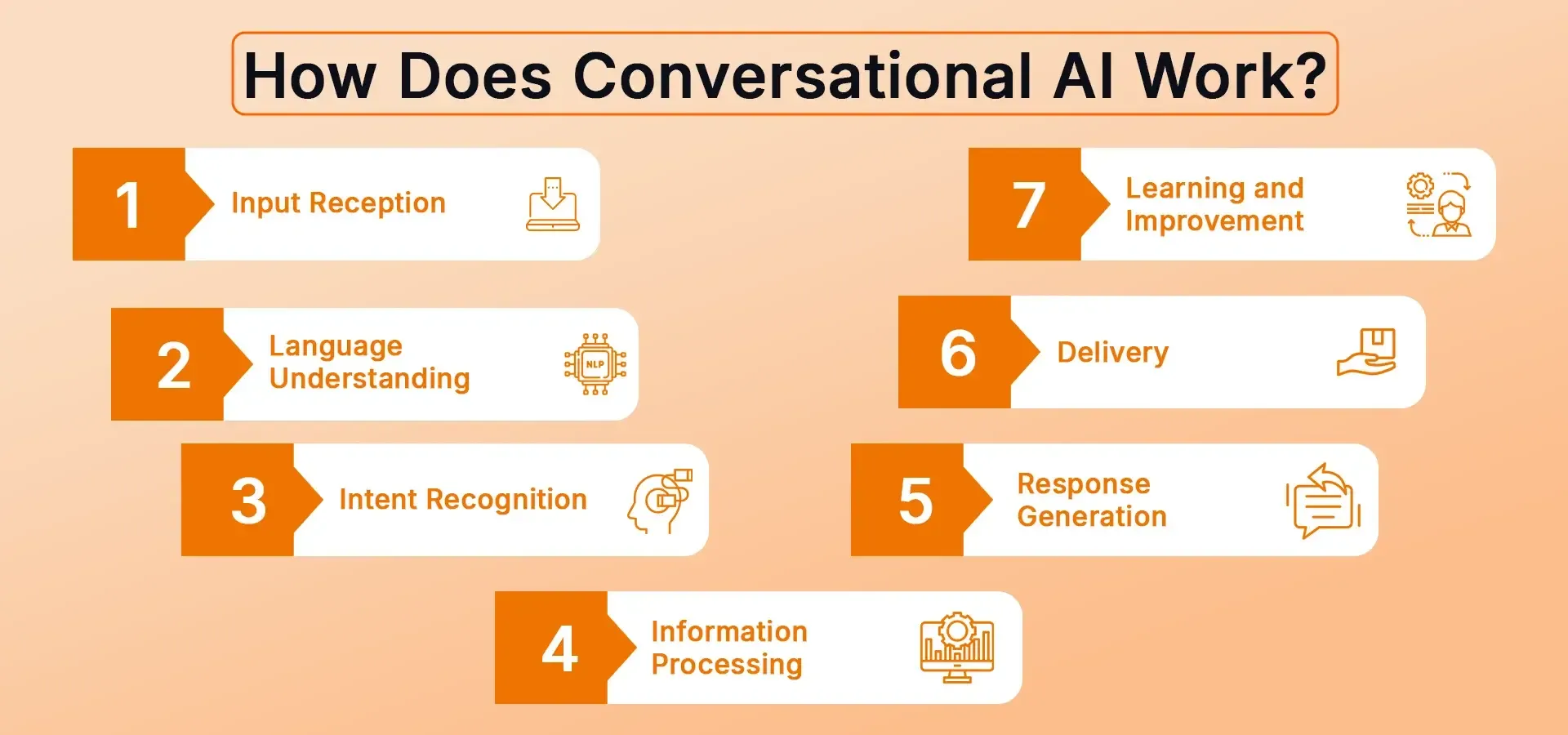
1. Input Reception
The system gets the message you send, either through voice or text. Speech recognition technology is employed to transform voice inputs into text.
2. Language Understanding
Using natural language processing, the system first decomposes the user message, and then it spots the keywords, detects the user's intent and the context, thereby figuring out the user's question.
3. Intent Recognition
The AI confirms the user's goal be it that the user is looking for information, asking for help, or wanting to carry out a certain action.
4. Information Processing
Your request is processed by machine learning algorithms, which compare it to an enormous number of documents and previous interactions to find the most suitable answer.
5. Response Generation
A proper reply in human-readable form is produced by the system, which meets the specific requirement of the user.
6. Delivery
The answer is either sent back as text or converted to speech, which seamlessly concludes the communication cycle.
7. Learning and Improvement
The system learns from every interaction, which in turn helps it to recognize the patterns and continuously improve the quality of responses in the future.
Core Components of Conversational AI
-
Natural Language Processing (NLP)
Natural language processing is like the brain, which enables machines to comprehend the human language along with its details. The process of NLP involves breaking down the sentences into parts, recognizing the grammar, uncovering the synonyms, and learning the meaning of informal or slang words.
1. Text Analysis
NLP analyzes your vocabulary, syntax, and punctuation marks to derive the meaning with precision.
2. Semantic Understanding
The machine comprehends the context, knowing that "bank" could refer to a financial institution or a riverbank depending on the flow of the conversation.
3. Sentiment Detection
NLP detects the feelings in your communication, identifying irritation, joy, or the need for a quick reply and thus, reacting accordingly.
4. Entity Recognition
It highlights key data such as people, dates, places, and products that are being talked about in the dialogue.
-
Machine Learning
With machine learning, conversational AI can learn from interactions and improve itself through experience, rather than only through clear programming. This is what makes these types of applications smarter as time goes on.
1. Pattern Recognition
Through machine learning, conversational AI is able to recognize patterns in the questions asked frequently and in most common situations, as well as the expected paths a conversation might take.
2. Predictive Analysis
The system uses machine learning algorithms to predict the next question a user will ask based on the conversation context and on data about previous conversations with them.
3. Personalized Responses
From historical data about the user preferences and previous interactions with the system, machine learning enables the system to create customized responses for users.
4. Continuous Improvement
Using the feedback users provide and the success rates of conversations, machine learning algorithms are constantly optimizing the system's responses to create better experiences for users.
Use Cases of Conversational AI
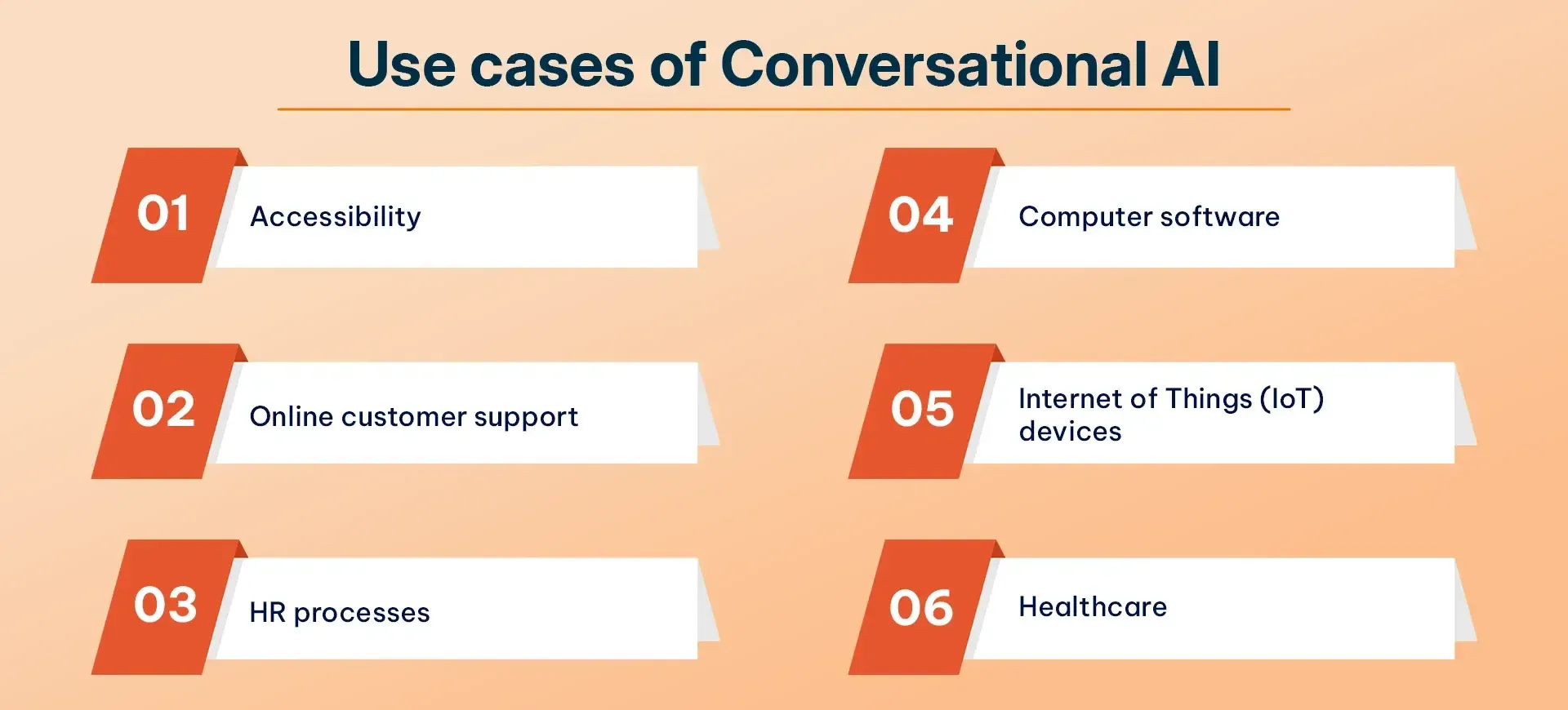
1. Accessibility
-
Voice-Activated Assistance
With the help of voice commands, the visually impaired can easily control devices, read texts, and obtain information.
-
Language Translation
The instant translation removes the communication barriers and lets the speakers of different languages interact and comprehend each other perfectly.
-
Text-to-Speech Conversion*
The written text is spoken, so the ones with reading difficulties can acquire information by themselves, without any hassle.
2. Online Customer Support
-
24/7 Availability
AI chatbots are always available to answer customer inquiries, which removes the wait times and provides instant support irrespective of the time zones.
-
Quick Problem Resolution
The automated workflows resolve common issues immediately, leading to a considerable decrease in confusion and an increase in customer satisfaction.
-
Seamless Escalation
The difficult issues are transferred to the human agents along with the complete conversation history, so the customers do not have to repeat themselves unnecessarily.
3. HR Processes
-
Recruitment Screening
AI helpers take charge of the first stage of candidate interviews, measure education and experience, and set up meetings for further discussion, thus making the hiring process very smooth.
-
Employee Onboarding
The new employee is informed about the company’s rules, benefits, and procedures instantaneously through talk-like systems, which makes the process of integrating him/her quicker and easier.
-
Leave Management
Workers make leave requests, inquire about their vacation balance, and get approved simply by chatting and without any paperwork involved.
3. Computer Software
1. Voice Commands Instead of complicated menu structures, users take control of the applications, perform functions, and move through the software with their natural speech.
2. Troubleshooting Help The integrated AI takes the users through the tech problems by providing the solutions in steps and significantly lowering the number of support tickets raised.
3. Feature Discovery Widgets that respond to users like a human help them discover the functionalities of the software by replying to "how do I" queries in simple words.
4. Internet of Things (IoT) Devices
-
Smart Home Control Voice commands control the lighting, temperature, security systems, and the home appliances, thus providing the easy-to-usehands-freee automation experiences in the house.
-
2Device Coordination The voice-based AI carries out the tasks of many IoT devices at the same time, making it possible to do complex routines with just a few words spoken.
-
Status Monitoring Customers use the natural conversation interfaces to ask the devices about their status, get alerts, and also troubleshoot the issues.
5. Healthcare
-
Symptom Assessment AI assistants collect patients symptoms, give initial assessments, and suggest proper levels of care depending on the answers.
-
Appointment Scheduling Without any phone calls, patients handle their booking, rescheduling, and receiving appointment reminders through chatbots, which are voice-based systems.
-
Medication Reminders E-health assistants automate the sending of individualized medication reminders, the replying to dosage inquiries, and the continuous keeping of adherence patterns.
-
Mental Health Support When human therapists are not available, therapeutic chatbots immediately offer emotional support, teach coping strategies, and provide crisis intervention.
Types of Conversational AI
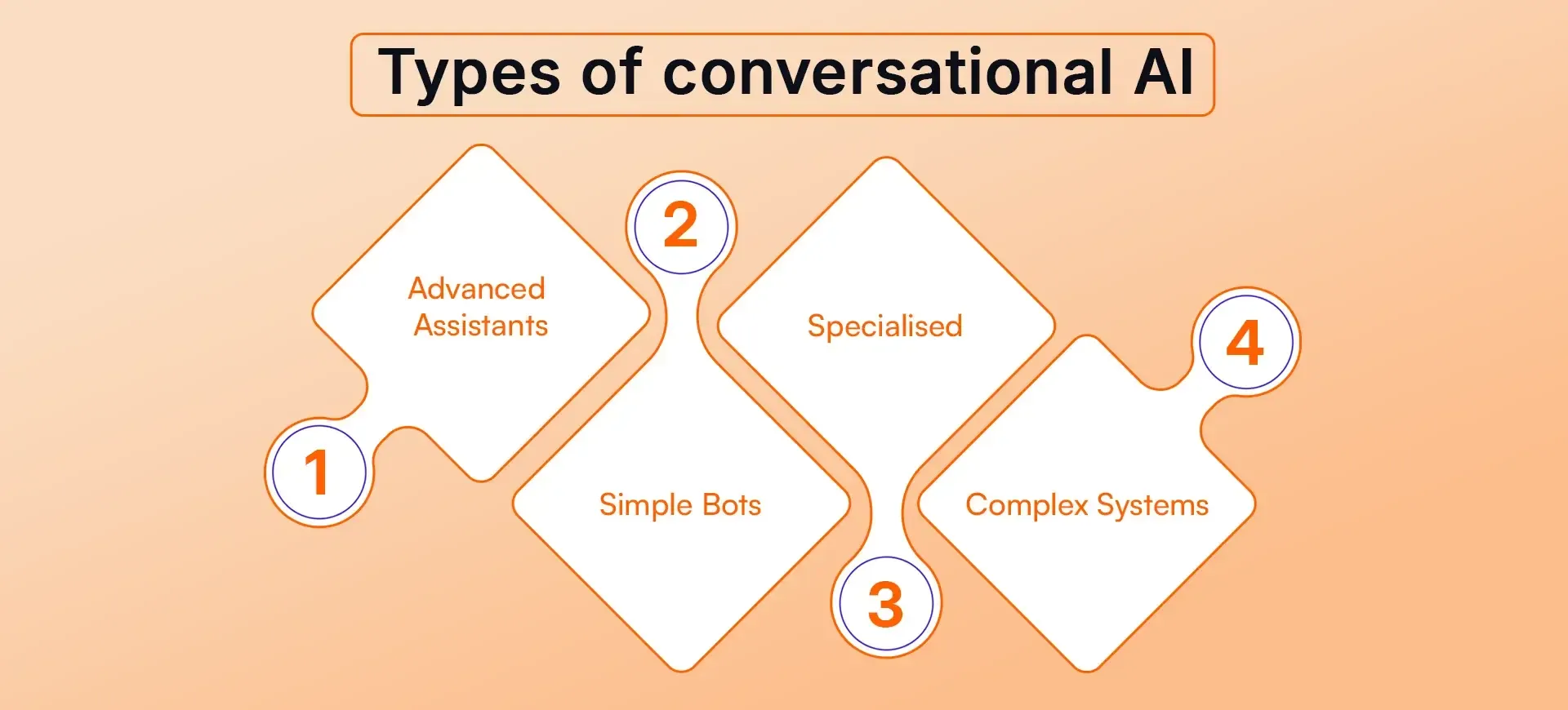
1. Simple Bots
Elementary bots simply follow predetermined guidelines and scripts, performing simple tasks in a very effective manner. They identify certain words and then activate the corresponding programmed reply. Such bots are an ideal solution for frequently asked questions, obtaining basic information, and conducting simple transactions. Although their lack of versatility is a drawback, they are still highly economical, provide a very simple and quick way to be set up, and can be trusted for interactions that are easy to forecast.
2. Advanced Assistants
Complicated voice assistants like Siri, Alexa, and Google Assistant have the capabilities to comprehend intricate requests, converse naturally, and multitask. They leverage the combination of speech recognition, natural language processing, and machine learning to enable very advanced interactions.
These digital helpers recognize the tastes of their users, work together with different apps, and cover difficult questions in various fields.
They process the next questions, keep the dialogue history in mind, and offer once-in-a-lifetime user experiences that are getting better all the time thanks to proper usage.
3. Specialized Systems
Specialized conversational AI is designed for particular industries or functions and provides a great degree of expertise in a specific area. Medical diagnosis bots, legal advice assistants, and financial planning chatbots are such AI systems. These systems are extremely knowledgeable in their fields, use the appropriate terms in the right way, and offer expert guidance. They are trained on the data relevant to their industries, have strict adherence to the regulations, and provide top-notch support in their respective areas.
4. Complex Systems
Complex systems demonstrate the peak development in conversational AI, being able to engage and communicate at a human level while managing business-like tasks and complicated workflows. They connect numerous databases, handle enormous amounts of data at the same time, and execute multi-step payments in a smooth manner.
These systems allow for omnichannel communication, ensure uniformity among the different channels, and grow to the point where thousands of dialogues can take place at the same time.
They use state-of-the-art ice and give very thorough information, and constantly improve their function through the evaluation of very extensive data.
Benefits of Conversational AI
1. Increased Sales and Customer Engagement
-
Proactive Engagement AI starts interacting with the visitors of the website, replying to their queries, and directing them to the products they want to buy, thus making a considerable rise in the conversion rates.
-
Personalized Recommendation Systems study the tastes and preferences of the customers along with their browsing history to suggest the most relevant products, thus making the shoppers' profile customized to their liking and increasing sales at the same time.
-
Reduced Cart leaving Chatbots provide solutions to the problems faced by the customers during the online payment process, extend their help, and even give discount coupons, thus efficiently recovering the sales that would have otherwise been lost.
-
Lead Qualification AI speaks to the possible customers, collects data, and classifies the leads according to their quality—the best ones for the sales teams to take charge of are thus pointed out efficiently.
2. Scalability
-
Unlimited Capacity Conversational AI is capable of managing thousands of concurrent conversations with no single degradation of quality, which practically removes the constraints of capacity during peak times.
-
Global Reach AI systems can work with many different languages and time zones, which means that businesses can cater to customers located all over the world without being affected by limitations of geography.
-
Rapid Deployment The introduction of new conversational AI instances over different channels is done in a very short time, allowing businesses to quickly increase their customer service operations.
3. Cost Efficiency
-
Reduced Labor Costs The use of AI for routine inquiries enables the human agents to deal with the more complex ones, thereby optimizing the workforce and cutting down the requirement for the number of employees.
-
Lower Training Expenses. When set up, conversational AI takes very little training compared to the time it takes to get human staff trained, but the performance is already at a consistent level of delivery.
-
Decreased Infrastructure Needs The use of cloud-based AI solutions does away with the need for an expensive call center infrastructure, which in turn leads to a significant reduction in the costs related to overhead and maintenance of operations.
Challenges of Conversational AI Technologies
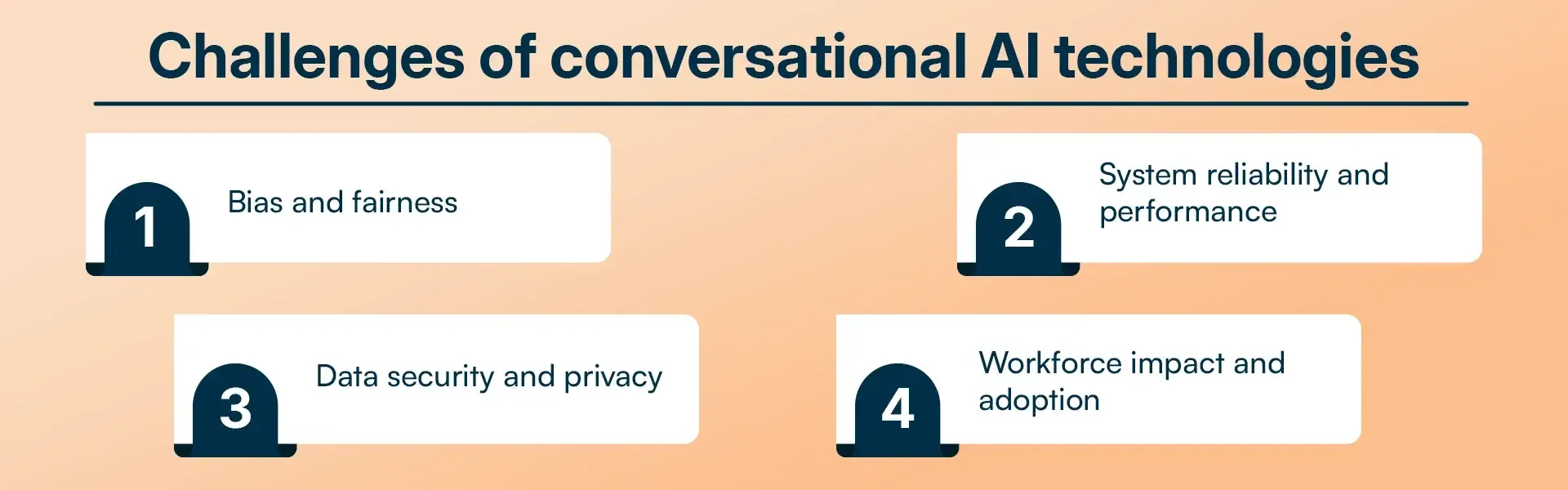
1. Bias and Fairness
-
Training Data Bias Historically biased data are the primary source of learning for AI systems that may unintentionally perpetuate the patterns of unfair treatment and even discrimination.
-
Language Limitations Performance of systems is heavily dependent on the language and dialect used, which may result in the unfairness of the speakers of less represented variations.
-
Cultural Misunderstandings. It may happen that conversational AI misconstrues cultural contexts, idioms, or communication styles; thus, appropriate or even offensive replies are sometimes given.
2. System Reliability and Performance
-
Misunderstanding Context. Occasionally, Artificial Intelligence mistakenly interprets ambiguous queries or does not recognize the context of the conversation, thus providing irrelevant answers that irritate users very much.
-
Technical Failures Service interruptions, prolonged response times, and problems with integration can hinder the system, and consequently, the amount of trust and satisfaction felt by the customers will be reduced.
-
Limited Problem-Solving Complex or rare cases are frequently beyond AI’s capacities, thus human intervention is needed, and at the same time, it poses the problem of smoothly escalating.
Data Security and Privacy
-
Sensitive Information Handling. Conversational AI is an application that gathers individuals' personal information through their conversations, thus becoming a probable cause of privacy issues if protective steps are not effective.
-
Compliance Requirements AI systems have to deal with a variety of complicated and strict regulations, such as GDPR and HIPAA, which necessitate the presence of strong data protection methods and auditing records.
-
Unauthorized Access Risks Weakly protected AI systems turn into the targets of hackers, who will then gain access to private customer data and corporate information.
Workforce Impact and Adoption
1. Job Displacement Concerns The widespread deployment of conversational AI is seen as a threat to workers, hence creating resistance that would need to be managed through change management strategies.
2. Skills Gap The companies are in a situation where the human resources that are required for AI management, data science, and conversation design are still not available in the market.
3. User Acceptance There is a portion of consumers that will always want to talk to a real person and will be suspicious of AI, thus forcing the companies to come up with a strategy of trying to automate, and at the same time keeping the personal touch.
Conclusion
The transformation of business operations and customer engagement through conversational AI revolution is taking place at the moment. Technology is a delivering source of accessibility and efficiency that has never been seen before, whether it is through simple chatbots or through complicated healthcare assistants.
The challenges do exist, but the benefits are so much more that the obstacles are practically nothing. Companies have thus made a decision to adopt AI conversationally because they have already seen the advantages that come with AI in terms of cost reduction, round-the-clock availability, and customer delight.
The major concern is not about whether to adopt it or not, but rather how soon. Start small, widen the plan wisely, and be there when the customers come for instant and smart interactions. Make sure the competitors do not cut you off. The future is here today; it is intelligent and conversational. Get going!
Frequently Asked Questions
1. What's the difference between chatbots and conversational AI?
Chatbots follow predefined scripts and rules, while conversational AI uses machine learning and NLP to understand context and learn from interactions. Conversational AI provides dynamic, intelligent responses that continuously improve over time.
2. Is conversational AI expensive to implement?
Costs vary based on complexity—simple chatbots are affordable while enterprise systems require substantial investment. Cloud-based solutions and AI-as-a-Service platforms have made conversational AI accessible even for small businesses.
3. Can conversational AI completely replace human customer service agents?
Not entirely. Conversational AI excels at routine queries, but complex situations and emotional issues require human empathy and judgment. The ideal approach combines AI efficiency with human expertise.
4. How secure is conversational AI with sensitive information?
Security depends on implementation. Reputable platforms use encryption, secure storage, and comply with regulations like GDPR. Organizations must choose trusted providers and implement proper security protocols.
5. How long does it take to implement conversational AI?
Simple chatbots launch within weeks, while complex systems require several months. Implementation time depends on business requirements, integration complexity, and desired sophistication level.
6. Which industries benefit most from conversational AI?
Retail, healthcare, banking, telecommunications, and hospitality see significant benefits. However, any industry handling customer inquiries, appointments, or routine transactions can leverage conversational AI effectively.
7. Do I need technical expertise to use conversational AI?
Not necessarily. Many platforms offer no-code or low-code solutions with intuitive interfaces. Advanced customization may require technical expertise or partnership with AI specialists.